
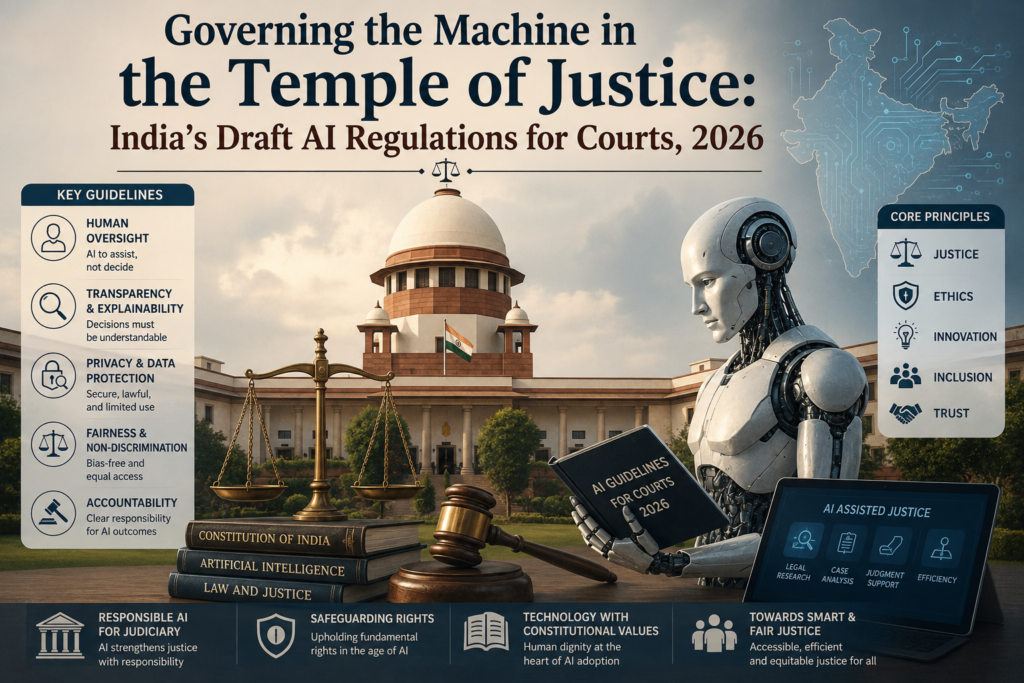
“The Supreme Court has released the most comprehensive framework ever proposed for artificial intelligence in India’s judicial system. It is ambitious, carefully calibrated, and constitutionally grounded — and it deserves to be read by every citizen who cares about the future of justice.”
On June 3, 2026, the Supreme Court of India’s AI Committee released a document that marks a genuinely historic moment in the country’s legal and technological history. The Draft Regulations for Use of Artificial Intelligence in Courts, 2026 — ten chapters, fifty-seven regulations, and a glossary of definitions that reads as a small treatise on the jurisprudence of emerging technology — represent the judiciary’s most ambitious and systematic attempt to bring artificial intelligence within the rule of law rather than allowing it to develop outside it. This is not a policy paper, a committee report, or a set of advisory guidelines. It is a draft regulatory framework, grounded in constitutional principles, carrying the institutional authority of the Supreme Court, and applicable to every court, tribunal, and statutory commission across India. It deserves to be read carefully and publicly debated before its consultation closes on June 20, 2026.
The context in which these regulations arrive is important. India’s judiciary is simultaneously one of the most burdened in the world and one of the most consequential — a system in which tens of millions of pending cases, delays measured in decades, and the sheer complexity of administering justice across a linguistically, geographically, and economically diverse subcontinent create both an urgent need for technological assistance and an equally urgent need for guardrails around how that assistance is deployed. The regulations acknowledge both imperatives directly. Their governing philosophy — expressed in what they call a presumption in favour of responsible AI adoption and an explicit preference for innovation over restraint — reflects a judiciary that has chosen to engage with technology seriously rather than either uncritically embrace it or defensively resist it.
Seventeen Principles That Frame Everything Else
Chapter II of the draft sets out seventeen general principles to govern the adoption, deployment, and use of AI in courts. These principles are not aspirational rhetoric. They are operative legal standards against which every AI system approved for use in any court in India will be evaluated, and against which any AI-related decision can be challenged. The framework begins with the primacy of human judgment and judicial independence — the insistence that AI shall always remain strictly subservient to human authority, that every AI system shall function solely in an assistive capacity, and that the ultimate authority to determine matters of law, fact, and justice shall vest exclusively in the judicial officers of the competent jurisdiction. From this foundation, the principles extend outward through fairness and non-discrimination, transparency and explainability, accountability, auditability and continuous oversight, data protection and privacy, purpose limitation, proportionality, inclusivity and accessibility, data integrity, and cyber security.
The most striking of these principles, from a jurisprudential standpoint, is the regulation on accountability. The draft states unequivocally that no officer may invoke the outputs of an AI system, the opacity of a black box, or the phenomenon of hallucination as a defence for a palpably incorrect, illegal, or harmful decision. This is a statement of considerable constitutional importance. It means that as AI enters the courtroom, it enters as a tool, not as an agent. The responsibility for every decision made with AI assistance remains entirely and inescapably human. The machine offers a recommendation. The judge decides. This is not merely a procedural formality — it is a constitutional commitment that the draft frames with unmistakable clarity.
Equally significant is the principle of inclusivity and accessibility, which requires that AI systems deployed in courts be designed and operated to promote equitable access to justice, with specific attention to ensuring that deployment does not create or widen digital divides. The regulations explicitly name rural communities, economically disadvantaged groups, and linguistically diverse populations as constituencies whose access to AI-assisted judicial services must be actively protected — a recognition that the technology’s greatest risk, in a country of India’s diversity, may be not what it does wrong but whom it systematically fails to reach.
“The ultimate authority to determine matters of law, fact and justice shall vest exclusively in the judicial officers of the competent jurisdiction. No AI System shall supplant or compromise the independent exercise of judicial authority.” — Draft AI Regulations for Courts, 2026, Regulation 4
Administrative Intelligence, Not Judicial Replacement
Chapter III’s catalogue of permissible uses is carefully drawn and deliberately bounded. AI may be used for case management and cause list preparation, automated transcription of court proceedings subject to mandatory human certification of accuracy, translation of judgments and pleadings subject to human verification of fidelity, legal research and precedent retrieval, citation verification and document summarisation, conversational chatbots to assist litigants in navigating procedural requirements, accessibility services for persons with disabilities or language barriers, document authenticity verification subject to mandatory human review, anonymisation of records for public publication, and analytical tools for monitoring judicial performance and backlog reduction. The common thread running through every permissible use is that AI may assist but not decide — it may process, organise, retrieve, and communicate, but the human officer retains full discretion to accept, modify, or reject any AI-generated output at any stage.
The definition of hallucination built into the regulations deserves particular attention. The draft defines it as the phenomenon in which an AI system generates outputs that appear plausible or coherent but are factually incorrect, fabricated, misleading, or unsupported by verifiable material — including the fabrication or misstatement of legal facts, case precedents, statutory provisions, or legal principles. In a domain where citations to non-existent judgments and invented statutory provisions have already caused embarrassment in courts around the world, this definitional clarity is not academic. The regulations place the burden of verification on the human officer responsible for using the AI tool, and make explicit that an AI hallucination is no excuse for a wrong or harmful outcome.
Nine Lines That Cannot Be Crossed
The most consequential section of the entire document is Regulation 20, which sets out nine absolute prohibitions on the use of AI in courts. These prohibitions are described as non-derogable — no authority, including the Chief Justice acting under the relaxation powers conferred by Regulation 56, may override them. They represent the constitutional floor below which AI governance in India’s courts will not descend, regardless of technological development, institutional pressure, or administrative convenience.
No judicial outcome — no judgment, order, or finding of fact or law — may be reached through algorithmic decision-making alone. No AI system may perform the function of adjudication or sentencing without mandatory human review, and any AI output in relation to adjudicative or sentencing questions is advisory only, subject to independent judicial evaluation. No undisclosed, opaque, or unexplainable AI system may be used in any process that may materially affect the lawful rights or personal liberty of any party. No AI system may be used to predict, profile, or infer the future conduct or behaviour of parties, accused persons, witnesses, or legal representatives. No AI system may be used for the surveillance or continuous monitoring of judicial officers, advocates, litigants, or any other person within court premises. No AI-generated output may be submitted as independent evidence without full and transparent disclosure of its AI-generated character. And no AI system may compromise the confidentiality of judicial deliberations or the independence of judicial decision-making.
The prohibition on Risk Scoring deserves particular emphasis and particularly careful public attention. The regulations define Risk Scoring as the use of an AI system to assign a numerical or categorical score to an individual estimating the probability of that person engaging in a specified future behaviour — including the commission of an offence, recidivism, or failure to appear before a court. Several jurisdictions, most prominently the United States, have deployed such tools in bail and sentencing decisions, with documented and deeply troubling consequences: these systems have been shown to embed and amplify racial and socioeconomic biases in ways that are invisible to both the judge relying on them and the person being scored. India’s draft regulations draw a bright constitutional line against this approach. No AI-generated risk score shall inform any bail, remand, or sentencing decision. This is not excessive caution. It is the application of the right to equality under Article 14 and the right to life and personal liberty under Article 21 to a technology that would otherwise threaten both.
A Three-Tier Governance Structure Built to Last
The regulatory architecture the draft establishes is impressively detailed and deliberately hierarchical. At its apex sits a permanent, full-time Apex Body at the Supreme Court of India, chaired by a Supreme Court judge nominated by the Chief Justice, with members drawn from High Courts, institutions of national importance, the Ministry of Electronics and Information Technology, and experts in finance, cybersecurity, technology law, and data privacy. This body is responsible for setting minimum mandatory standards for AI use across all courts in India, approving AI systems for deployment, coordinating with High Court AI Committees on a harmonised national approach, and publishing an Annual Governance Report on the state of AI in Indian courts.
Below the Apex Body, every High Court constitutes its own AI Committee — a bench of judges chaired by a judge of at least five years’ standing — which approves AI systems for use within its jurisdiction following mandatory Technical and Ethical Impact Assessments, monitors compliance with the regulations, and issues supplementary directions tailored to local requirements. Each AI Committee is in turn supported by a dedicated AI Secretariat headed by an officer of District Judge rank, staffed by experts in judicial administration, technology, data science, and law, responsible for day-to-day operations including maintaining the AI Register, managing the AI Incident Database, conducting audits, and processing approvals.
Threading through this structure is the Centre of Research and Excellence on Artificial Intelligence — CoRE-AI — an integrated body combining judges, lawyers, computer scientists, academicians, senior fellows from think-tanks, and post-doctoral researchers, charged with conducting original research on AI in judicial contexts, evaluating AI tools and prototypes, monitoring national and international jurisprudential developments in AI and emerging technologies, and publishing white papers and empirical studies. The inclusion of CoRE-AI signals that the Supreme Court understands its regulatory role to be not merely supervisory but intellectually engaged — that governing AI in courts requires ongoing knowledge-production and comparative analysis, not just the application of fixed rules to a technology that will not remain static.
Every System Watched, Every Incident Recorded
Chapter V on oversight, audits, and incident management reflects a clear-eyed understanding that regulatory frameworks for AI are only as good as their enforcement mechanisms. Every AI system deployed in any court must undergo periodic technical, legal, and ethical audits at intervals not exceeding one year. These audits are to be conducted in-house — the draft explicitly prohibits sharing source code, algorithms, datasets, or architectural information with any third party for an external audit — a provision that reflects both legitimate cybersecurity concerns and a determination to keep sensitive judicial data securely within the judiciary’s own institutional perimeter.
The AI Incident Database is among the framework’s most valuable institutional innovations. Every AI system failure, erroneous output, malfunction, or data breach must be recorded centrally, and where an incident occurs in one High Court, its findings and lessons must be communicated without delay to all other High Court AI Secretariats and to the Apex Body. This cross-jurisdictional learning mechanism ensures that a problem discovered in one jurisdiction does not recur unaddressed in another. In a judicial system of India’s scale and geographical spread, institutional memory of this kind is a governance necessity. Every nominated officer responsible for supervising any AI system retains full discretion at all times to accept, modify, or reject any AI-generated recommendation, and bears full professional responsibility for the outcome of that exercise of discretion.
Vendors Welcome, But on the Judiciary’s Terms
The regulations are notably unsentimental about the private sector’s role. Chapter VI permits the engagement of private entities and vendors but subjects every such engagement to prior written approval, comprehensive technical and ethical evaluation, and a battery of mandatory contractual provisions that leave vendors in no doubt about where authority in the relationship resides. Courts retain ownership of, or a perpetual royalty-free licence to, any AI tool developed using judicial data or court resources. No private entity may claim exclusive intellectual property rights over tools built primarily on judicial data. Sensitive judicial data may not be transferred to any external system without express written authorisation. Vendors must indemnify courts against harm caused by defects in their AI systems. The AI Secretariat retains the right to audit vendor-supplied systems throughout the engagement. And the explicit prohibition on retraining, fine-tuning, or modifying AI models using court data without the express written approval of the AI Committee closes the most obvious avenue through which a commercial vendor might seek to leverage the extraordinary value of India’s judicial data for purposes beyond the engagement.
The data protection provisions in Chapter VII are equally rigorous. Data minimisation, purpose limitation, and privacy-by-design are mandatory at every stage of AI procurement, deployment, and audit. Sensitive judicial data — broadly defined to include all personal identifiable information of parties, witnesses, and legal representatives — receives the highest standard of protection, consistent with the Digital Personal Data Protection Act, 2023, and the constitutional right to privacy affirmed in the Puttaswamy judgment. Annual cybersecurity audits, access control protocols governed by the principle of least privilege, and the maintenance of a comprehensive record of all security incidents in the AI Incident Database complete a data governance framework that is, by any standard, more rigorous than what most government departments currently apply to far less sensitive information.
A Framework the World Will Watch
India is not the first country to grapple with AI in its courts, but it may be the first to attempt to regulate the entire ecosystem — permissible uses, absolute prohibitions, institutional architecture, audit mechanisms, vendor contracts, data protection, grievance redressal, and capacity building — in a single comprehensive framework applicable to every level of the judicial system from the Supreme Court to the lowest tribunal. The European Union’s AI Act addresses high-risk AI applications broadly. Several individual courts and jurisdictions around the world have issued guidelines, but none carries the institutional authority or the constitutional grounding that the Supreme Court of India brings to this draft.
The framework’s explicit grounding in the Bangalore Principles of Judicial Conduct, its absolute prohibition on algorithmic risk scoring informed by the documented failures of such systems elsewhere, its insistence on Human-in-the-Loop requirements for any AI application touching personal liberty, its protection of judicial independence from algorithmic encroachment, and its preference for innovation over restraint — these are not merely technical choices. They are philosophical positions about what kind of judicial system India intends to be in the age of artificial intelligence. The public consultation that closes on June 20, 2026 is an opportunity for lawyers, technologists, civil society organisations, litigants, and citizens to shape those choices before they are formalised into regulations that will govern India’s courts for decades. It is an opportunity that deserves to be taken with the seriousness the moment demands.