
The Supreme Court’s new AI chatbot is a bold step toward digital justice. But between the promise of efficiency and the peril of exclusion lies every difficult question about what justice is actually for.
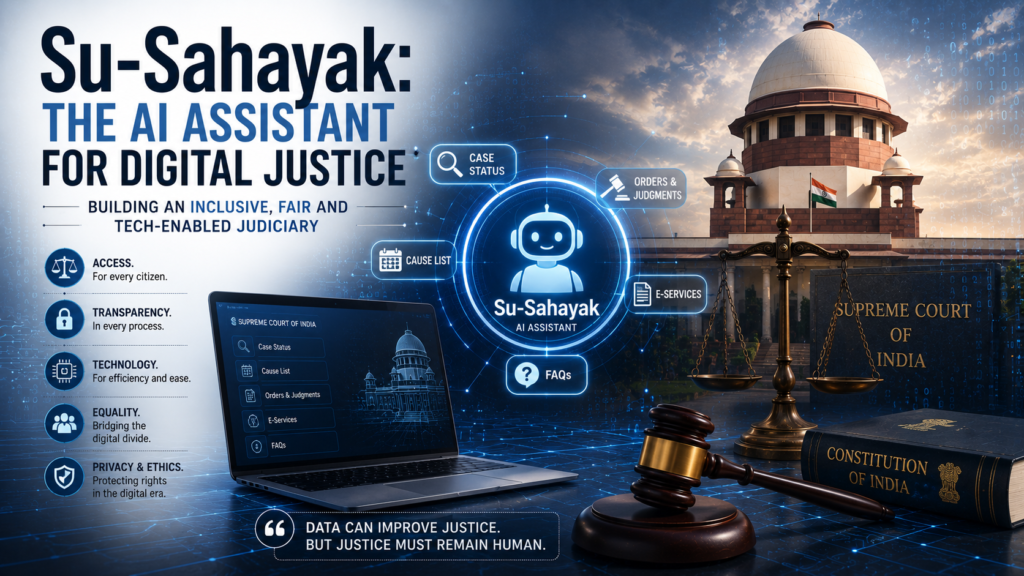
There is a particular kind of frustration that has defined the experience of millions of ordinary Indians with their courts for generations — not the frustration of an unjust verdict, but the more quotidian despair of simply not knowing what is happening with one’s case, of arriving at a court complex to find one’s matter adjourned without notice, of being unable to parse the procedural labyrinth that separates a litigant from the judge who will decide their fate. It is a frustration born not of malice but of scale, of a judicial system that serves more than a billion people with infrastructure that has never quite kept pace with the demands placed upon it. Into this gap, the Supreme Court of India has now introduced Su-Sahayak — an AI-powered chatbot designed to help users navigate case status, cause lists, judgments, orders and e-services through its website. The ambition is real. The questions it raises are equally so.
Su-Sahayak is not a judge. It will not tell a litigant whether they will win their case, interpret the law for them, or advise them on legal strategy. What it will do, in theory, is answer the procedural and informational questions that have historically required either a savvy advocate, an expensive tout outside the court gates, or a frustrating afternoon spent navigating a government website designed by and for people already familiar with it. In this narrower sense, the chatbot represents a genuinely useful intervention — a digital assistant that can, if it works as intended, lower the threshold of knowledge required to engage with the formal justice system. The question is whether that ambition can survive its collision with the structural inequalities of the society it is meant to serve.
| ⚖️ Case Status | 📋 Cause Lists | 📄 Judgements & Orders | 🔗 E-Services | ❓ FAQs & Guidance |
A Judiciary Under Pressure — and the Case for Technology
To understand what Su-Sahayak is attempting, one must first appreciate the scale of the problem it is responding to. Indian courts carry one of the heaviest case loads of any judicial system in the world. Tens of millions of cases remain pending across district courts, High Courts and the Supreme Court, with average disposal times that stretch across years and, for complex matters, decades. The human cost of this pendency is incalculable — in bail applications that languish while under-trial prisoners remain in custody, in property disputes that outlast the lifetimes of the disputants, in commercial matters that strangle businesses long before they are resolved. Against this backdrop, the argument for technology is not merely attractive. It is pressing.
Su-Sahayak forms part of a broader judicial modernisation effort that includes the “One Case, One Data” or OCOD initiative, which aims to standardise court records and create a unified digital backbone for judicial administration. The logic of this integrated vision is sound. A judiciary that knows, in real time, where every case stands, which stages are causing systemic delay, and which courts are functioning below capacity is better placed to address its own inefficiencies than one that operates on paper files and institutional memory. AI, applied carefully to administrative functions, can deliver genuine improvements in court management — surfacing bottlenecks, automating routine notifications, and freeing judges and their staff for the work that actually requires human judgment.
“A machine may organise information efficiently. But it cannot fully comprehend dignity, trauma, inequality or constitutional morality. The danger lies in allowing efficiency to overshadow humanity within the legal system.”
Two Sides of the Digital Justice Equation
| The Promise Immediate case status accessible without visiting court. Reduced dependence on expensive intermediaries. Standardised, consistent procedural information in plain language. Administrative burden shifted away from court staff. Data-driven identification of systemic delays. Transparent access to judgments and orders for all citizens. | The Peril Text-based interfaces exclude those with low digital literacy. Rural, elderly and economically weaker litigants face access barriers. Algorithmic bias may reproduce historical inequalities in bail and remand patterns. Centralised data creates privacy and surveillance risks. Language barriers remain unaddressed. New digital middlemen may emerge, increasing costs. |
The digital divide is perhaps the most immediate concern. India’s urban-rural and class-based inequalities in internet access, digital literacy and technological familiarity are well documented. The communities most likely to benefit from a system that reduces dependence on court touts and procedural gatekeepers are also, paradoxically, the communities least equipped to use a text-based chatbot on a website. A first-generation litigant from a rural district, arriving at a district court for the first time, navigating a system conducted in a language that may not be their mother tongue, is unlikely to find meaningful relief in a Supreme Court website chatbot. For this person, the digital transformation of justice risks replacing one set of intermediaries — human, local, and expensive — with another set that is technological, remote, and equally inaccessible. Access to justice cannot become conditional on the possession of a smartphone, a reliable internet connection, and the digital confidence to use them.
Algorithms Trained on an Unequal Past
Behind the Su-Sahayak chatbot lies a more fundamental challenge that will confront every AI application in the Indian judicial system as its ambitions expand beyond information retrieval toward anything resembling decision support. Artificial intelligence systems are trained on historical data. In a society where structural inequalities based on caste, class, gender and religion have consistently shaped who gets arrested, who gets bail, who gets convicted, and who gets acquitted, any AI system trained on the outputs of that system will — unless designed with extraordinary care and constant auditing — tend to reproduce those patterns rather than correct them. This is not a hypothetical concern. It is the documented experience of AI-assisted criminal justice systems in jurisdictions around the world, most prominently in the United States, where algorithmic risk assessment tools have been shown to replicate and in some cases amplify racial disparities in incarceration.
In India’s context, the implications are particularly serious. The communities most at risk of algorithmic prejudice — those who have historically faced disproportionate arrests, harsher remand decisions, and longer pre-trial detention — are precisely the communities whose access to digital tools is most limited and whose ability to challenge AI-driven decisions is most constrained. A chatbot that tells a litigant their case status is one thing. An AI system that begins to influence, even informally, decisions about bail, adjournment, or the scheduling of hearings is something qualitatively different — and the line between these functions, once the infrastructure is in place, has a tendency to blur over time. The judiciary must establish, clearly and publicly, where that line is drawn and how it will be enforced.
What Machines Cannot Know About Justice
There is a temptation, in any discussion of judicial technology, to frame the question as one of speed versus delay, efficiency versus bureaucracy, innovation versus inertia. This framing is seductive and misleading in equal measure. The deeper question is not whether courts should use technology — they clearly should, and in many administrative respects they already do. The question is what technology can and cannot do in a domain where the most consequential decisions are irreducibly human. Judicial reasoning, at its most demanding, involves the interpretation of constitutional principles that were designed to be living and evolving rather than static. It involves weighing competing values — liberty against security, individual dignity against collective welfare, procedural regularity against substantive fairness — in ways that require not just information processing but moral judgment. It involves, at its most fundamental, an encounter between a human being seeking justice and a system that is obligated to see that person in their full complexity and vulnerability.
No AI system currently in existence is capable of that encounter. Su-Sahayak, as an administrative tool, does not claim to be. But the history of technology in large bureaucratic systems suggests that the function creep from administrative assistance to decisional influence is rarely announced in advance and is often invisible when it occurs. The judiciary must therefore approach its own digital transformation not merely as a technical project but as a constitutional one — asking, at every stage, whether the integration of AI is strengthening or eroding the values of equality, accessibility, procedural fairness and human oversight that the rule of law requires.
Privacy, Data, and the Right to Be Seen Only by Those Who Must
There is one further dimension of judicial digitisation that receives insufficient attention in debates about efficiency and access: the privacy of those whose lives pass through the courts. Court records are among the most sensitive documents in any person’s life. They contain details of criminal allegations, medical conditions, family breakdowns, financial ruin, and personal histories that individuals have the deepest possible interest in keeping from general circulation. The centralisation of these records in digital databases — a necessary precondition for the kind of AI-assisted judicial management the OCOD initiative envisions — creates concentrations of sensitive personal data that, without robust protection, become targets for breach, profiling, and misuse.
The Supreme Court’s recognition of the right to privacy as a fundamental right under Article 21, in the Puttaswamy judgment of 2017, establishes that this concern is not merely administrative but constitutional. The judiciary, which has been the guardian of that right in litigation, must now apply it rigorously to its own digital infrastructure. Data minimisation, purpose limitation, access controls, independent audit, and the right of litigants to know what data about them is held and how it is used — these are not luxuries to be added later. They are constitutional requirements that must be built into Su-Sahayak and every system that follows it from the beginning. The challenge before India’s judiciary is therefore not a technological one. It is, as it has always been, a constitutional one — the challenge of ensuring that every innovation in the delivery of justice remains answerable to the values that make justice worth delivering.