
From Convenience to Dependence
In contemporary India, bottled water has quietly transformed from an occasional travel necessity into an everyday staple. Railway stations, corporate offices, restaurants and even small retail shops display stacks of plastic water bottles, signalling a growing public distrust of municipal supply systems. For many urban citizens, water sealed in plastic has become synonymous with safety.
This perception, however, is increasingly being questioned. Scientific research conducted in various parts of India now suggests that while bottled water may be largely free from microbial contamination, it is not necessarily free from other, less visible risks. The debate is shifting from bacteria and pathogens to microplastics, chemical leaching and long-term exposure risks.
The assumption that packaged water guarantees purity deserves closer scrutiny.
Microplastics: The Emerging Contaminant
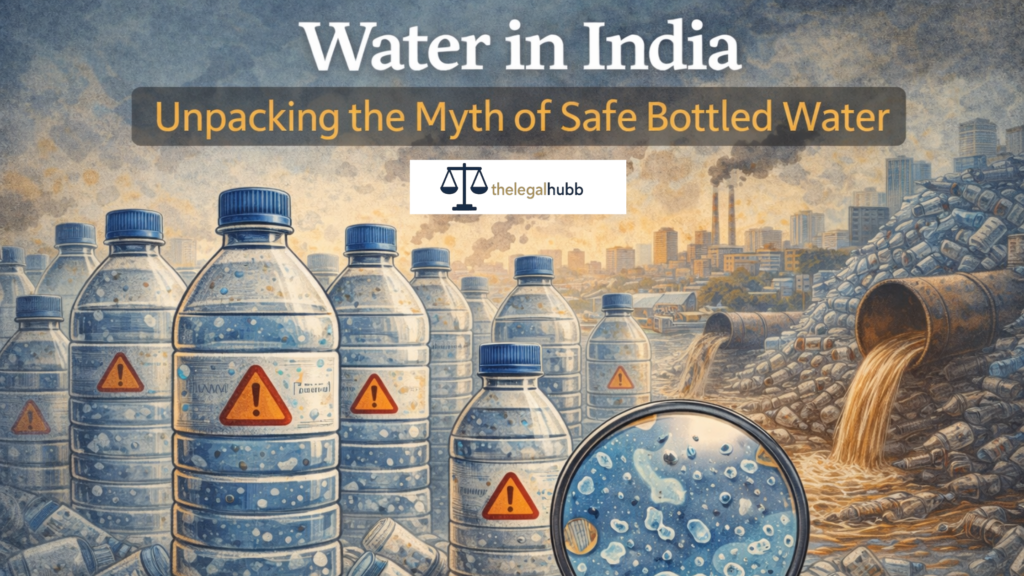
Microplastics — plastic particles smaller than five millimetres — have emerged as a significant concern in bottled drinking water. Studies conducted in Indian cities have detected microplastics in all sampled brands of bottled water, with concentrations varying widely. In some instances, locally bottled water showed higher contamination levels than nationally distributed brands, indicating possible lapses in production standards and quality control.
The presence of microplastics suggests contamination may occur at multiple points — during bottling, packaging, storage or transportation. Unlike visible impurities, these particles are microscopic and undetectable to consumers. Yet their ingestion has become almost unavoidable.
The concern deepens with nanoplastics, even smaller particles that remain beyond current detection limits and regulatory frameworks. These particles may cross biological barriers in the human body, raising questions about long-term health consequences that remain insufficiently studied.
Chemical Leaching and Heat Exposure
Beyond microplastics, bottled water is vulnerable to chemical leaching from plastic containers. Additives such as phthalates, antimony and other plasticisers can migrate into the water, especially when bottles are exposed to high temperatures.
India’s climatic conditions exacerbate this risk. Bottles often remain stored in warehouses, transport vehicles or roadside shops under direct sunlight. Prolonged exposure to heat and ultraviolet radiation accelerates the leaching process. By the time a bottle reaches the consumer, it may contain trace amounts of chemicals that were never part of the original water source.
While regulatory standards exist, enforcement mechanisms struggle to monitor these dynamic variables across vast supply chains.
The Regulatory Gap
India’s bottled water industry is regulated primarily for microbiological safety and visible contaminants. However, the emerging risks associated with microplastics and nanoplastics reveal a significant regulatory blind spot. Safety standards remain focused on traditional contaminants, while long-term exposure to plastic-derived particles remains insufficiently addressed.
This gap highlights a broader challenge: regulatory systems often lag behind scientific discovery. As evidence of microplastic contamination grows, policies must evolve to incorporate new risk assessments and testing protocols.
Without updated standards, consumer confidence may be built on incomplete assurances.
The Environmental Cost
The proliferation of bottled water also carries substantial environmental implications. Plastic waste from single-use bottles contributes to landfill accumulation and marine pollution. In many parts of India, recycling systems remain inadequate, leading to improper disposal.
Ironically, a product marketed as clean and safe may contribute to environmental degradation that ultimately contaminates natural water sources. The cycle becomes self-perpetuating: declining trust in public supply increases bottled water consumption, which in turn exacerbates ecological stress.
Addressing bottled water safety must therefore include environmental sustainability.
Rebuilding Trust in Public Supply
The rise of bottled water consumption reflects a deeper issue — declining confidence in municipal water systems. Instead of relying exclusively on packaged solutions, long-term reform must prioritise strengthening public water infrastructure.
Improving treatment facilities, monitoring pipelines, reducing leakages and ensuring equitable distribution can restore trust. When citizens believe in the reliability of tap water, dependence on plastic bottles naturally declines.
The solution lies not only in regulating bottled water, but in revitalising public systems.
Conclusion: Rethinking Water Safety
Water in India is not merely a question of access; it is a question of quality, regulation and perception. Bottled water, long considered a safer alternative, now stands under scientific scrutiny. Microplastics, chemical leaching and regulatory gaps challenge the myth of guaranteed purity.
The path forward requires a dual approach: stricter oversight of the bottled water industry and renewed investment in public water infrastructure. Consumers deserve transparency about what they drink, and policymakers must respond to emerging scientific evidence with urgency.
Safe water cannot be reduced to packaging. It must be ensured through systems that are sustainable, scientifically informed and publicly accountable.