Q.1
(a) Define Artificial Intelligence (AI) and distinguish it from traditional computational systems by highlighting differences in architecture, operation, and functionality.
(b) Explain the concept of Artificial Intelligence as a possible legal entity and discuss the implications of granting legal recognition to AI systems.
(c) Discuss the ethical principles governing Artificial Intelligence with special reference to transparency, accountability, fairness, and non-discrimination.
(d) Identify any two legislative or regulatory frameworks in India that regulate Artificial Intelligence and briefly explain their significance.
(e) Analyze the impact of Artificial Intelligence on the legal profession with suitable examples from contemporary legal practice.
(f) Examine the challenges relating to data privacy and protection in Artificial Intelligence systems engaged in large-scale data processing.
(g) Explain the concept of AI governance and evaluate its role in ensuring ethical and responsible deployment of Artificial Intelligence technologies.
(h) Define Artificial Intelligence and critically explain its expanding scope across social, economic, and technological sectors.
(i) Critically analyze the jurisprudential debate concerning the recognition of Artificial Intelligence systems as legal persons.
(j) Examine the ethical dilemmas arising from the design, deployment, and governance of Artificial Intelligence technologies with special emphasis on fairness and accountability.
(k) Identify two landmark judicial pronouncements that have influenced the evolution of Artificial Intelligence regulation and briefly discuss their legal significance.
(l) Evaluate the implications of Artificial Intelligence on informational privacy and data protection within emerging legal frameworks.
(m) Discuss the role of predictive analytics in transforming legal reasoning, adjudication, and judicial decision-making processes.
(n) Critically examine the importance of institutional governance frameworks and regulatory mechanisms in ensuring ethical, transparent, and accountable AI systems.
PART – B
(10 Marks Each)
Q.2
Analyze the existing legal and regulatory framework governing Artificial Intelligence in India by highlighting its major features, strengths, and limitations.
Q.3
Discuss the applicability of the Indian data protection framework to AI-driven systems in relation to the collection, processing, and protection of personal data.
Q.4
Examine the application of Artificial Intelligence in legal documentation and case management with suitable illustrations.
Q.5
Discuss the use of Artificial Intelligence tools in legal research, predictive analysis, and case evaluation with relevant examples.
Q.6
Critically analyze the issue of civil and criminal liability arising from AI-driven autonomous decision-making systems with reference to existing legal principles.
Q.7
Apply relevant legal doctrines to determine liability in a hypothetical situation involving harm caused by an AI-based system.
Q.8
Discuss the emerging trends in Artificial Intelligence regulation and evaluate their implications for businesses, governance, and society.
Q.9
Propose suitable AI governance mechanisms to ensure transparency, accountability, fairness, and ethical automated decision-making.
Q.10
Elucidate the significance and broader implications of regulating Artificial Intelligence within the Indian legal framework with reference to policy and governance challenges.
Q.11
Critically examine the necessity for a harmonized international legal framework governing Artificial Intelligence in light of global technological expansion and regulatory fragmentation.
Q.12
Analyze the transformative impact of Artificial Intelligence on the delivery of legal services with reference to practical and contemporary examples.
Q.13
Critically evaluate the legal implications of AI-generated content in the context of copyright law and patent jurisprudence.
Q.14
Evaluate the effectiveness of global governance models and international regulatory mechanisms in addressing challenges posed by Artificial Intelligence technologies.
Q.15
Analyze the doctrinal and practical challenges associated with fixing liability for AI-based decision-making systems under existing legal frameworks.
Q.16
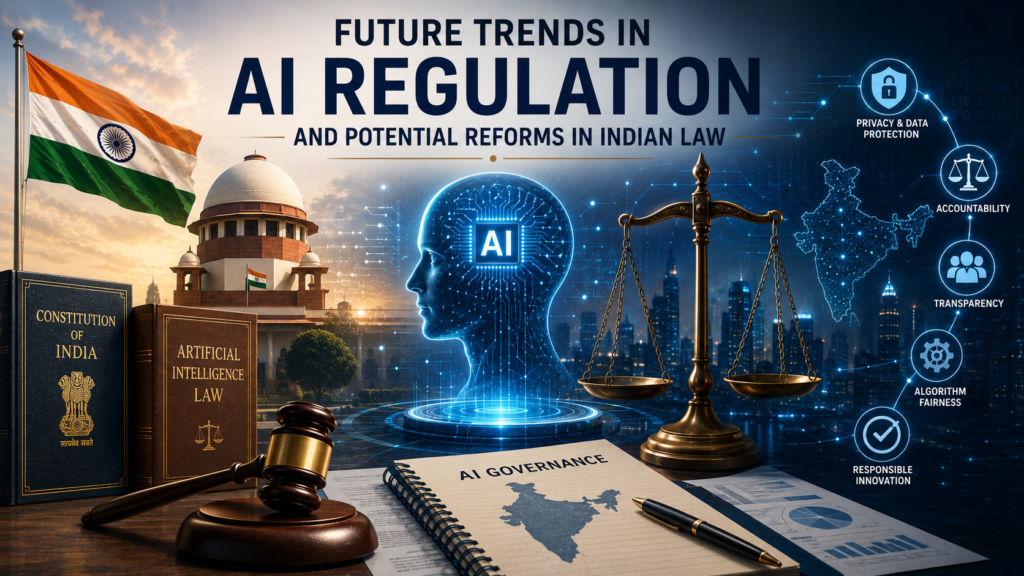
Assess the emerging developments in Artificial Intelligence regulation and suggest necessary legal reforms within the Indian regulatory landscape.
Q.17
Examine the compliance and regulatory challenges faced by Artificial Intelligence systems while operating across different national and international legal regimes.