
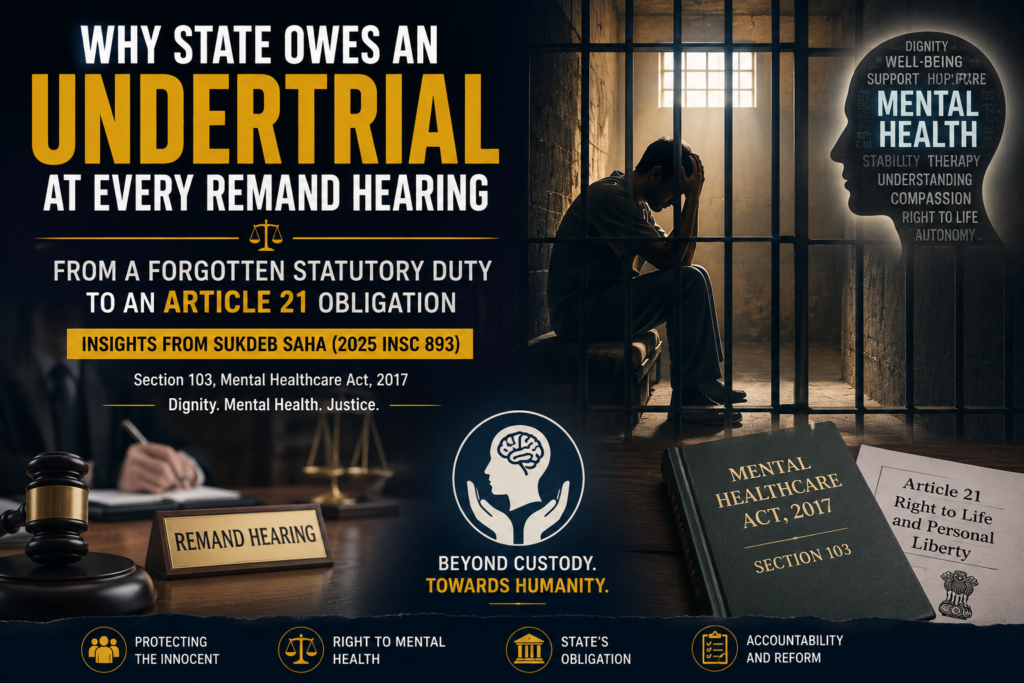
How the Supreme Court’s Decision in Sukdeb Saha Revives Section 103 of the Mental Healthcare Act as an Article 21 Guarantee
Every day, thousands of remand hearings take place across India. A magistrate examines the case diary, hears the prosecution and the defence, and decides whether the accused should remain in judicial custody. The discussion usually revolves around the seriousness of the offence, the possibility of absconding, the need for further investigation, or the likelihood of tampering with evidence. Once the remand order is signed, the accused is sent back to prison.
Yet one critical question almost never arises: What happens to the mental health of an undertrial who is repeatedly sent back to custody?
This silence is no longer merely an administrative omission. It is increasingly becoming a constitutional concern. The Supreme Court’s decision in Sukdeb Saha v. State of Andhra Pradesh (2025 INSC 893), read alongside Section 103 of the Mental Healthcare Act, 2017, fundamentally changes the legal conversation surrounding prison administration and undertrial rights. Together, they strengthen the argument that the State owes every undertrial not only physical custody but also constitutionally adequate mental healthcare.
The Forgotten Dimension of Article 21
Article 21 of the Constitution guarantees that no person shall be deprived of life or personal liberty except according to procedure established by law. Over the decades, the Supreme Court has interpreted this provision expansively, recognising that the right to life means much more than mere survival.
It includes:
- dignity,
- health,
- privacy,
- speedy trial,
- legal aid,
- clean environment,
- and humane treatment in custody.
The Supreme Court’s judgment in Sukdeb Saha represents another important development in this constitutional journey.
Although the case arose from the tragic death of a teenage student, the Court made an observation that transcends the facts of the case. It declared that mental health is an integral component of the right to life under Article 21, emphasising that dignity, autonomy, psychological integrity, and well-being are inseparable constitutional values.
This declaration is not confined to educational institutions. It articulates a general constitutional principle applicable wherever Article 21 operates—including prisons.
Section 103: A Statutory Duty Ignored Since 2018
Long before the Supreme Court recognised mental health as an Article 21 guarantee in Sukdeb Saha, Parliament had already imposed concrete obligations upon governments through the Mental Healthcare Act, 2017.
Section 103 of the Act specifically addresses mental healthcare within prisons.
Among its key mandates are:
- training all prison medical officers to provide basic and emergency mental healthcare; and
- establishing mental health facilities in at least one prison within every State and Union Territory.
These provisions came into force on 29 May 2018.
Yet, implementation across the country has remained deeply inadequate.
Reports continue to reveal an alarming shortage of psychologists, psychiatrists, trained medical personnel, and dedicated mental healthcare facilities within Indian prisons. Consequently, the statutory promise made by Parliament has remained largely unfulfilled.
Why This Matters for Undertrial Prisoners
The constitutional significance becomes even greater because the overwhelming majority of prison inmates in India are undertrial prisoners.
Unlike convicts, undertrials have not been found guilty of any offence.
Their detention is intended only to ensure the proper administration of justice until trial concludes.
The Supreme Court has repeatedly emphasised this distinction.
In Hussainara Khatoon v. State of Bihar, the Court reminded the nation that prolonged incarceration of undertrials strikes at the heart of Article 21.
More recently, Satender Kumar Antil v. CBI reaffirmed that liberty remains the norm and detention the exception.
If an individual who is presumed innocent is repeatedly remanded into a prison lacking even the minimum mental healthcare infrastructure mandated by law, an important constitutional question naturally arises:
Can such detention still be described as “just, fair and reasonable” within the meaning of Article 21?
The State’s Responsibility—Not the Magistrate’s
An important aspect of this debate concerns institutional responsibility.
A magistrate deciding a remand application neither controls prison administration nor appoints psychiatrists or psychologists.
Those responsibilities belong to the State.
Once judicial custody is authorised, the State assumes complete control over the prisoner’s physical environment, healthcare, and welfare.
Accordingly, the constitutional obligation created by Article 21 and the statutory obligations imposed by Section 103 rest primarily upon the executive machinery responsible for prison administration.
The issue therefore is not whether individual magistrates have failed.
The issue is whether the State itself has fulfilled the duties Parliament has already imposed upon it.
Due Process Means More Than Legal Formality
Since Maneka Gandhi v. Union of India, the Supreme Court has consistently held that every procedure affecting personal liberty must be fair, just and reasonable.
This constitutional standard extends beyond the legality of detention itself.
It also governs the conditions under which detention is carried out.
If the State knowingly detains individuals in institutions that lack basic mental healthcare despite a statutory obligation requiring such facilities, questions inevitably arise regarding compliance with the constitutional standard of fairness.
Mental healthcare cannot be treated as an optional welfare measure.
Following Sukdeb Saha, it increasingly forms part of the constitutional content of Article 21.
Prisons and Mental Health: The Human Cost
The consequences of neglecting prison mental healthcare are no longer speculative.
Government reports and prison statistics have repeatedly highlighted concerns regarding:
- custodial suicides,
- self-harm,
- psychological distress,
- prolonged isolation,
- depression,
- anxiety disorders,
- and other mental health challenges faced by inmates.
Undertrials often experience additional pressures arising from:
- uncertainty regarding trial,
- separation from family,
- financial hardship,
- social stigma,
- overcrowded prisons,
- and indefinite incarceration.
Without accessible mental healthcare, these vulnerabilities may worsen substantially.
A Case for Structural Reform
The solution lies not merely in recognising constitutional rights but in implementing structural reforms.
Several measures deserve serious consideration:
Strengthening Prison Infrastructure
Every State should establish functional mental health units within prisons as contemplated by Section 103.
Regular Mental Health Assessment
Undertrials held in prolonged custody should undergo periodic psychological evaluation by trained professionals.
Compliance Monitoring
State Governments should periodically disclose compliance regarding prison mental healthcare before constitutional courts and oversight bodies.
Legal Aid Intervention
Legal aid lawyers appearing at remand hearings should be empowered to raise concerns regarding the availability of statutory mental healthcare facilities wherever necessary.
Capacity Building
Prison medical officers and correctional staff require specialised training to identify mental health concerns at an early stage.
Why This Debate Matters Beyond Prisons
The constitutional importance of this issue extends beyond correctional institutions.
It reflects a broader principle of constitutional governance.
The legitimacy of the criminal justice system is measured not merely by its ability to punish offenders but by the manner in which it treats every individual placed under its control.
When the State assumes custody over a person—particularly someone who remains legally innocent—it simultaneously assumes responsibility for preserving that person’s dignity, physical health, and mental well-being.
Article 21 demands nothing less.
Conclusion
The Mental Healthcare Act, 2017 imposed statutory duties upon governments more than seven years ago. The Supreme Court’s decision in Sukdeb Saha has now reinforced the constitutional significance of those duties by recognising mental health as an integral component of the right to life under Article 21.
The result is a compelling constitutional proposition: every undertrial who is remanded to judicial custody is entitled not merely to lawful detention but to detention consistent with dignity, humanity, and access to mental healthcare.
The challenge before India is therefore no longer one of legislative reform. Parliament has already spoken through Section 103. The Constitution has spoken through Article 21. The Supreme Court has reaffirmed the centrality of mental health to human dignity.
The remaining question is one of implementation. Until every prison provides the mental healthcare that both statute and Constitution require, the promise of Article 21 will remain incomplete for thousands of undertrial prisoners whose liberty has been restricted—but whose dignity remains fully protected by law.



Обновлено сегодня: https://kosmosjizni.top
Інформаційний ресурс для аудиторії https://massmedia.one зібрані для зручного читання онлайн.
Latest updates winter-memories.pro
I AM BACK AGAIN
Hi,how are you
Your blog continually inspires readers with its blend of expertise and clarity, making even complex topics relatable. It would be intriguing to see you delve into how these ideas intersect with innovative developments, such as artificial intelligence or sustainable living. Your skill in uncovering insights is remarkable. Thanks for consistently delivering such enlightening content—I eagerly await your next post!
thaiseasalt.doae.go.th
Its Amazing