Written by Vipra Sharma, LL.B. III Semester Student at KR Mangalam University
INTRODUCTION
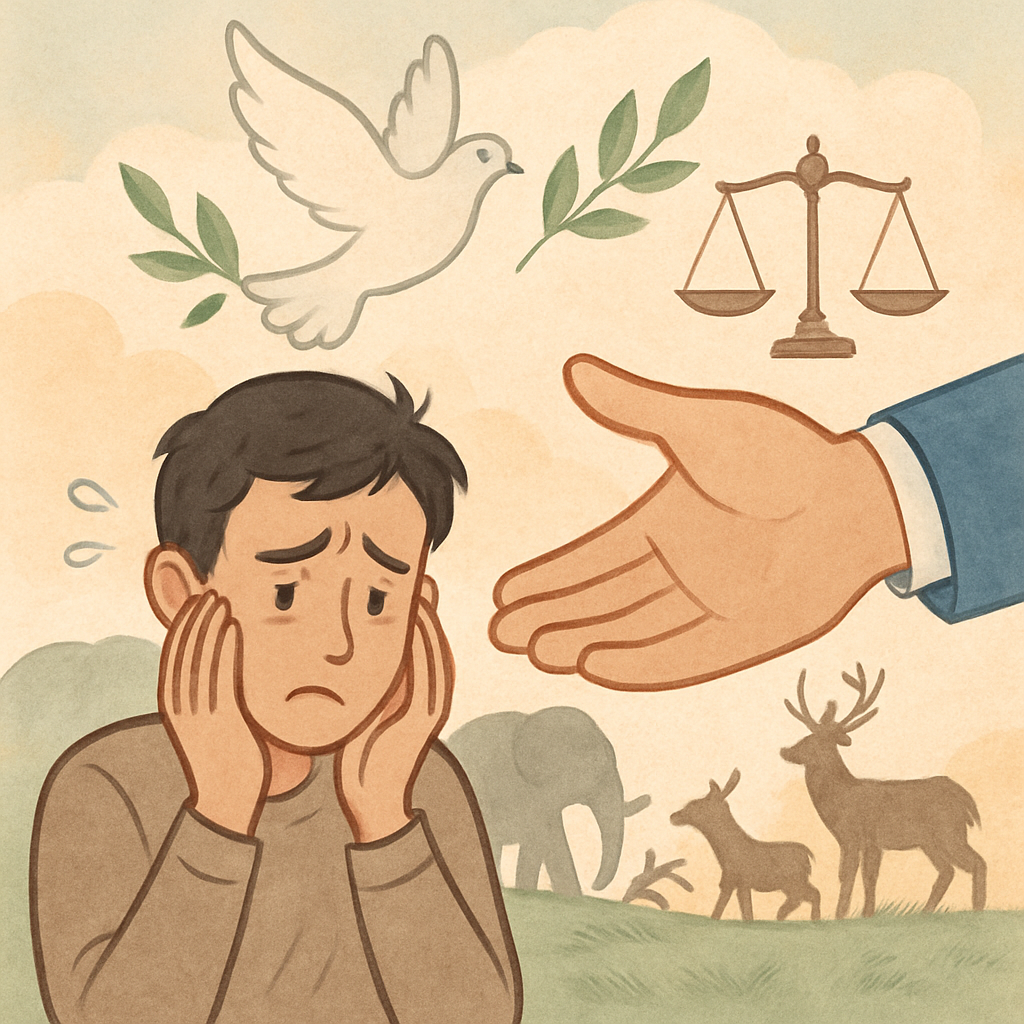
Human-wildlife conflict had increasingly become one of India’s most pressing environmental and legal concerns. From crop damage and livestock loss to tragic human fatalities, the growing overlap between human settlements and wildlife habitats has turned coexistence into a daily challenge. Recognising this urgent issue, the National Legal Services Authority (NALSA), in collaboration with the Kerala State Legal Services Authority (KeLSA), has launched a dedicated legal aid programme to protect individuals and families affected by such conflicts.
This initiative marks a turning point not just for Kerala, but for India’s approach to environmental justice. It brings together constitutional rights, social welfare, and environmental protection under a single umbrella – aiming to close the justice gap for those who are often left unheard.
THE ARISING CONFLICT
Human-wildlife conflict is no longer an occasional problem but a persistent challenge that affects thousands of household every year. Deforestation, Rapid Urban Expansion, Infrastructural Development, and Climate Change have drastically reduced animal habitats, forcing species such as Elephants, Leopards and Tigers into closer contact with humans.
This growing overlap leads to:
- Crop Damage – Often destroying an entire season’s income for small farmers.
- Livestock Loss – Devastating for household’s dependent on animal husbandry.
- Injuries and fatalities – With attacks by elephants, leopards, and wild boars claiming human lives.
- Psychological Trauma – Families live in constant fear of encounters.
- Economic Displacement – Forcing communities to abandon farmland or relocate.
Until recently, victims had to rely on compensation schemes that were slow, inconsistent and inadequate. With limited awareness about their rights and little to no access to legal assistance, many suffers silently.
LEGAL AND JUDICIAL BACKGROUND
Indian courts have long recognised the Right to a Healthy Environment as a part of the Right to Life under Article 21 of the constitution. Several landmark judgements laid the groundwork for this new legal aid programme
1. ANIMAL WELFARE BOARD OF INDIA V. A. NAGARAJA (2014)
In this case, The Supreme court of India outlawed two sports namely “Jalikattu” and “Bullock Cart Race” which was practised in the States of Maharashtra as well as Tamil Nadu. Both of these sports were contrary to the provisions of Prevention of Cruelty to Animals Act, 1960.
Although later on the Act was amended and assented by the President to allow both the sports, with certain regulations, to continue.
2. CENTRE FOR ENVIRONMENTAL LAW, WWF v. UNION OF INDIA (2013)
The Supreme court, in this case, through a continuous Mandamus, issues key directions for better management of National Parks and Sanctuaries: Vaccination Programmes near protected areas, Strict Anti-Poaching measures, Modern Equipment for forest guards, completion of land/right acquisition under the wildlife act, and formation of State Wildlife Advisory Boards and honorary wardens within two months.
THE NEW LEGAL AID PROGRAMME
The new Legal Aid Programme was formally announced at a regional conference titled “Human-Wildlife Conflict and Co-Existence: A Legal and Policy Perspective” which saw the participation of Hon’ble Justice Shri Surya Kant, Supreme Court of India.
In his address, Justice Kant urged at the Right to Life under Article 21 of the Constitution must be interpreted in a larger context – not merely as protection of physical existence, but as encompassing a healthy, sage and sustainable environment. This broader understanding, he argued, provides a solid constitutional foundation for dealing with rising incidence of human-wildlife conflict in a holistic manner.
NEW FEATURED INTRODUCED BY THE PROGRAMME
1. Assistance to Vulnerable Groups
The programme recognises that certain communities – especially farmers who rely solely on their land for livelihood, migrant workers who may not be fully aware of it able to access state schemes, tribal populations dwelling at the edge forests and segments for population of women, children and the elderly – are disproportionately affected by human-wildlife conflict.
These individuals often face multiple barriers: Lack of Information, Low literacy and Financial Constraints. By directing the scheme towards them, the justice becomes more inclusive, which mandates free legal aid to ensure equal opportunity in matter of legal rights.
2. Beyond Simple Compensation
The programme is structured to offer more than financial redress. Alongside compensation, it plans to provide Insurance for Life and Property, which can help in sudden losses.
Disability certification for injured victims so that they may access ongoing state benefits; Psychological Counselling to help deal with trauma which is an often neglected component in many relief schemes; and active coordination with relevant government departments to help victims navigate bureaucratic process more smoothly.
3. Data-Driven and Institutional Strengthening
Both NALSA and KeLSA will map high-conflict zones to better focus their outreach, maintain a digital database of cases enabling tracking of whether victims are receiving timely compensation and support, and ensure that legal aid lawyers are trained in wildlife law and environmental regulations so they can handle these complex disputes efficiently.
4. Reinforces Constitutional Mandate
The programme overall does not introduce a completely new principle, but rather strengthens enforcement of existing constitutional protections. It underlines that environmental safety and welfare of human communities living with wildlife are intertwined under the fundamental rights guaranteed by the Constitution.
KERALA’S LEGAL AND ADMINISTRATIVE EFFORTS
Kerala has already taken steps to build the groundwork for the programmes’ success. In Its 2025 judgement, the Kerala High Court directed KeLSA to conduct surveys in areas prone to Human-Wildlife Conflicts. Residents in those zones as to actively inform them about their rights under existing compensation schemes. This ensures that legal literacy is not just theoretical but reaches people on the ground who need it the most.
Meanwhile, the compensation data over the last six years in Kerala reveals payments totalling approx. 79.14 crore rupees, of which roughly 26.44 crore were paid out in respect of fatalities and 20.18 crore rupees for injuries. However, the average fatality compensation of 5.53 lakh in rupees is widely viewed as insufficient, especially when compared to other Indian states that award significantly more in such cases.
An Amicus Curiae report submitted to the Kerala High Court has suggested a blended compensation model, combining funds from central and state governments with disaster-relief provisions, to raise compensation for fatalities to approx. 24 lakhs in rupees. Such recommendations point to both growing awareness of the gaps, and possible policy directions for remedying them.
WHY THIS MATTER: CONCLUSION
Human-wildlife conflict isn’t only a matter of environmental conservation – it is a deep human rights issue. Without legal structures that ensure Accessibility, Fairness and Accountability, many victims are left without redress and remain trapped in cycles of economic loss, psychological trauma, and social marginalisation.
This legal aid programme has transformative potential, it seeks to bridge the gap between law on paper and reality by ensuring marginalise groups are heard. Its holistic relationship model – including mental health, disability and insurance – reflects a more humane and complete form of justice.
Moreover, it also strengthens India’s environmental jurisprudence by reinforcing that constitutional rights include environmental well-being. If effectively implemented, it could serve as s strong model not just for Kerala, but for all states facing similar issues of coexistence and environmental justice.