
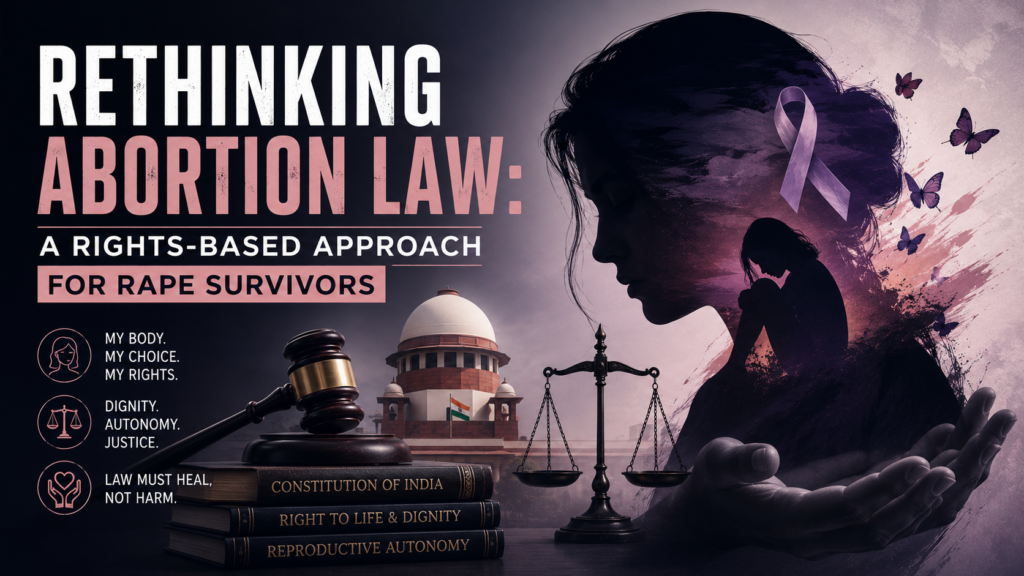
Beyond Statutory Limits: Reclaiming Dignity and Autonomy
The Supreme Court of India’s recent observations urging the Union Government to reconsider the gestational limits under the Medical Termination of Pregnancy (MTP) Act in cases involving rape survivors marks a significant constitutional moment. It reflects a growing judicial recognition that rigid statutory timelines often fail to respond to the lived realities of survivors of sexual violence.
This intervention is not merely about amending abortion law. It is about redefining the relationship between law, dignity, bodily autonomy and constitutional rights. At its core lies a fundamental question: should procedural rigidity prevail over the physical and psychological well-being of a rape survivor?
The Existing Legal Framework and Its Limitations
India’s abortion law is governed primarily by the Medical Termination of Pregnancy Act, 1971, as amended in 2021. While the legislation is often viewed as progressive in comparison to many jurisdictions, it continues to impose rigid gestational limitations that frequently fail to accommodate exceptional circumstances.
Under the present framework:
- Termination up to 20 weeks is permitted based on the opinion of a registered medical practitioner.
- Between 20 and 24 weeks, abortion is allowed for specified categories, including rape survivors, subject to the opinion of two practitioners.
- Beyond 24 weeks, termination is generally restricted to cases involving substantial fetal abnormalities and requires approval from a Medical Board.
Although these provisions appear procedurally balanced, they often become barriers in cases involving sexual violence. Rape survivors frequently face delayed reporting due to trauma, fear, social stigma, family pressure and lack of access to medical facilities. As a result, pregnancies may be detected only after the statutory period has expired.
In such situations, the law ceases to function as a protective mechanism and instead becomes an instrument of continued suffering.
From State Control to Constitutional Autonomy
Indian constitutional jurisprudence has increasingly recognised reproductive choice as an essential aspect of personal liberty under Article 21 of the Constitution.
A landmark shift occurred in Suchita Srivastava v. Chandigarh Administration, where the Supreme Court unequivocally held that a woman’s right to make reproductive choices forms part of her dignity, privacy and bodily integrity.
This judgment transformed the legal understanding of abortion from a state-regulated medical exception to a matter of constitutional autonomy.
The principle established by the Court is clear: reproductive decisions belong fundamentally to the individual. The State cannot impose a singular moral or procedural framework upon deeply personal choices that directly affect bodily integrity and mental well-being.
For a rape survivor, forcing continuation of pregnancy is not merely a physical burden. It represents a continuing violation of dignity and psychological autonomy.
The Supreme Court’s Recent Intervention
The Supreme Court’s recent decision permitting termination of a minor rape survivor’s pregnancy beyond 30 weeks demonstrates the judiciary’s willingness to prioritise constitutional values over mechanical statutory interpretation.
The Court acknowledged that strict gestational limits often fail to account for the lived experiences of survivors, particularly minors. Delayed reporting, social ostracisation and emotional trauma frequently prevent timely access to legal and medical remedies.
Importantly, the Court treated medical opinion as supportive rather than controlling. The emphasis remained on the survivor’s autonomy and welfare.
This approach reflects a broader constitutional principle: where statutory rigidity produces injustice, constitutional guarantees must prevail.
Far from constituting judicial overreach, such interventions preserve the humane purpose of law by preventing legal procedures from becoming instruments of cruelty.
The Constitutional Foundations of Reproductive Rights
The constitutional basis for reproductive autonomy in India lies primarily within Article 21, which guarantees the right to life and personal liberty.
Over time, judicial interpretation has expanded Article 21 to include:
- Dignity
- Privacy
- Bodily autonomy
- Decisional freedom
In matters involving reproductive choice, these protections become particularly significant.
Compelling a rape survivor to continue an unwanted pregnancy directly impacts her physical health, psychological well-being and future life choices. Such compulsion cannot be reconciled with constitutional guarantees of dignity and liberty.
Additionally, Article 14 raises concerns regarding equality and fairness within the statutory framework. The present law creates classifications and procedural barriers that may disproportionately affect survivors whose circumstances are inherently exceptional.
A constitutional democracy cannot allow procedural timelines to outweigh the realities of trauma and vulnerability.
The Need for a Rights-Based Approach
The existing framework continues to operate largely through a medicalised and procedural lens. A rights-based approach requires a shift in focus toward the survivor herself.
Under such an approach:
- The survivor’s autonomy becomes central
- Medical Boards facilitate rather than obstruct access
- Trauma-informed procedures are prioritised
- Delayed reporting is recognised as a social reality rather than treated as procedural failure
The objective of abortion law should not merely be regulation; it should be protection of dignity and freedom.
The law must recognise that survivors are not seeking exceptional privilege. They are seeking control over their own bodies and futures.
Why Legislative Reform Is Necessary
The repeated need for judicial intervention clearly indicates that the present statutory framework is inadequate.
Several reforms deserve immediate consideration:
Relaxation of Gestational Limits in Rape Cases
Rigid upper limits should be reconsidered in cases involving rape, incest and exceptional trauma, subject to medical feasibility.
Time-Bound Functioning of Medical Boards
Medical Boards should operate within strict timelines to prevent procedural delays that effectively deny relief.
Uniform Guidelines for Late-Term Termination
Clear national guidelines can reduce uncertainty and prevent survivors from repeatedly approaching constitutional courts for emergency relief.
Survivor-Centric Procedures
The process must prioritise informed consent, confidentiality, mental health support and dignity throughout.
Law Must Respond to Human Reality
The central problem with rigid abortion laws is that they assume all pregnancies unfold within predictable timelines and ideal circumstances. Reality is far more complex.
Survivors of sexual violence often navigate fear, trauma, social stigma and institutional barriers before seeking help. The law cannot remain indifferent to these realities.
A constitutional legal system must be capable of compassion. Procedures exist to serve justice, not to obstruct it.
Conclusion
The debate on abortion law for rape survivors is ultimately about far more than medical termination. It concerns the meaning of dignity, autonomy and constitutional freedom in a democratic society.
The Supreme Court’s recent intervention signals an important evolution in Indian constitutional jurisprudence — one that recognises that reproductive autonomy cannot be sacrificed at the altar of procedural rigidity.
A rights-based approach does not weaken the law. It strengthens the constitutional promise that every individual has the right to live with dignity, bodily integrity and meaningful freedom of choice.
In the end, the true legitimacy of law lies not merely in enforcing rules, but in responding humanely to suffering while protecting the constitutional values upon which justice itself depends.