
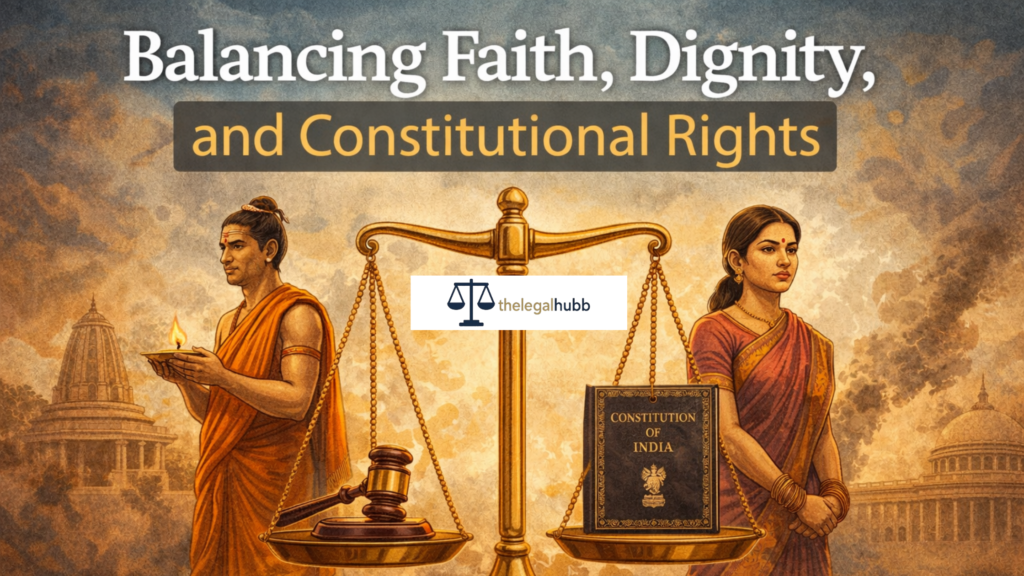
When Belief Meets the Constitution
Few constitutional debates in India have been as emotionally charged and philosophically complex as the question of balancing religious faith with constitutional guarantees of equality and dignity. The controversy surrounding temple entry restrictions, particularly in the Sabarimala case, reopened foundational questions about the relationship between faith and fundamental rights.
At its core, the issue is not about a single shrine or a single community. It is about the architecture of Indian constitutionalism. Can deeply held religious practices stand immune from constitutional scrutiny? Or must they yield when they conflict with principles of equality and individual dignity?
The answers are neither simple nor uniform.
The Constitutional Promise of Equality
The Constitution of India guarantees equality before the law and prohibits discrimination. It also assures freedom of religion, allowing individuals and groups to practise, profess and propagate their faith. These guarantees were designed to coexist, not compete.
However, conflict arises when a religious practice excludes a particular group — in this case, women of a specified age bracket — from access to a public religious institution. The majority view in the Sabarimala judgment held that such exclusion violated the constitutional promise of equality and dignity. It rejected the argument that the devotees constituted a separate religious denomination entitled to manage internal affairs without interference.
The Court reasoned that constitutional morality must prevail over social or religious morality when the two are in tension. Dignity, it argued, cannot be subordinated to tradition.
The Essential Religious Practices Debate
Indian constitutional jurisprudence has long relied on the “essential religious practices” doctrine. Under this test, courts attempt to determine whether a contested practice is essential to a religion. If it is deemed essential, it may receive constitutional protection; if not, it may be regulated.
This approach, however, has drawn criticism. It requires judges to interpret theology, often placing courts in the uncomfortable position of defining what constitutes “true” religion. Critics argue that this risks judicial overreach.
In the Sabarimala case, the majority held that the exclusion of women was not an essential practice. The dissenting opinion, however, warned against courts venturing too deeply into matters of faith. It emphasised that a secular Constitution must harmonise rights rather than impose a uniform equality standard that overrides distinct religious identities.
The divergence reflects a deeper philosophical divide: should constitutional adjudication prioritise individual rights over collective religious autonomy?
The Anti-Exclusion Principle
An alternative approach proposed in the judgment was the “anti-exclusion” principle. Instead of asking whether a practice is essential to religion, this framework asks whether the consequences of the practice are compatible with constitutional values.
This shift is significant. It centres the inquiry on dignity and equal treatment rather than theological authenticity. Under such a test, practices that deny access based on immutable characteristics such as gender would struggle to survive constitutional scrutiny.
The anti-exclusion principle seeks to reconcile religious freedom with transformative constitutionalism. It protects belief while rejecting discrimination cloaked in religious language.
Faith, Identity and Social Sensitivity
Yet constitutional adjudication does not occur in a vacuum. Religious practices are often deeply embedded in identity and community life. Judicial decisions that alter longstanding customs may generate resistance, as seen in the protests that followed the Sabarimala verdict.
This reaction underscores a reality: law alone cannot resolve cultural transformation. Courts may declare principles, but social acceptance evolves gradually. In plural societies, sensitivity to belief systems must accompany constitutional enforcement.
The challenge, therefore, lies in enforcing rights without alienating communities or undermining social cohesion.
Transformative Constitutionalism
India’s Constitution is often described as transformative. It was designed not merely to preserve existing social arrangements but to reform them. Practices rooted in hierarchy, exclusion or discrimination were meant to yield to constitutional equality.
Balancing faith and rights thus becomes a test of constitutional maturity. A secular state does not oppose religion, but neither does it permit discrimination in its name. The task is to protect diversity without legitimising inequality.
This balancing act demands nuance. It requires acknowledging the emotional depth of faith while affirming the supremacy of constitutional guarantees.
The Way Forward
The debate over faith and equality is unlikely to end with a single verdict. Larger constitutional benches may revisit doctrinal approaches. Legislatures may intervene in limited contexts. Civil society will continue to negotiate cultural change.
Ultimately, the balance must be guided by two enduring principles: respect for genuine religious freedom and unwavering commitment to dignity and equal citizenship.
The Constitution does not demand the erasure of faith. It demands that faith coexist with justice.
Conclusion: Harmony Through Constitutional Morality
Balancing faith, dignity and constitutional rights is not about choosing one over the other. It is about ensuring that faith flourishes within the framework of equal citizenship. The Constitution does not deny the sacred; it disciplines power exercised in its name.
In a diverse and deeply religious society like India, this balance will always remain delicate. But it is precisely this delicate equilibrium that defines the strength of Indian democracy.
When belief and rights appear to collide, the Constitution serves as the compass — not to extinguish faith, but to ensure that dignity remains inviolable.