Written by Prashant Panwar
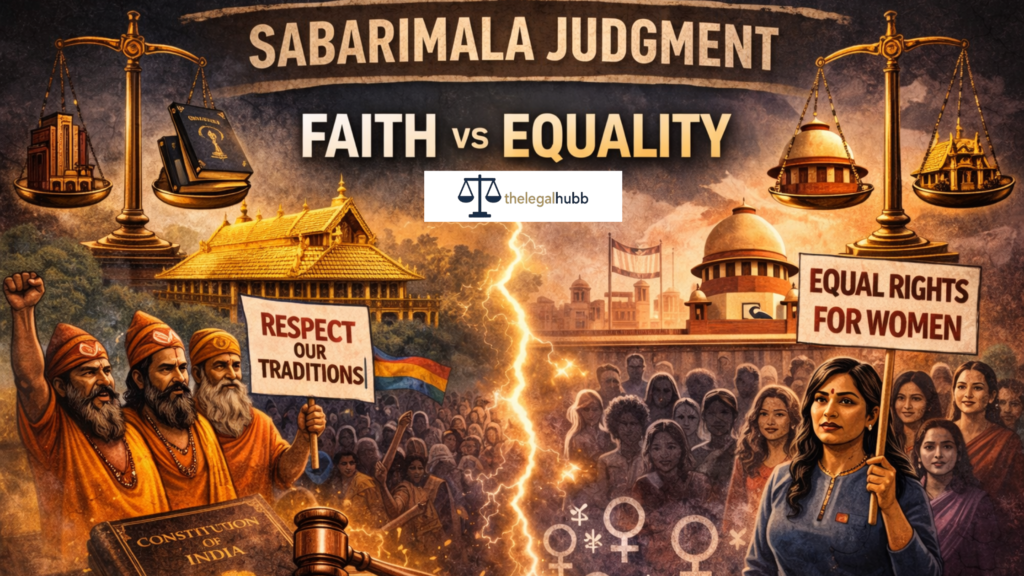
Few cases in modern Indian constitutional history carry the emotional and jurisprudential weight that the Sabarimala matter does. Seven years ago, a five-judge bench of the Supreme Court split four-to-one and declared that women of menstruating age — long barred from entering the Sabarimala shrine in Kerala — could not be denied entry on the basis of biology. That verdict, delivered in the case of Indian Young Lawyers Association vs. the State of Kerala, sent shockwaves through courts, temples, and legislatures alike. Today, with a nine-judge Constitution Bench now convened to revisit the matter, that storm is gathering again.
The hearing that opened this week before a bench headed by Chief Justice of India Surya Kant is not, strictly speaking, a rehearing of the original case. It is a reference — a deliberate exercise to evolve what one might call a “judicial policy” for constitutional courts grappling with the delicate intersection of the right to religious freedom under Article 25 and a denomination’s privilege to manage its own religious affairs under Article 26. The questions it raises, however, are no less consequential for that careful framing.
Background
The Original Verdict and Its Fault Lines
When the Supreme Court delivered its landmark 2018 ruling, Chief Justice Dipak Misra, along with Justices R.F. Nariman, A.M. Khanwilkar, and D.Y. Chandrachud, formed the majority. They held that devotion cannot be subjected to gender discrimination — a formulation as elegant as it was revolutionary. The lone dissenter was Justice Indu Malhotra, the only woman on that bench, who argued that the court was overstepping its role by adjudicating the internal customs of a living religious tradition. Her dissent was not merely a minority opinion; it planted a seed of constitutional doubt that has grown considerably since.
The Union government, which now holds that the judgment was an intrusion into the free exercise of religious freedoms and denominational rights, has maintained a consistent position: it is the legislature, not the courts, that ought to drive reform in religion. This is a view with deep roots in constitutional theory, and it resonates in a country where lawmaking and religious reform have historically proceeded in tandem through democratic deliberation rather than judicial decree.
“If social evils are given a religious colour, then the courts can intervene to distinguish between the two.”
— Justice B.V. Nagarathna, Supreme Court
Current Proceedings
Justice Nagarathna and the Question of Essential Practices
In the ongoing hearing, Justice B.V. Nagarathna — today the sole woman on the Supreme Court and a member of this nine-judge bench — offered a formulation that cuts to the heart of the matter. Social ills, she observed, cannot be branded and passed off as essential religious practices. It is a deceptively simple observation, but one that carries immense jurisprudential freight. The doctrine of Essential Religious Practices, evolved entirely through judicial interpretation and not mentioned anywhere in the Constitution, is precisely the tool courts have used to distinguish between what is genuinely central to a faith and what is custom masquerading as doctrine.
The doctrine itself has a chequered history. It was the Supreme Court’s attempt to operationalise Article 25 the guarantee of freedom of conscience and free profession, practice, and propagation of religion — without turning every court into a theology seminar. In practice, however, it has meant that judges must rule on what practices are indispensable to a religion’s core beliefs. The Sabarimala case sharpened the question dramatically: is the exclusion of women of menstruating age an essential practice of the Ayyappa faith, or is it a social discrimination dressed in religious garb?
Constitutional Stakes
Articles 25 and 26: The Tension at the Core
Solicitor-General Tushar Mehta, arguing before the bench, pointed to the Preamble of the Constitution, which champions liberty of thought, expression, belief, faith, and worship. His invocation of the Preamble was deliberate: it signals that the state views religious freedom as a foundational commitment, not merely a conditional privilege. But the Constitution is rarely comfortable with absolutes, and Article 25 itself permits the state to regulate or restrict religious practice in the interests of public order, morality, and health and crucially, to provide for social welfare and reform. The key question for the nine-judge bench is where the line falls between courts acting as agents of social reform and courts engaging in what the Union government now calls judicial overreach.
Article 26 adds another layer of complexity. It grants religious denominations the right to manage their own affairs in matters of religion. Whether the devotees of Ayyappa at Sabarimala constitute a distinct religious denomination with protected autonomy — rather than simply a subset of the broader Hindu faith — was a contested factual and legal question in the original case, and it remains unresolved at the constitutional level. The nine-judge bench is expected to grapple with this question directly, and its answer will have consequences far beyond the gates of Sabarimala.
Wider Implications
A Doctrine on Trial
The Sabarimala reference arrives at a moment when the Essential Religious Practices doctrine is under unusual pressure from multiple directions simultaneously. The Supreme Court’s own track record on the doctrine is not entirely consistent. In the triple talaq case, the court ruled that instant talaq was not an essential Islamic practice and that it violated women’s rights, a ruling widely celebrated as a progressive intervention. In the Santhara case, the Rajasthan High Court’s finding that the Jain practice of voluntary fasting unto death was not essential to religion was stayed by the Supreme Court, suggesting the justices were not prepared to make that call hastily. Each of these cases has added to a body of precedent that is rich, but not always coherent.
What makes the present reference particularly significant is its ambition. Rather than merely deciding whether women may enter Sabarimala, the bench appears poised to lay down broader principles about how constitutional courts should approach religious freedom claims going forward. Will they retain the power to test religious practices against constitutional morality, or will they retreat toward a posture of greater judicial deference to denominational autonomy? The answer will shape the constitutional landscape for decades.
For students of governance and public policy, this case is a reminder that the boundaries between law, morality, religion, and democracy are never settled permanently. They are continuously renegotiated in courtrooms, in legislative chambers, and in the lives of millions of ordinary citizens who feel both the pull of faith and the promise of constitutional equality. The nine judges seated before Chief Justice Surya Kant carry that weight on their shoulders, and the nation watches with considerable interest.