
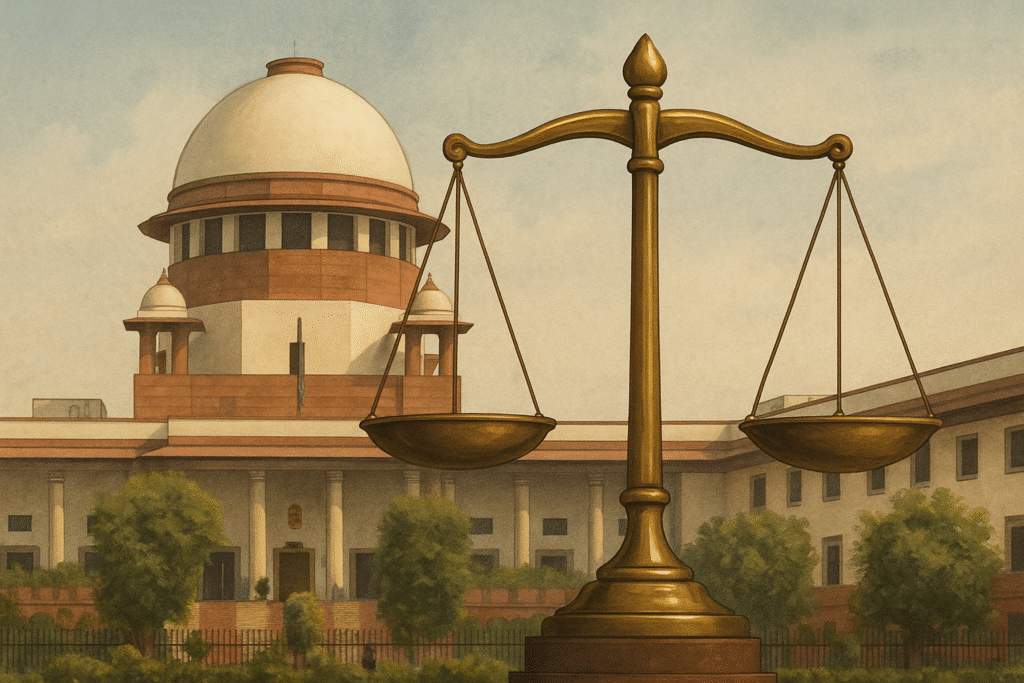
In a significant constitutional development, the Supreme Court of India has clarified that courts cannot compel the President or Governors to act within fixed timelines while deciding on Bills passed by State legislatures. The five-judge Bench delivered this advisory opinion in response to the 16th Presidential Reference, amid growing tensions between several State governments and Raj Bhavans over delays in granting assent to legislation.
The court observed that imposing deadlines or introducing the idea of “deemed assent” would be antithetical to the Constitution and violate the doctrine of separation of powers. According to the Bench, the role of the judiciary is to interpret the Constitution—not to redesign it by prescribing new procedures for constitutional authorities. Therefore, the President and Governors cannot be legally forced to dispose of Bills within a court-mandated time frame.
At the same time, the Supreme Court did not endorse prolonged inaction. It criticised the practice of sitting on Bills indefinitely, calling such behaviour “prolonged and evasive inaction.” While the court cannot dictate the exact timeline, it emphasised that constitutional authorities are expected to act within a reasonable period and not allow legislative processes to be stalled. The Bench also clarified that limited judicial review is still available in situations involving arbitrary delay, mala fide intent, or constitutional misuse.
The ruling also sheds clarity on gubernatorial discretion under Article 200. A Governor may assent to a Bill, withhold assent while communicating reasons to the legislature, return the Bill for reconsideration (except Money Bills), or reserve it for the President. However, these powers are not meant to function as political vetoes or tools of obstruction. Similarly, when a Bill is reserved under Article 201, the President acts on the aid and advice of the Union Cabinet and is not bound by any judicially imposed deadline.
This advisory opinion arrives at a time when several non-BJP-ruled States—such as Tamil Nadu, Kerala, and Punjab—have accused Governors of delaying Bills for months, creating legislative deadlocks. The Centre, however, argued that any attempt to impose timelines would amount to rewriting the Constitution. The Supreme Court agreed, noting that only Parliament can introduce such changes, not the courts.
Ultimately, the judgment strikes a careful balance. It prevents judicial overreach into executive functioning while cautioning Governors and the President against using silence as a constitutional strategy. The message is clear: discretion does not mean delay, and constitutional offices must function with responsibility, transparency, and respect for democratic processes. The opinion reinforces that the Constitution works not merely through written provisions, but through the good faith and timely action of those entrusted to uphold it.