
Prime Minister Young Achievers Scholarship Award Scheme for Vibrant India
A comprehensive look at India’s umbrella scholarship scheme — its origins, structure, eligibility, sub-schemes, and significance for educational equity
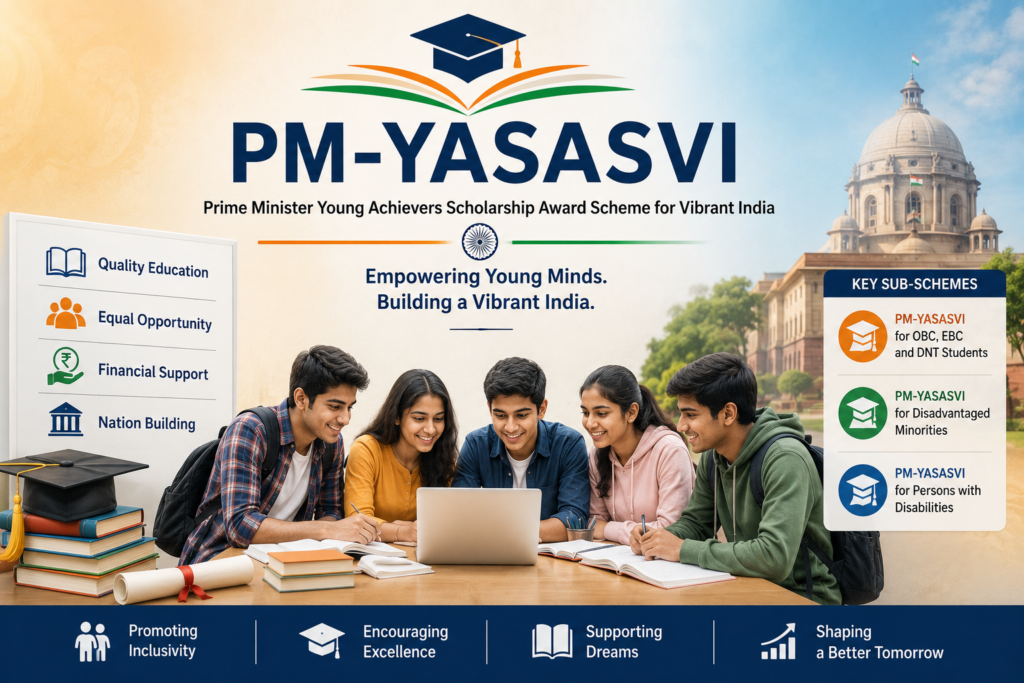
Education has long been described as the great equaliser, but in a country as vast and unequal as India, access to quality education remains heavily dependent on where you are born, what community you belong to, and how much your family can afford. For millions of students from Other Backward Classes (OBC), Economically Backward Classes (EBC), and Denotified, Nomadic, and Semi-Nomadic Tribes (DNT), the gap between aspiration and opportunity is not about talent — it is about money, geography, and institutional reach.
PM-YASASVI — the Prime Minister Young Achievers Scholarship Award Scheme for Vibrant India — is the Government of India’s attempt to close that gap. Implemented by the Department of Social Justice and Empowerment under the Ministry of Social Justice and Empowerment, it is a comprehensive umbrella scheme that unifies scholarship support and residential hostel infrastructure for socially and educationally backward youth across the country.
During the Parliament Monsoon Session, Minister of State for Social Justice and Empowerment Shri B.L. Verma gave a written reply in Lok Sabha reaffirming the government’s commitment to strengthening educational opportunities for OBC, EBC, and DNT students through PM-YASASVI. This article unpacks the scheme in detail — its historical roots, eligibility framework, financial benefits, five sub-schemes, and what it means in the broader landscape of social justice policy in India.
Historical Background: From Hostel Construction to a Unified Framework
PM-YASASVI did not emerge from a vacuum. Its hostel construction component dates back to 1998–99, when the government first recognised that educational backwardness among OBC youth was partly a problem of physical access — students in rural areas simply had nowhere to stay if they wanted to attend schools and colleges in towns and cities. That initial programme underwent a major revision in 2017–18, expanding both its scope and its operational framework.
The real transformation came when the government decided to restructure and consolidate multiple fragmented scholarship initiatives into a single umbrella framework. Rather than running half a dozen disconnected programmes — each with its own bureaucracy, eligibility criteria, and disbursement timelines — PM-YASASVI brought them all under one roof. The result is a scheme that can, in principle, support a student continuously from Class 9 all the way through top-tier college education. That continuity is rare in Indian social welfare design, and it addresses a well-known problem: students who receive support at one stage often fall through the cracks when transitioning to the next.
Core Objective: Eliminating Financial and Geographical Barriers
The stated aim of PM-YASASVI is to eliminate financial constraints and geographical barriers for students hailing from rural and economically weaker sections. The scheme seeks to ensure equitable access to secondary and higher education through two parallel mechanisms — direct financial scholarships and quality hostel facilities.
This dual approach matters. Scholarships alone don’t help a student in a remote Himalayan village or a tribal hamlet in central India if there is no college within a hundred kilometres. Conversely, building hostels is pointless if students cannot afford tuition, books, or basic living expenses. PM-YASASVI attempts to solve both problems simultaneously, which gives it a structural advantage over narrower schemes.
Who Can Apply: Eligibility Criteria
PM-YASASVI is targeted at a specific set of beneficiaries, and the eligibility criteria are worth understanding in detail because they determine who actually gains access to the scheme’s benefits.
The scheme is open to students belonging to three identified categories: Other Backward Classes (OBC), Economically Backward Classes (EBC), and Denotified, Nomadic, and Semi-Nomadic Tribes (DNT), including SAR, NT, and SNT communities. Applicants must be permanent residents of India and must be listed in the Central or State/UT lists of OBCs. Crucially, OBC applicants must fall strictly outside the creamy layer — this ensures that the benefits reach the economically weaker segments within these communities rather than being captured by relatively affluent families.
The family annual income of the applicant must not exceed ₹2.5 lakh. Only students studying in Class 9 or Class 11 are considered eligible for the scholarship entrance test. Students of all genders are eligible — the scheme does not discriminate on this front.
For the hostel component, priority is given to post-matric and undergraduate students coming from rural areas that lack local colleges. There is also a mandatory 5% seat reservation for students with disabilities, reflecting a broader commitment to inclusive access.
Selection Mechanism: The YASASVI Entrance Test
Unlike many government scholarship schemes where selection is based purely on documentary verification, PM-YASASVI requires candidates to pass a computer-based entrance test. The National Testing Agency (NTA) — the same body that conducts exams like JEE, NEET, and UGC NET — has been entrusted with the responsibility of conducting this test.
This merit-based selection mechanism serves two purposes. First, it ensures that the scholarships go to students who are academically capable and likely to benefit most from the financial support. Second, it lends credibility to the scheme by making the selection process transparent and standardised, reducing the scope for discretionary allocation that has plagued many welfare programmes in the past.
Financial Benefits: What Do Students Actually Get?
The financial assistance under PM-YASASVI is structured by class level:
| Class Level | Annual Scholarship |
| Class IX | ₹75,000 per year |
| Class XI | ₹1,25,000 per year |
These are not negligible amounts. For families with annual incomes below ₹2.5 lakh, a scholarship of ₹75,000 or ₹1,25,000 can make the difference between a child continuing their education and dropping out to work. The amounts are designed to cover not just tuition but also ancillary costs like books, stationery, and living expenses that often push economically vulnerable students out of the education system.
The Five Sub-Schemes: A Closer Look
The umbrella nature of PM-YASASVI becomes most apparent when you examine its five constituent sub-schemes. Each one targets a different stage of the educational pipeline, and together they create a reasonably comprehensive support system.
1. Pre-Matric Scholarship Scheme
This sub-scheme is aimed at students studying in Classes IX and X on a full-time basis in government schools only. The benefit is a consolidated academic allowance of ₹4,000 per annum. While the amount is modest compared to the other sub-schemes, it serves an important purpose — it keeps students in school during the critical secondary years when dropout rates tend to spike, particularly among disadvantaged communities. By limiting eligibility to government school students, the scheme also implicitly supports public education infrastructure.
2. Post-Matric Scholarship Scheme
This component targets students at the post-matriculation or post-secondary stage, providing financial support to help them complete their education. The allowance ranges from ₹5,000 to ₹20,000 per annum depending on the category of course being pursued. The tiered structure recognises that different types of post-matric education — whether vocational courses, undergraduate degrees, or professional programmes — carry different cost burdens.
3. Top Class Education in Schools Scheme
This is where the scheme gets more ambitious. It targets meritorious students from OBC, EBC, and DNT categories studying from Class 9 onwards through Class 12. The scholarship covers tuition fees, hostel fees, and other charges, subject to a maximum of ₹75,000 per annum for students in Classes 9 and 10, and ₹1,25,000 per annum for students in Classes 11 and 12. The emphasis on “top class” education signals that this sub-scheme is designed to place talented students from backward communities in quality institutions — not just keep them enrolled somewhere, but give them access to the kind of schooling that can genuinely transform their life trajectories.
4. Top Class Education in Colleges Scheme
Extending the same logic to higher education, this sub-scheme is open to OBC, EBC, and DNT students pursuing college-level education. The financial support here is comprehensive — it covers tuition fees, living expenses, books, and stationery. The goal is to ensure that a student who has made it through school with PM-YASASVI’s support does not falter at the college stage simply because the costs escalate. This is particularly significant for students pursuing professional degrees in engineering, medicine, law, or management, where the costs can be prohibitive for families in the target income bracket.
5. Construction of Hostel for OBC Boys and Girls
This is the infrastructural backbone of the scheme. The sub-scheme aims to provide hostel facilities to students belonging to socially and educationally backward classes, especially those from rural areas, to enable them to pursue secondary and higher education at government schools, universities, and institutes located at a reasonable distance. Without hostel accommodation, many of these students would simply not be able to access educational institutions outside their villages or districts. The 5% reservation for students with disabilities ensures that the most marginalised within disadvantaged communities are not left behind.
Significance in the Broader Context of Social Justice Policy
PM-YASASVI is worth paying attention to for several reasons beyond its immediate beneficiaries.
First, the umbrella structure itself represents a policy design innovation. India’s social welfare architecture has historically been fragmented — dozens of schemes with overlapping mandates, different ministries, separate application processes, and inconsistent disbursement schedules. By consolidating multiple scholarship and hostel programmes under one framework, PM-YASASVI reduces administrative redundancy and makes it easier for both beneficiaries and implementing agencies to navigate the system.
Second, the merit-based selection through NTA-conducted entrance tests introduces accountability into the process. It is not enough to belong to the right category and meet the income threshold — students must demonstrate academic readiness. This balances equity with efficiency, ensuring that scarce public resources are allocated to those most likely to put them to productive use.
Third, the combination of scholarships and hostel infrastructure addresses both the demand side and the supply side of the educational access problem. Most scholarship schemes focus only on affordability and leave students to figure out accommodation on their own — an approach that works in urban areas but fails entirely in rural India, where the nearest quality institution may be hundreds of kilometres away.
Finally, PM-YASASVI’s focus on OBC, EBC, and DNT communities fills a specific gap in the social justice landscape. While Scheduled Castes and Scheduled Tribes have long had dedicated scholarship programmes, the backward classes — particularly the denotified and nomadic tribes — have historically received less systematic attention. PM-YASASVI helps correct that imbalance.
For UPSC Aspirants: Why This Scheme Matters
For students preparing for competitive examinations, PM-YASASVI is relevant across multiple dimensions. From a Prelims standpoint, the factual details are important — the concerned ministry, the five sub-schemes, the eligibility criteria, the role of NTA, and the income ceiling of ₹2.5 lakh are all testable facts.
For Mains, particularly GS Paper II (Social Justice and Governance), the scheme can be discussed in the context of educational equity, welfare scheme design, and affirmative action for backward classes. Questions on whether India’s scholarship architecture is effective, whether umbrella schemes work better than standalone ones, and how to balance merit with equity can all draw on PM-YASASVI as a case study.
The scheme also has connections to broader themes — the National Education Policy 2020’s emphasis on equitable access, the constitutional mandate under Articles 15(4) and 46 to promote the educational interests of weaker sections, and the ongoing policy debates around creamy layer exclusion in OBC reservations.
Conclusion
PM-YASASVI is not a revolutionary new idea — it is a pragmatic consolidation of existing efforts, redesigned to be more comprehensive, more accessible, and more accountable. Its strength lies in its structure: continuous support from school through college, a combination of financial aid and physical infrastructure, and a transparent selection mechanism. Whether it delivers on its promise will depend, as always, on implementation — on how efficiently the NTA conducts its tests, how quickly scholarships are disbursed, how well the hostels are built and maintained, and whether the scheme reaches the students who need it most rather than being captured by those who need it least.
But as a design, PM-YASASVI represents a thoughtful answer to a complex problem. And in a country where a large share of the population still lives in rural areas and where educational attainment remains sharply stratified by caste and class, thoughtful answers are exactly what is needed.
For more such analyses, visit thelegalhubb.com


Pingwin PRO https://pingwin.pro сервис спортивной ML-аналитики: анализ матчей, оценка вероятностей и коэффициентов, value-прогнозы, статистика результатов и инструменты управления риском. Модели регулярно обновляются и проверяются на новых данных.
Прогноз на день https://horoscope-web.com расскажет предсказания на день. Узнавайте о тенденциях.
Актуальні матеріали для користувачів https://ua-meta.com охоплюють різні теми та практичні питання.
Цікавий ресурс для читачів https://ukrdigest.com зібрані для зручного читання онлайн.
Get the complete details https://premier-league-jatekok.hu