
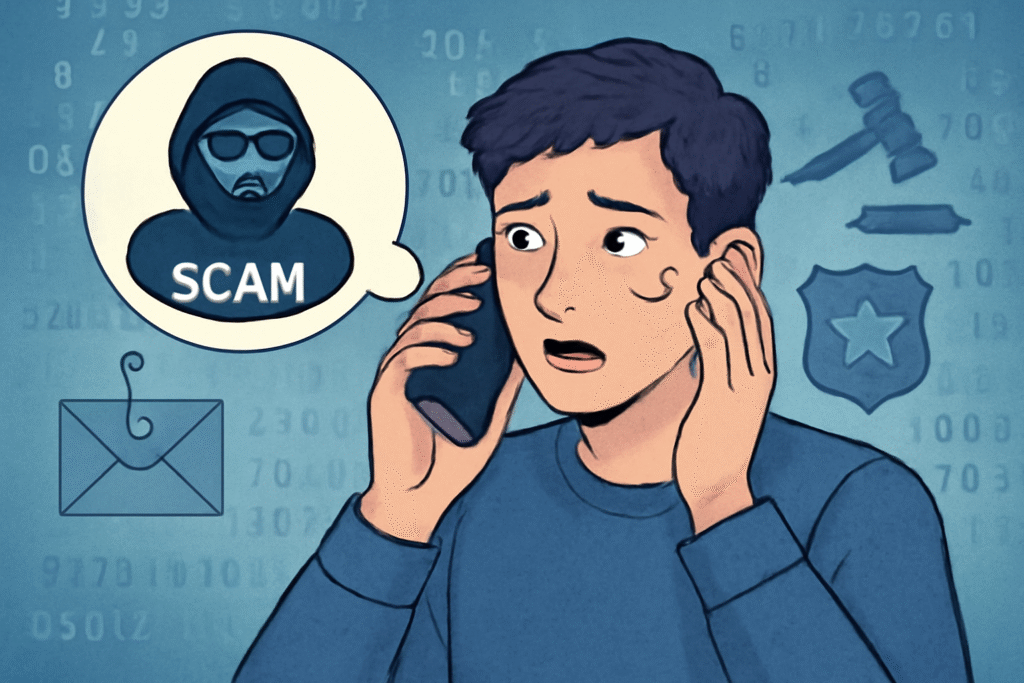
With rapid digitization and widespread internet access, crime has evolved beyond physical boundaries into the digital realm. Among the many threats faced online today, one particularly alarming trend in India is the rise of “digital arrest” scams—a deceptive cybercrime tactic that exploits fear, ignorance of legal procedures, and the anonymity of the internet to defraud unsuspecting victims.
What is Digital Arrest?
“Digital arrest” is a form of cybercrime where fraudsters impersonate law enforcement or government officials—such as police officers, Central Bureau of Investigation agents, Reserve Bank of India representatives, or Enforcement Directorate officers—over phone calls, emails, or messaging platforms. They falsely accuse individuals of crimes like fraud, money laundering, tax evasion, or other serious offenses and threaten immediate arrest or imprisonment unless the victim pays a sum of money or reveals sensitive personal information.
Victims are often isolated and pressured into compliance through intimidation, fake legal notices, or threats of digital surveillance, thereby falling prey to financial extortion and identity theft. The scam’s key weapon is the fear of arrest, creating panic that compels victims to act hastily without verifying the legitimacy of the claims.
The Modus Operandi of Digital Arrest Scams
These scammers employ sophisticated tactics:
- Spoofed phone numbers and emails to mimic official agencies.
- Fake websites or portals resembling government domains.
- Use of official-sounding jargon and legal terminology to confuse the target.
- Threats of freezing bank accounts, property seizure, or cyber trails.
- Demand for instant payments through electronic transfers or cryptocurrencies.
This layered deception makes it difficult for victims to discern fact from fiction.
Legal Framework to Address Digital Arrest
India’s legal provisions do not yet specifically criminalize “digital arrest” as a distinct offence. However, several existing laws apply to these fraudulent acts:
- Bharatiya Nyaya Sanhita (BNS), 2023: Sections dealing with impersonation of public servants, cheating (Section 318), forgery, extortion, and criminal intimidation are relevant. Offenders may face imprisonment ranging typically from six months to ten years, depending on the offence’s severity.
- Information Technology Act, 2000: Addresses identity theft (Section 66C), cheating by personation using computer resources (Section 66D), and breach of privacy or confidentiality (Section 72).
- Reserve Bank of India (RBI) Guidelines: Direct banks and financial institutions to prevent frauds and respond effectively to reported digital scams.
- Bharatiya Nagarik Suraksha Sanhita (BNSS), 2023: Clarifies that no law enforcement agency is authorized to conduct arrests digitally. Legal notices require in-person delivery following due process.
Landmark Case: Rajasthan High Court’s Suo Moto Intervention
The alarming increase in digital arrest scams prompted the Rajasthan High Court to take suo moto cognizance in early 2025. Justice Anoop Kumar Dhand highlighted the rising number of victims losing crores to such scams. The Court declared that “digital arrest” has no legal standing under Indian criminal law and reiterated that lawful arrest can only happen through physical procedures.
The Court directed:
- The Government to raise public awareness regarding fake digital arrest scams.
- The Reserve Bank of India to initiate mechanisms for blocking payments linked to suspected fraudulent accounts.
- Police authorities to avoid communicating arrest notices or summons via WhatsApp or other unverified digital media without proper procedure.
This intervention marked a crucial step toward protecting citizens and emphasizing legal safeguards against cyber impersonation scams.
Government Initiatives and Preventive Measures
The Government of India, in collaboration with the Ministry of Home Affairs, telecom providers, RBI, and state agencies, has implemented proactive measures:
- Blocking thousands of suspicious phone numbers and social media accounts involved in scams.
- Launching awareness campaigns through media and public advisories about the signs of digital arrest scams.
- Developing real-time fraud reporting platforms enabling victims to lodge complaints quickly and trace transactions.
- Working with banks to halt suspicious international or domestic electronic fund transfers promptly.
Notable Reported Cases
- Bengaluru Techie Loses ₹11.8 Crore (Dec 2024): A corporate professional was coerced through fake digital arrest threats into transferring massive sums.
- Gujarat Senior Citizen Defrauded of ₹1 Crore (Nov 2024): An elderly victim was manipulated into divulging banking credentials.
- Madhya Pradesh Teacher’s Tragic Suicide (Jan 2025): Following repeated digital arrest threats and financial loss, a middle-aged educator took his own life, spotlighting the psychological toll.
These cases underscore the widespread impact, affecting individuals from varied backgrounds and professions.
How to Protect Yourself from Digital Arrest Scams
- Verify Official Communication: Genuine law enforcement agencies use formal letters and direct, verifiable communication, not threatening calls or messages.
- Do Not Share Personal Information: Never divulge OTPs, banking PINs, or passwords to callers.
- Report Suspicious Activity: Contact local police cyber cells, the Indian Cyber Crime Coordination Centre (IC4), or use government fraud reporting portals.
- Consult Legal Assistance: When in doubt, seek advice from recognized legal professionals rather than responding impulsively.
Conclusion
Digital arrest scams represent a disturbing convergence of technology and deception, exploiting fear to perpetrate cyber extortion. While Indian law provides multiple legal remedies to tackle these crimes, public awareness and vigilant enforcement remain pivotal. The judiciary’s proactive stance and government initiatives offer hope to combat these fraudulent practices, restoring confidence in lawful processes.
As technology evolves, so must legal protections and citizen education to uphold justice and security in the digital age.
References
- “From Clicks to Cuffs: Understanding Digital Arrest in the Indian Legal Landscape,” Cyril Amarchand Blogs, 2025
- “Digital Arrest Scam in India,” Ujjivan Small Finance Bank, 2025
- “The Increasing Trend of Digital Arrests in India,” Jus Corpus, 2025
- “Suo Motu: In the Matter of Tackling the Issue of Digital Arrest Scams,” Rajasthan High Court, 2025
- “Digital Arrest: A Legal And Technological Puzzle,” RestTheCase Legal, 2025
- Press Release: Cyber Crime and Digital Arrest Scam Measures, Press Information Bureau, 2024



Онлайн-слоты — это одни из самых востребованные игры в онлайн-казино.
https://designlife.fashionsecret.ru/pMS0XTpGd7eK/
На данном сайте вы сможете отыскать полезную информацию.
https://legicon-pravo.ru/data/3407-novinki-byuti-kollektsiy-sukhie-masla-rue-de-miro-muss-medavita-i-drugie-roskoshi.html
Здесь портале есть шанс почерпнуть важную информацию.
https://ipcfms.ru/read/393-mobilnyy-opyt-v-randx-casino-kak-igrat-so-smartfona.html
На данном портале есть шанс отыскать ценную информацию.
https://metaltp.ru/data/2026-06-28-bonusy-i-promoaktsii-v-onlayn-kazino-polnoe-rukovodstvo/
Trustless digital asset swaps enable traders to exchange coins while not giving up custody of their private keys.
Different from custodial exchanges, trustless exchanges never take custody of trader funds on the platform’s wallets.
Rather, transactions occur directly between parties, so individuals always retain total ownership of the funds.
This approach eliminates counterparty risk and enhances security, though it expects individuals to safeguard their personal keys responsibly.
https://app.readthedocs.org/profiles/quickex/
Предпринимательство является значимым двигателем роста страны.
Оно создаёт дополнительные рабочие места и даёт гражданам стабильный заработную плату.
https://typical-moscow.ru/oleg-belaj-30-let-na-odnoj-volne-s-rynkom/
Кроме того, бизнес ускоряет нововведения и появление современных продуктов.
Таким образом, предпринимательство делает экономику намного более динамичной и открывает шанс для успеху.
On this portal, you can locate an abundance of practical content.
This resource features in-depth articles on a wide range of subjects.
Whether a novice or a professional, you will come across content useful.
Much of the data is well-organized, so it’s simple to access the information you need.
https://truthincongress.com/
El juego consciente representa una filosofía que busca conservar el control sobre las apuestas y minimizar los riesgos vinculados a esta actividad.
Implica definir topes de dinero previo a comenzar, y también detectar los indicios de un problema.
https://www.apkfiles.com/apk-622658/descargar-mobcash-apk-oficial-gesti-n-de-caja-m-vi
Además, impulsa elecciones informadas y pretende que la la diversión siga siendo la finalidad central al la experiencia.
En definitiva, este enfoque facilita a los jugadores a preservar la rienda suelta de su comportamiento y a vivir la experiencia de manera equilibrada.
Finding an online broker remains a critical choice for any trader.
Traders need to review legal oversight and confirm the broker is licensed by a reputable authority.
mymerrill login page
Evaluate costs, order execution, and available assets to ensure they suit your goals.
Also, check the service’s customer support, stability, and interface before funding significant capital.