
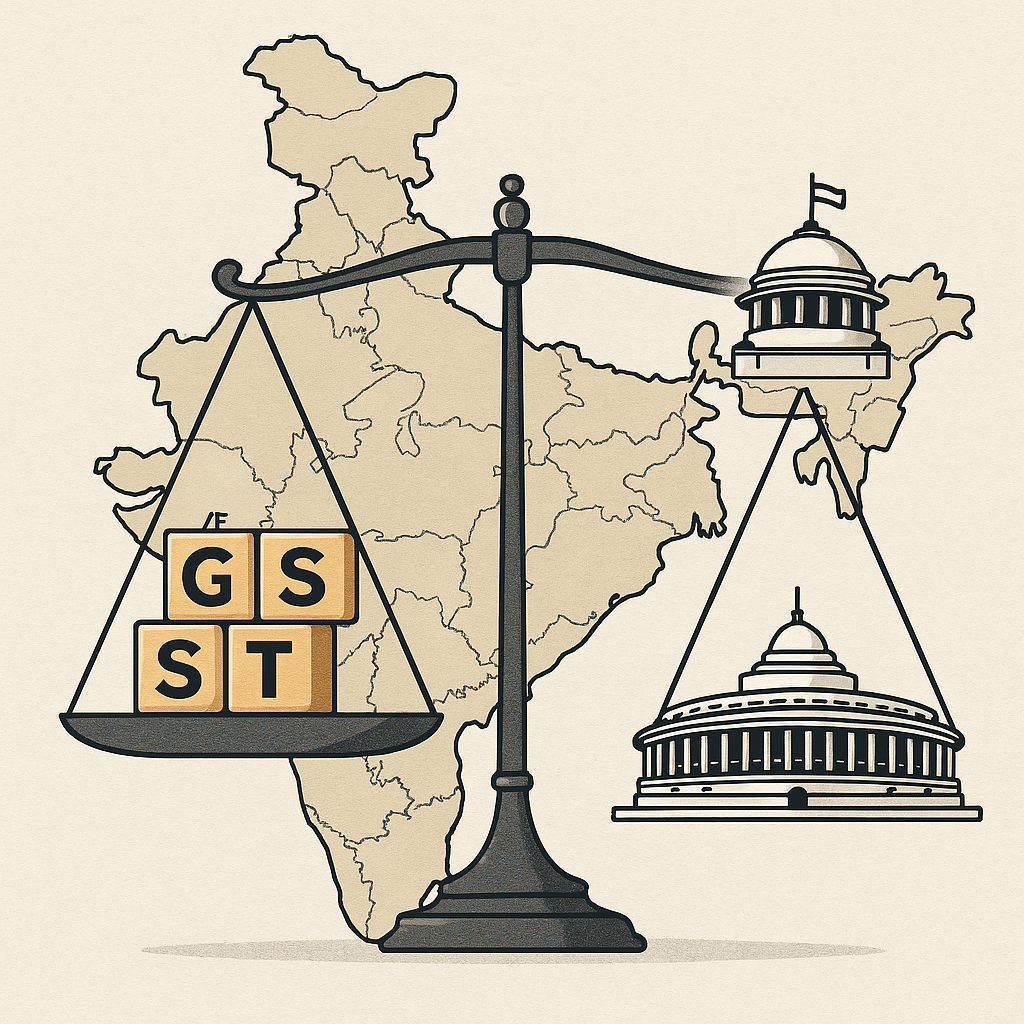
India’s federal structure has always been a delicate balance between unity and diversity—between a powerful Centre and assertive States. But recent developments, from the rollout of the Goods and Services Tax (GST) to changing political equations, have reignited the debate: Is Indian federalism weakening under single-party hegemony?
The GST reform, while hailed as a landmark step toward economic integration, has also triggered friction. Several States have voiced concerns over declining revenue autonomy, delayed compensation, and the shrinking space for fiscal negotiation. Earlier, States retained a larger share of taxation flexibility; now, they depend on central transfers to a greater extent. This shift has deepened anxieties around whether cooperative federalism is gradually morphing into centralised control.
Experts point out that this tension is not merely administrative—it is deeply political. In the 1990s and 2000s, coalition governments at the Centre depended on regional parties for survival. This era strengthened negotiation, accommodation, and regional assertion. States could bargain, influence national policies, and safeguard federal interests. With the emergence of a dominant single party at the national level, that balance has altered.
The issue is also rooted in fiscal asymmetry. Southern and economically stronger States contribute more to the national tax pool but do not always receive proportional returns. Their demand is not for privilege but for fairness—questioning whether redistribution has turned into structural inequity. When the Finance Commission’s formulae change without sufficient consultation, it reinforces the sense of sidelining.
Despite these challenges, experts caution against assuming that federalism has collapsed. India’s federal structure is not a gift from any government—it is constitutional, dynamic, and periodically shaped by political shifts. History shows that phases of central dominance have come and gone. The real concern is not temporary imbalance but whether institutional mechanisms for dialogue—like the Inter-State Council or Planning Commission (now dissolved)—will be revived or remain weakened.
The debate also intersects with electoral behaviour. As national politics centralises, regional politics does not vanish—it adapts. Some States respond through competitive nationalism, others by asserting regional identity. The rise of strong State leaders, renewed regional coalitions, and judicial interventions suggest that the story is far from over.
In the end, the question is not whether a single party governs, but whether India preserves the spirit of shared rule and self-rule—the essence of federalism. For a country as vast and diverse as India, federalism is not merely a constitutional arrangement; it is the foundation of democratic trust. The resilience of that foundation will depend not only on political actors but on whether dialogue, decentralisation, and genuine cooperation are allowed to thrive.