Copyright and Patent Challenges in AI-Generated Content
1. INTRODUCTION
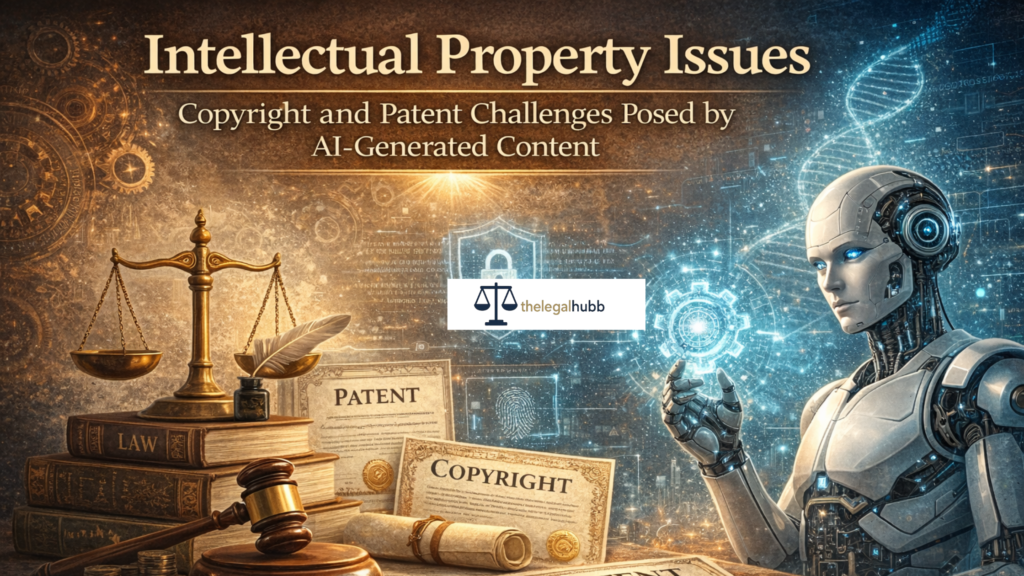
The rapid development of Artificial Intelligence has significantly transformed the creation of content and innovation processes. AI systems are now capable of generating text, music, art, and even scientific inventions. While these advancements promote efficiency and creativity, they simultaneously challenge traditional frameworks of intellectual property law.
Copyright and patent laws were originally designed with human creators and inventors in mind. The emergence of AI-generated works raises fundamental questions regarding authorship, ownership, originality, and legal accountability. As a result, existing legal systems are struggling to adapt to this technological shift.
2. COPYRIGHT CHALLENGES IN AI-GENERATED CONTENT
2.1 Authorship and Ownership of AI-Generated Works
One of the most complex issues is determining ownership of content created by AI. Traditional copyright law grants protection to works created by human authors. However, when an AI system independently generates content, identifying the “author” becomes problematic.
There are multiple competing perspectives. Some argue that the developer of the AI should own the rights, as they created the system. Others contend that the user who provides input or prompts should be treated as the author. A third view suggests that AI-generated content may not qualify for copyright protection at all due to the absence of human creativity.
Courts, particularly in jurisdictions like the United States, have consistently emphasised human authorship as a prerequisite for copyright protection, thereby excluding purely AI-generated works.
2.2 Absence of Clear Legal Framework
Most legal systems have not yet developed comprehensive rules governing AI-generated content. Existing copyright laws are based on assumptions that no longer fully apply in the age of autonomous systems.
As a result, AI-generated works often fall into a legal grey area. This lack of clarity creates uncertainty for creators, businesses, and technology developers. Courts have begun addressing these issues, but a uniform legal framework is still evolving.
2.3 Use of Copyrighted Material in AI Training
AI systems are typically trained on large datasets, many of which contain copyrighted works. This raises questions regarding whether such use constitutes fair use or infringement.
From one perspective, training AI is seen as transformative and thus permissible. However, content creators argue that their works are being used without consent or compensation, thereby violating their rights.
This issue has become particularly significant with the rise of generative AI models, leading to increasing litigation and demands for licensing frameworks.
2.4 Plagiarism and Derivative Works
AI systems may produce outputs that closely resemble existing copyrighted works. This creates difficulties in determining whether such outputs are original or derivative.
Unintentional replication of existing works raises concerns about plagiarism and infringement. Courts must evaluate whether AI-generated outputs are sufficiently distinct or whether they unlawfully reproduce protected content.
This problem highlights the need for clearer standards on originality in the context of AI.
3. PATENT CHALLENGES IN AI-GENERATED INVENTIONS
3.1 Concept of Inventorship
Patent law traditionally recognises only natural persons as inventors. The emergence of AI-generated inventions challenges this assumption.
A key question arises: can an AI system be recognised as an inventor? Most jurisdictions currently reject this possibility, maintaining that inventorship must involve human contribution.
However, as AI systems become more autonomous, the role of human input in innovation is increasingly limited, raising questions about the adequacy of existing laws.
3.2 Novelty and Non-Obviousness
For an invention to be patentable, it must be novel and non-obvious. AI systems, however, can generate multiple variations of existing ideas at high speed.
This raises concerns about whether AI-generated inventions genuinely satisfy the requirement of non-obviousness. If an AI produces predictable outcomes based on existing data, such inventions may fail to meet patent standards.
The assessment of innovation becomes more complex in an AI-driven environment.
3.3 Prior Art and Patent Examination
AI systems are capable of analysing vast amounts of existing knowledge. While this enhances research capabilities, it also complicates the determination of prior art.
Patent authorities must now assess whether an AI-generated invention represents a genuine advancement or merely a recombination of existing information. This increases the burden on patent examiners and may lead to overlapping claims.
3.4 Ownership and Licensing Issues
Ownership disputes are common in AI-generated inventions. Multiple parties may claim rights, including:
- The developer of the AI system
- The user who applied the AI
- The organisation funding the research
Determining ownership becomes particularly challenging when AI operates with minimal human intervention. This necessitates clearer contractual and legal frameworks to avoid disputes.
4. GLOBAL LEGAL RESPONSES AND EMERGING TRENDS
4.1 Comparative Legal Approaches
Different jurisdictions have adopted varying approaches to AI-related intellectual property issues.
In the United States, both copyright and patent law continue to emphasise human authorship and inventorship. The European Union follows a similar approach, although it is actively exploring regulatory reforms.
China has shown relatively greater flexibility by recognising certain rights in AI-assisted creations, particularly where human involvement can be established.
4.2 Future Legal Reforms
Legal scholars and policymakers are increasingly considering reforms to address AI-related challenges. Some proposals include:
- Creation of a new category of rights specifically for AI-generated works
- Development of licensing systems for AI training data
- Clarification of ownership rules in AI-assisted innovation
Such reforms aim to balance innovation with protection of creators’ rights.
5. CONCLUSION
Artificial Intelligence is reshaping the landscape of intellectual property law. The traditional concepts of authorship, inventorship, and originality are being redefined in light of technological advancements.
While existing legal frameworks provide a starting point, they are insufficient to address the complexities introduced by AI. Courts and policymakers must adapt to ensure that innovation is encouraged without undermining the rights of creators.
The future of intellectual property law lies in achieving a balance between technological progress and legal certainty.