
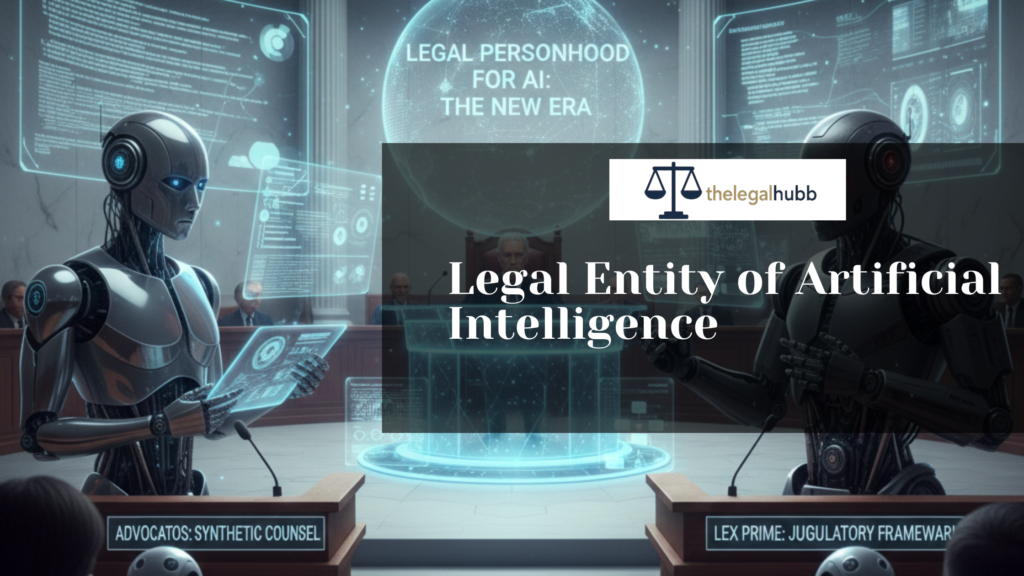
2.1 Concept of Legal Personality
The concept of legal personality is central to understanding whether artificial intelligence can be treated as a legal entity. Legal personality refers to the capacity of an entity to be recognised by law as a subject of rights and duties. A legal person can own property, enter into contracts, sue and be sued, and be held liable for legal wrongs.
In legal theory, personality is not confined to human beings. Law has historically recognised several non-human entities as legal persons in order to facilitate social, economic, and administrative objectives. Thus, legal personality is a legal construct or fiction, created by the law whenever it considers such recognition necessary or convenient.
This idea is crucial in the context of artificial intelligence because AI systems, though non-human, increasingly participate in activities that have legal consequences. The question, therefore, is not whether AI is human-like, but whether law should treat AI as a subject rather than merely an object of law.
2.2 Jurisprudential Foundation of Juristic Persons
Jurisprudence distinguishes between natural persons and juristic (artificial) persons. Natural persons are human beings who possess legal personality by birth. Juristic persons, on the other hand, are entities that are granted legal personality by law despite lacking biological existence.
Examples of juristic persons include corporations, companies, universities, statutory authorities, and even religious idols. The rationale behind recognising juristic persons is functional rather than moral. Such recognition enables these entities to hold property, enter into legal relations, and be held accountable independently of the individuals associated with them.
Indian courts have consistently affirmed that juristic personality is a matter of legal policy.
Case Law: Shiromani Gurdwara Prabandhak Committee v. Som Nath Dass (2000)
In this case, the Supreme Court of India clarified that juristic personality is not inherent but is conferred by law. The Court observed that an entity may be treated as a juristic person if such recognition is necessary to achieve legal or social objectives. However, the Court also cautioned that such recognition must be justified and should not be extended indiscriminately.
This judgment is frequently cited in debates on AI legal personality. It establishes that law has the power to recognise non-human entities as legal persons, but such recognition must be purposeful and policy-driven.
From a jurisprudential perspective, this means that AI could theoretically be recognised as a juristic person, but only if the legislature or judiciary finds compelling reasons to do so.
2.3 Artificial Intelligence as a Legal Person: Arguments For and Against
The debate on whether AI should be recognised as a legal person is one of the most contested issues in AI and Law.
Arguments in Favour of Recognising AI as a Legal Person
Supporters of AI legal personality argue that advanced AI systems exhibit a high degree of functional autonomy. Modern AI systems can learn from data, adapt their behaviour, and make decisions without direct human intervention. As a result, it may be difficult to attribute specific outcomes to a single human actor.
One major concern is the accountability gap. AI systems are often created, trained, deployed, and operated by multiple actors, including developers, data providers, manufacturers, and users. When harm occurs, fixing liability on one party may be complex and inefficient. Granting AI limited legal personality, it is argued, could simplify liability by making AI a direct bearer of responsibility, supported by insurance or compensation mechanisms.
Another argument draws an analogy with corporations. Corporations lack consciousness, emotions, and moral reasoning, yet they are recognised as legal persons. Proponents argue that if corporations can be legal persons for reasons of convenience and accountability, AI systems could similarly be granted limited legal personality.
Arguments Against Recognising AI as a Legal Person
The dominant legal position strongly opposes granting legal personality to AI. A central objection is that AI lacks consciousness, intention, and moral agency. Legal responsibility, especially in criminal law, is closely tied to the idea of mens rea, or guilty mind. AI systems operate on algorithms and data; they do not possess awareness or ethical understanding.
Granting legal personality to AI may also lead to evasion of human responsibility. Corporations or developers could deflect blame onto AI systems, thereby avoiding accountability for harmful technologies that they design and profit from.
From an ethical standpoint, recognising AI as a legal person risks undermining the human-centric foundation of law. Indian legal philosophy, influenced by constitutional values such as dignity, justice, and responsibility, places humans at the centre of legal accountability.
Therefore, while AI may act autonomously in a functional sense, it lacks the normative qualities that justify recognition as a legal person.
2.4 Artificial Intelligence and Legal Agency under the Indian Contract Act, 1872
The concept of agency is governed by the Indian Contract Act, 1872. According to the Act, an agent is a person employed to do any act for another or to represent another in dealings with third persons. Agency is based on three essential elements: legal capacity, consent, and intention.
For an entity to act as an agent, it must be capable of understanding legal consequences and must act with the authority of the principal. AI systems, despite their ability to perform automated tasks, lack legal capacity and cannot give or receive consent. They also lack the ability to form intention in the legal sense.
Case Law: State of Maharashtra v. Mohd. Yakub (1980)
In this case, the Supreme Court emphasised that conscious intention and knowledge are essential components of legal responsibility. This principle reinforces the conclusion that AI cannot independently act as a legal agent.
Consequently, AI cannot be recognised as an agent under the Indian Contract Act. Instead, AI is treated as a tool or instrument through which a human or corporate principal acts. Any legal consequences arising from AI actions are attributed to the principal who deploys or controls the AI system.
2.5 Liability and Case Law Integration
Indian courts have consistently linked liability to control and human agency.
Case Law: Dharangadhara Chemical Works v. State of Saurashtra (1957)
The Supreme Court held that the degree of control and supervision exercised is a key determinant of responsibility. This principle applies directly to AI systems. The person or organisation exercising control over AI deployment bears legal responsibility for its actions.
Case Law: Nathulal v. State of Madhya Pradesh (1966)
The Court held that absence of guilty intention negates criminal liability. Since AI lacks mens rea, it cannot be subjected to criminal punishment. Criminal liability therefore lies with programmers, operators, or organisations where negligence or recklessness can be established.
These cases collectively reinforce the principle that AI cannot independently bear legal responsibility under existing Indian law.
2.6 The Indian Legal Position on AI as a Legal Entity
At present, Indian law does not recognise artificial intelligence as a legal entity or legal person. There is no statutory provision or judicial precedent granting AI legal personality. AI is treated as property, software, or technology, depending on the context of its use.
All legal consequences arising from AI-related activities are attributed to:
- Developers
- Manufacturers
- Owners
- Users
- Corporations deploying AI systems
Indian courts and policymakers adopt a human-centric accountability model, ensuring that responsibility for AI actions remains with human actors and legal persons rather than machines.
It’s clear that you are passionate about making a positive impact and your blog is a testament to that Thank you for all that you do