When Trade Policy Meets Constitutional Restraint
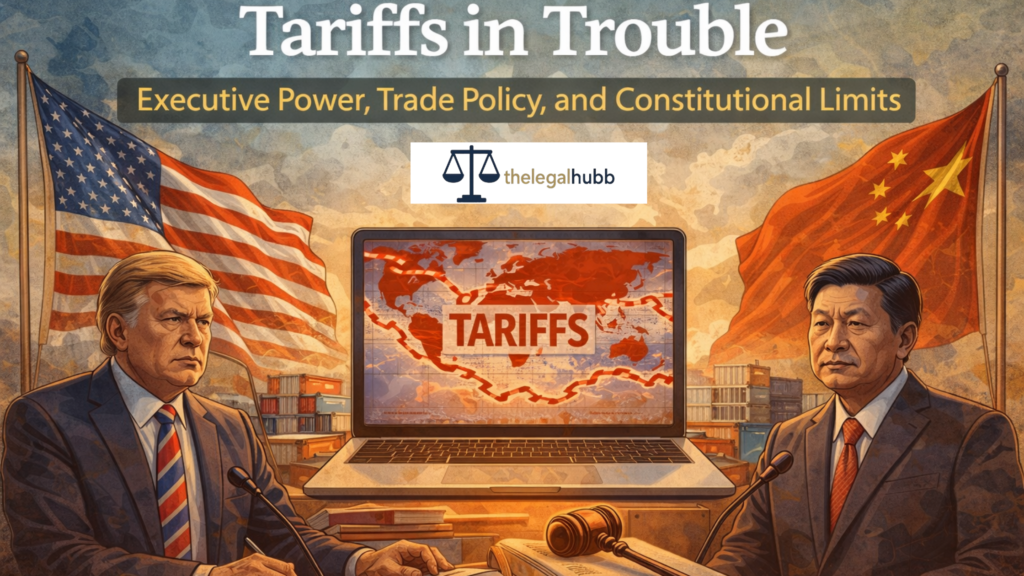
Trade has always been an instrument of power. Nations impose tariffs not merely to regulate imports but to signal political intent, negotiate strategic leverage and protect domestic industries. Yet in constitutional democracies, even economic power must operate within legal boundaries. Recent developments in the United States have once again brought this principle into sharp focus, as judicial scrutiny placed limits on executive authority to impose sweeping tariffs under emergency powers.
The issue is not simply about trade rates or protectionism. It is about the balance of power between the executive and the legislature, and about whether emergency economic provisions can be stretched to justify broad, unilateral action.
The Contested Use of Emergency Powers
At the centre of the controversy lies the use of the International Emergency Economic Powers Act (IEEPA). This legislation grants the U.S. President authority to regulate commerce during a declared national emergency. However, the question raised before the U.S. Supreme Court was whether this statute permits the imposition of wide-ranging tariffs without explicit congressional approval.
In a significant ruling, the Court concluded that such expansive use of IEEPA to impose tariffs was inconsistent with the statutory framework. The judgment reaffirmed that emergency economic powers cannot substitute for clear legislative authorisation when it comes to taxation and tariff measures.
The executive may declare emergencies, but it cannot unilaterally expand the scope of economic regulation beyond what Congress has permitted.
Separation of Powers in Economic Governance
Tariffs are, in essence, a form of taxation. In constitutional systems, the power to tax traditionally rests with the legislature. When executive authorities impose tariffs through emergency declarations, the delicate architecture of separation of powers is tested.
The Court’s intervention underscores a broader constitutional philosophy: extraordinary powers must remain anchored in clear statutory limits. If the executive can freely reinterpret emergency statutes to impose trade barriers, legislative oversight weakens and democratic accountability erodes.
The ruling thus reinforces the idea that economic policy, even in turbulent geopolitical times, must remain tethered to constitutional design.
Implications for Global Trade
Beyond domestic constitutional questions, the ruling carries international implications. Trade policy decisions by major economies affect global supply chains, investment flows and diplomatic relations. When tariff regimes are introduced abruptly through executive action, they generate uncertainty for businesses and trading partners.
Countries affected by such tariffs often retaliate, triggering cycles of trade friction. Markets respond with volatility. Negotiations stall. In this context, judicial restraint on unilateral trade actions may restore a measure of predictability.
At the same time, the executive retains authority under other trade laws, such as provisions related to national security or specific sectoral protections. The ruling does not eliminate tariff powers entirely; it clarifies their boundaries.
The Political Economy of Tariffs
Tariffs often serve domestic political objectives. They may be framed as tools to protect local industries, reduce trade deficits or assert economic sovereignty. In election cycles, protectionist measures frequently appeal to sections of the electorate concerned about globalisation and job displacement.
However, tariffs also raise costs for consumers and downstream industries. When imported components become more expensive, domestic manufacturers face higher input costs. Inflationary pressures may follow.
The economic debate over tariffs therefore intersects with constitutional governance. If protectionist policies are pursued without robust legislative debate, the public bears consequences without adequate representation in decision-making.
Lessons for Democratic Systems
The broader lesson extends beyond one country. In any democracy, concentration of economic authority in the executive branch risks marginalising parliamentary or congressional oversight. Emergency powers, while necessary in exceptional circumstances, must not become routine instruments of economic management.
For emerging economies like India, where trade policy and executive discretion also interact, the episode offers a reminder of the importance of institutional balance. Economic strategy must be rooted in law, not merely in political expediency.
Courts play a vital role in preserving this equilibrium. By scrutinising the scope of executive action, they ensure that constitutional principles remain intact even during economic crises.
Trade, Strategy and the Future
Global trade today is intertwined with geopolitics. Supply chain diversification, technology restrictions and strategic decoupling reflect broader shifts in global power structures. Tariffs are increasingly used as tools of strategic competition rather than purely economic regulation.
In such an environment, constitutional clarity becomes even more critical. If trade policy becomes unpredictable, global markets destabilise. If executive power expands unchecked, democratic legitimacy weakens.
A rules-based trade regime—both domestically and internationally—requires that tariff authority be exercised transparently, with legislative backing and judicial oversight.
Conclusion: Law Above Leverage
The “tariffs in trouble” episode ultimately reaffirms a foundational democratic principle: power must remain accountable. Economic leverage cannot override constitutional limits. Even in times of geopolitical tension or economic competition, the rule of law must guide policy choices.
Trade wars may capture headlines, but constitutional discipline sustains democracy. The strength of a system lies not in how forcefully it can impose tariffs, but in how faithfully it adheres to the principles that define its governance.
In the long run, stability in global commerce depends as much on constitutional restraint as on economic ambition.