
I. Introduction: Conceptual Framework of Islamic Jurisprudence
Islamic jurisprudence is a structured legal system derived from divine revelation and human interpretation. The term “Sharia” refers to the divine path or law ordained by God, whereas “Fiqh” represents the human understanding and interpretation of that law. Thus, while Sharia is immutable in its divine origin, Fiqh is dynamic and responsive to social conditions.
The sources of Muslim law are traditionally divided into primary sources and secondary sources. The primary sources constitute the foundational texts, whereas the secondary sources reflect juristic reasoning, custom, legislation, and judicial development.
Understanding these sources is essential for law students because Muslim personal law in India continues to operate through the interaction of classical sources and constitutional interpretation.
II. Historical Background of Muslim Law
The roots of Muslim law lie in the socio-legal conditions of pre-Islamic Arabia. Before Islam, Arabian society was governed largely by tribal customs. Justice was often retaliatory, women had limited inheritance rights, and social organization was patriarchal.
The emergence of Islam in the 7th century introduced ethical monotheism and codified principles of justice, equity, and social welfare. The Qur’an laid down moral and legal norms, while the Prophet’s conduct provided practical illustrations of those norms.
Over time, jurists systematized these teachings into a comprehensive legal framework.
III. Primary Sources of Muslim Law
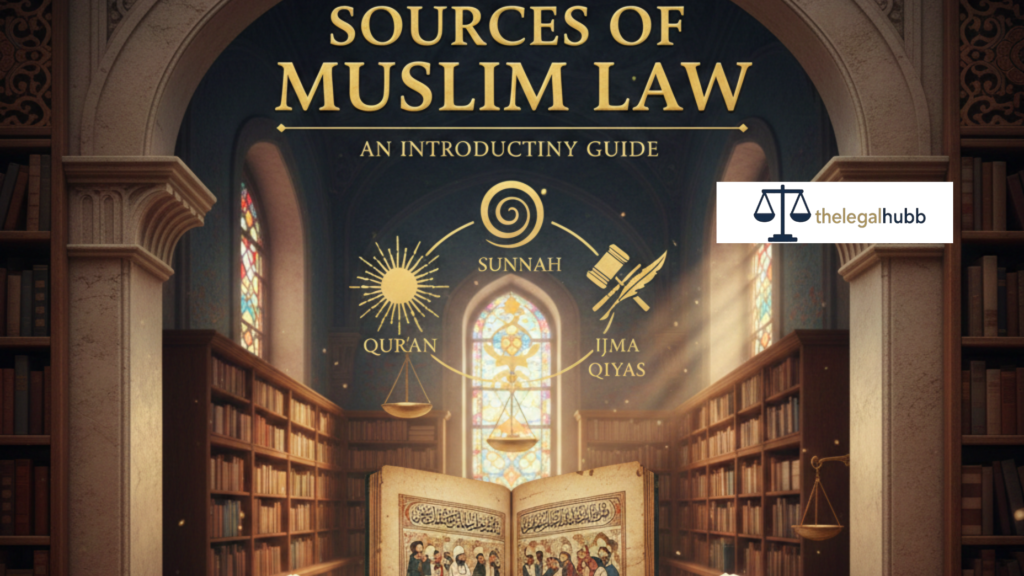
The four universally recognized primary sources are:
- Qur’an
- Sunnah (Hadith)
- Ijma (Consensus)
- Qiyas (Analogical Reasoning)
Each of these sources operates within a hierarchical structure.
1. The Qur’an
The Qur’an is the supreme and primary source of Muslim law. It is regarded as the direct revelation of God to Prophet Muhammad over approximately twenty-three years.
Nature and Authority
The Qur’an is not a code in the modern sense. It contains theological, moral, and legal principles. Only a limited number of verses deal directly with legal matters such as marriage, divorce, inheritance, contracts, and criminal sanctions.
Despite this, it remains the ultimate authority. No rule can contradict its express provisions.
Legislative Character
The Qur’an introduced revolutionary principles in its time, including:
- Recognition of women’s inheritance rights
- Regulation of polygamy
- Protection of orphans
- Ethical commercial conduct
Its authority is absolute. Where the Qur’an provides a clear rule, no juristic reasoning is permissible to override it.
2. Sunnah and Hadith
The Sunnah consists of the practices, sayings, and approvals of Prophet Muhammad. Hadith refers to the recorded narration of those practices and sayings.
Difference Between Qur’an and Sunnah
The Qur’an contains the direct word of God. The Sunnah contains the Prophet’s expressions and actions inspired by divine guidance. Where the Qur’an provides general principles, the Sunnah explains their practical application.
Categories of Sunnah
- Sunnat-ul-Qual (Sayings) – Verbal statements of the Prophet.
- Sunnat-ul-Fail (Conduct) – Actions and behavior of the Prophet.
- Sunnat-ul-Taqrir (Approval) – Silence or implied approval of acts performed in his presence.
Authentication of Hadith
Over time, false traditions emerged. Islamic scholars developed a scientific method to verify authenticity through examination of the chain of transmission (Isnad). Only reliable narrations were accepted as authoritative.
The Sunnah functions as a supplement to the Qur’an and clarifies ambiguous provisions.
3. Ijma (Consensus)
Ijma refers to the unanimous agreement of qualified jurists (Mujtahids) on a legal issue.
Rationale
After the Prophet’s death, no new revelation was possible. Where the Qur’an and Sunnah were silent, jurists collectively determined legal rules.
Ijma ensures stability and uniformity in Islamic law.
Types of Ijma
- Consensus of Companions – Considered highly authoritative.
- Consensus of Jurists – Agreement of scholars of a particular age.
- Consensus of the Community – Accepted mainly in religious practices.
Once validly established, Ijma becomes binding and cannot be easily overturned.
4. Qiyas (Analogical Reasoning)
Qiyas is the process of deriving a legal rule for a new situation by analogy with an existing rule in the Qur’an or Sunnah.
Nature of Qiyas
Qiyas does not create new law. It extends existing principles to new circumstances.
For example, prohibition of wine in the Qur’an is based on intoxication. By analogy, other intoxicants are also prohibited.
Conditions of Valid Qiyas
- The original text must be capable of extension.
- The analogy must not contradict primary sources.
- It must not alter established law.
Although accepted by Sunni schools, Qiyas is considered inferior to textual sources because it relies on human reasoning.
IV. Secondary Sources of Muslim Law
Secondary sources operate where primary sources do not provide explicit guidance.
1. Custom (Urf or Aadat)
Custom plays a supplementary role. A valid custom must:
- Be continuous and certain
- Be reasonable
- Not contradict Qur’anic provisions
The Prophet himself recognized certain pre-Islamic customs that were consistent with Islamic principles.
2. Judicial Precedents
Classical Muslim law did not formally recognize binding precedent in the modern sense. However, contemporary Indian courts apply the doctrine of stare decisis.
Judicial decisions now shape Muslim personal law significantly, particularly in areas of maintenance, divorce, and women’s rights.
3. Legislation
Legislation has played an important role in India. Important statutes include:
- Muslim Personal Law (Shariat) Application Act, 1937
- Dissolution of Muslim Marriages Act, 1939
- Muslim Women (Protection of Rights on Divorce) Act, 1986
- Muslim Women (Protection of Rights on Marriage) Act, 2019
Statutory intervention demonstrates that Muslim personal law operates within constitutional governance.
4. Equity, Justice and Good Conscience
Islamic jurisprudence recognizes equitable principles such as:
- Istihsan (Juristic Preference) – Departure from strict analogy to avoid hardship.
- Istislah (Public Interest) – Law based on societal welfare.
- Istidlal (Inference) – Logical deduction in absence of direct authority.
These doctrines reflect flexibility within the framework of Sharia.
V. Important Judicial Precedents in India
1. Mohd. Ahmed Khan v. Shah Bano Begum (1985)
Facts
Shah Bano, a divorced Muslim woman, sought maintenance under Section 125 of the Criminal Procedure Code. Her husband argued that his obligation ended after the iddat period under Muslim personal law.
Issues
- Does Section 125 CrPC apply to Muslim women?
- Can personal law override secular maintenance law?
Judgment
The Supreme Court held that Section 125 is a secular provision applicable to all citizens. A divorced Muslim woman unable to maintain herself is entitled to maintenance beyond iddat.
Significance
The case affirmed that secular welfare legislation prevails over restrictive interpretations of personal law.
2. Danial Latifi v. Union of India (2001)
Facts
The constitutional validity of the Muslim Women (Protection of Rights on Divorce) Act, 1986 was challenged.
Issue
Whether the Act deprived Muslim women of maintenance rights.
Judgment
The Supreme Court upheld the Act but interpreted “reasonable and fair provision” to include provision for future maintenance. The husband must make a lump-sum arrangement during iddat sufficient for her future needs.
Significance
The judgment harmonized personal law with constitutional guarantees of equality and dignity.
3. Chand Patel v. Bismillah Begum (2008)
Issue
Whether marriage with wife’s sister during subsistence of first marriage is void or irregular.
Judgment
The Supreme Court held such marriage is irregular, not void. Until annulled, the wife is entitled to maintenance under Section 125 CrPC.
Significance
The case clarified the distinction between void and irregular marriages under Muslim law.
4. Shayara Bano v. Union of India (2017)
Issue
Constitutional validity of instant triple talaq.
Judgment
By majority, the Supreme Court declared triple talaq unconstitutional as arbitrary and violative of fundamental rights.
Significance
The case marked a shift toward constitutional scrutiny of personal law practices.
5. Mohd Abdul Samad v. State of Telangana (2024)
Issue
Whether divorced Muslim women can claim maintenance under secular law.
Judgment
The Supreme Court reaffirmed that secular maintenance provisions apply irrespective of religion and are not barred by the 1986 Act.
Significance
The decision reinforced gender justice within the constitutional framework.
VI. Conceptual Distinctions
Sharia
The divine law as revealed in the Qur’an and Sunnah.
Fiqh
Human interpretation and application of Sharia.
Usul al-Fiqh
The principles and methodology used to derive legal rules from primary sources.
Conclusion
The sources of Muslim law reflect a unique synthesis of divine revelation and human reasoning. The Qur’an and Sunnah form the foundation, while Ijma and Qiyas provide interpretative continuity. Secondary sources such as custom, legislation, and judicial decisions ensure adaptability.
In India, Muslim personal law functions within a constitutional framework that emphasizes equality, dignity, and social justice. Judicial interpretation has increasingly harmonized classical doctrines with modern constitutional values.
For law students, mastery of the sources of Muslim law requires understanding not only classical theory but also contemporary judicial application. Muslim law today is not static; it is a living legal tradition interacting continuously with constitutional principles.