
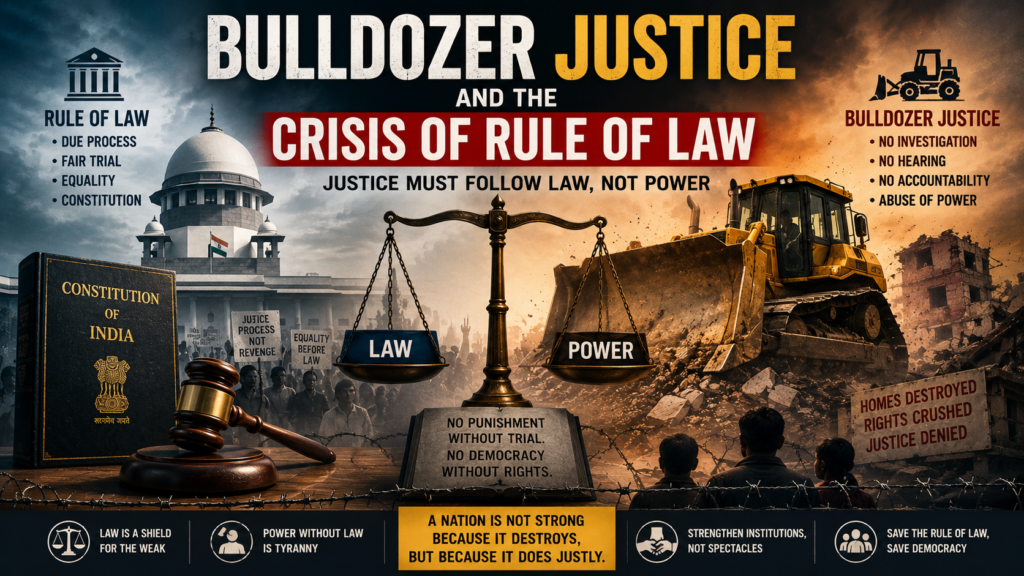
When Justice Becomes a Spectacle
In recent years, the term “bulldozer justice” has become deeply embedded in India’s political vocabulary. Bulldozers, once associated with urban development and construction, are now increasingly projected as symbols of state power and instant punishment. What was earlier viewed as an administrative tool has gradually transformed into a political message — one that equates swift demolition with decisive governance.
The growing public celebration of this model reflects a troubling shift in democratic consciousness. The issue is no longer limited to demolitions themselves; it concerns the larger acceptance of executive actions that bypass legal safeguards in the name of efficiency and public anger.
The Rise of Instant Justice
The popularity of bulldozer action is closely linked to public frustration with the slow pace of the justice system. Courts across India face an enormous backlog of cases, with crores of matters pending for years. Delays in investigation, trial and conviction often create a perception that formal legal procedures are ineffective.
In such an environment, instant action by the state appears attractive. Demolitions carried out immediately after allegations of crime create an image of strong leadership and quick accountability. For many citizens exhausted by delays, this visible assertion of authority appears more satisfying than prolonged judicial proceedings.
However, constitutional democracies are not built on speed alone. They are built on fairness, legality and due process.
Due Process vs Public Popularity
The central problem with bulldozer justice is that it substitutes procedure with spectacle. In many instances, demolitions occur immediately after accusations are made, often before investigations are completed or guilt is legally established.
This creates a dangerous situation where the state effectively assumes the role of:
- Investigator
- Prosecutor
- Judge
- Executioner
Such concentration of power directly contradicts the constitutional principle of separation of powers.
The criminal justice system exists precisely to prevent punishment without trial. If executive authorities begin imposing penalties based on allegations or public sentiment, the distinction between lawful governance and arbitrary power begins to disappear.
The Constitutional Dimension
The Indian Constitution guarantees important protections under Article 14 and Article 21.
- Article 14 ensures equality before law and protection against arbitrary state action.
- Article 21 guarantees that no person can be deprived of life or personal liberty except according to procedure established by law.
Bulldozer actions that bypass procedural safeguards raise serious constitutional concerns because punishment cannot precede adjudication.
The Supreme Court has repeatedly emphasised that due process is an essential part of constitutional governance. The legitimacy of the state depends not only on maintaining order but also on respecting legal procedures.
A Dangerous Normalisation
One of the most worrying aspects of bulldozer justice is its normalisation in public culture. When demolitions are celebrated politically and symbolically, they risk shaping public attitudes toward justice itself.
The image of instant destruction creates the impression that constitutional safeguards are obstacles rather than protections. Over time, this weakens public faith in institutions such as courts, investigations and legal remedies.
It also risks encouraging majoritarian impulses where public outrage becomes a substitute for evidence and judicial determination.
Historical Parallels
The use of demolitions as instruments of state power is not entirely new. During the Emergency period, bulldozers were used in large-scale clearance drives, including in Delhi’s Turkman Gate area. At that time, such actions were widely criticised as examples of state excess and authoritarianism.
What has changed today is not merely the action itself, but its political perception. Measures once viewed with suspicion are now often celebrated as signs of administrative efficiency.
This transformation reflects a broader shift in how power and legality are understood in public discourse.
The Administrative Contradiction
Another important question often goes unanswered: if a building allegedly violates municipal or land laws, why was it allowed to exist in the first place?
Illegal constructions usually emerge because of administrative failure, corruption or regulatory negligence. Selective demolitions after criminal allegations raise concerns about arbitrariness and selective enforcement.
If the purpose of demolition is to enforce municipal law, then the process must follow legal standards consistently for all violators. If it is meant as punishment, then it enters the realm of criminal justice, where due process becomes indispensable.
The Real Solution: Strengthening Institutions
Public frustration with delayed justice is real and legitimate. But the solution does not lie in bypassing institutions; it lies in strengthening them.
India requires:
- More judges and courts
- Faster investigations
- Better prosecution systems
- Modernised judicial infrastructure
- Efficient fast-track mechanisms for serious crimes
Institutional reform may not produce dramatic visuals like bulldozers, but it creates sustainable justice rooted in constitutional principles.
Rule of Law or Rule by Force?
A constitutional democracy derives legitimacy not from the speed of punishment but from the fairness of its processes. The rule of law requires that every person, regardless of accusation, receives legal protection and a fair hearing.
Bulldozer justice may satisfy demands for immediate action, but it risks replacing constitutional governance with executive spectacle. Once due process is weakened for some, its protection becomes uncertain for everyone.
Conclusion
The debate over bulldozer justice is ultimately a debate about the nature of the Indian state itself. Should justice be governed by constitutional procedure or by public anger and executive force?
Democracy is tested not when institutions act against the popular enemy, but when they remain committed to fairness even under pressure.
The state must certainly act firmly against crime. But firmness cannot come at the cost of legality. A society that begins to celebrate punishment without process risks weakening the very foundations of justice it seeks to protect.
In the end, the true strength of the rule of law lies not in the speed of destruction, but in the discipline of restraint and the integrity of procedure.