A Significant Clarification in Bail Law
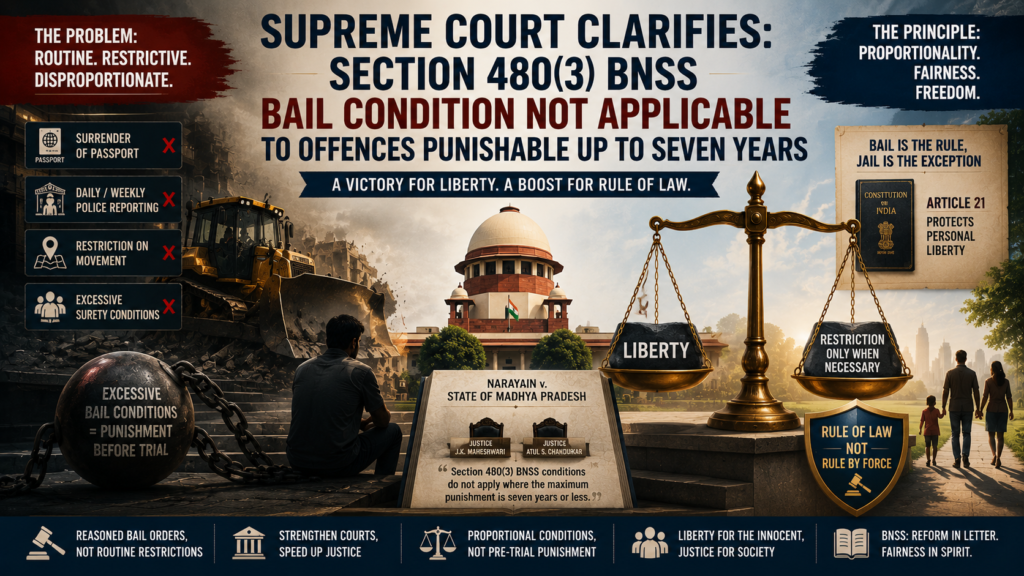
In April 2026, the Supreme Court delivered an important ruling that could reshape how trial courts across India impose bail conditions under the Bharatiya Nagarik Suraksha Sanhita, 2023 (BNSS). In Narayan v. State of Madhya Pradesh, the Court clarified that the mandatory conditions prescribed under Section 480(3) BNSS do not automatically apply to offences punishable with imprisonment up to seven years.
Though seemingly technical, this judgment addresses a larger and deeply significant constitutional issue: the routine curtailment of personal liberty through excessive bail conditions.
At a time when undertrial incarceration remains one of the gravest concerns in India’s criminal justice system, the ruling serves as a reminder that bail conditions cannot become punishment before trial.
Understanding Section 480(3) BNSS
Section 480(3) BNSS corresponds to the old Section 437(3) of the CrPC. It empowers courts to impose certain restrictive conditions while granting bail in serious non-bailable offences.
These conditions typically include:
- Mandatory appearance before court
- Restrictions on committing similar offences
- Non-interference with evidence or witnesses
The key phrase in the provision is:
“offences punishable with imprisonment which may extend to seven years or more.”
The Supreme Court clarified that these mandatory conditions are triggered only where the offence carries punishment extending beyond the prescribed threshold. In offences punishable up to seven years, courts are not bound to impose such stringent restrictions as a matter of routine.
This interpretation may appear straightforward, yet trial courts across the country had been applying these conditions indiscriminately.
The Hidden Punishment of Bail Conditions
One of the most overlooked realities in criminal procedure is that bail conditions themselves can become oppressive.
In many cases, accused persons are required to:
- Report daily or weekly to police stations
- Surrender passports
- Restrict movement outside districts or states
- Furnish excessively high sureties
For an undertrial, these conditions can destroy employment, disrupt family life and damage professional careers even before guilt is established.
An IT professional working abroad may lose employment due to passport surrender. A doctor may miss surgeries or international opportunities. A businessman may be unable to travel for work. In effect, liberty is formally granted but practically denied.
This creates what may be called “jail outside prison walls.”
Bail Is the Rule, Not the Exception
The Supreme Court’s reasoning is firmly rooted in India’s constitutional jurisprudence on personal liberty.
Indian courts have repeatedly emphasised that:
“Bail is the rule and jail is the exception.”
This principle flows from Article 21 of the Constitution, which protects personal liberty. The criminal justice system is founded on the presumption of innocence, meaning that an accused person cannot be treated as guilty before conviction.
The Court has consistently held in landmark judgments that detention before trial should occur only when absolutely necessary, such as:
- Risk of absconding
- Threat to witnesses
- Possibility of tampering with evidence
- Danger to public safety
Routine restrictions without case-specific reasons violate the doctrine of proportionality.
The Problem of Institutional Habit
Despite clear constitutional principles, excessive bail conditions remain common. The judgment indirectly exposes a deeper structural problem within the lower judiciary.
One major reason is institutional caution. Trial judges often fear criticism if an accused person absconds after receiving relaxed bail conditions. As a result, courts impose harsher conditions to shield themselves from institutional scrutiny.
Another factor is the absence of effective challenge. Defence lawyers frequently focus on securing bail itself and may avoid contesting restrictive conditions imposed alongside it.
There is also a continuity problem. Many courts continue to mechanically apply practices inherited from the CrPC era without fully adapting to the framework and interpretation of the BNSS.
Constitutional Proportionality and Liberty
The judgment reflects the constitutional doctrine of proportionality, now central to Indian constitutional law.
Under this doctrine, any restriction on liberty must:
- Be lawful
- Serve a legitimate objective
- Be proportionate to the purpose sought to be achieved
- Impose the least restrictive burden possible
When courts impose conditions mechanically and without reasons, they fail this constitutional test.
The Supreme Court’s ruling therefore goes beyond statutory interpretation. It is fundamentally about preserving constitutional liberty against routine administrative excess.
The Need for Reasoned Bail Orders
An important implication of the judgment is that bail conditions must now be justified with specific reasons.
If a court requires surrender of a passport or regular police reporting, it must explain:
- Why such restrictions are necessary
- What specific risk exists
- Whether there is any prior conduct justifying such measures
Without individualized reasoning, restrictive conditions become arbitrary.
This is essential because judicial discretion cannot become judicial routine.
Reform Beyond the Judgment
The decision also points toward broader reforms needed in India’s criminal justice system.
Judicial Training
Magistrates and trial judges require updated training regarding the interpretation and application of BNSS provisions.
Active Defence Advocacy
Lawyers must begin challenging disproportionate bail conditions at the earliest stage instead of accepting them unquestioningly.
High Court Supervision
High Courts should monitor patterns of excessive bail restrictions imposed by subordinate courts and ensure consistency with constitutional standards.
Humanising Criminal Procedure
Most importantly, courts must recognise that undertrial individuals are not convicts. Bail conditions should secure the presence of the accused, not destroy their lives.
Liberty and the Future of BNSS
The BNSS was introduced as a major reform of India’s criminal procedure framework. However, no procedural reform can succeed unless courts interpret and apply the law in a manner consistent with constitutional values.
The Supreme Court’s judgment is therefore a timely intervention. It reminds trial courts that liberty cannot be curtailed merely because it is administratively convenient.
The purpose of bail is not to impose silent punishment but to balance investigation with constitutional freedom.
Conclusion
The Supreme Court’s clarification on Section 480(3) BNSS is more than a technical ruling—it is a reaffirmation of the constitutional commitment to personal liberty.
In a criminal justice system burdened by delays, overcrowded prisons and a massive undertrial population, routine and excessive bail conditions risk turning the process itself into punishment.
The judgment sends a clear message:
Courts must stop treating restrictive bail conditions as default practice. Liberty can only be limited when genuinely necessary, and every restriction must be justified, proportionate and lawful.
A constitutional democracy is measured not by how easily it restricts freedom, but by how carefully it protects it.