
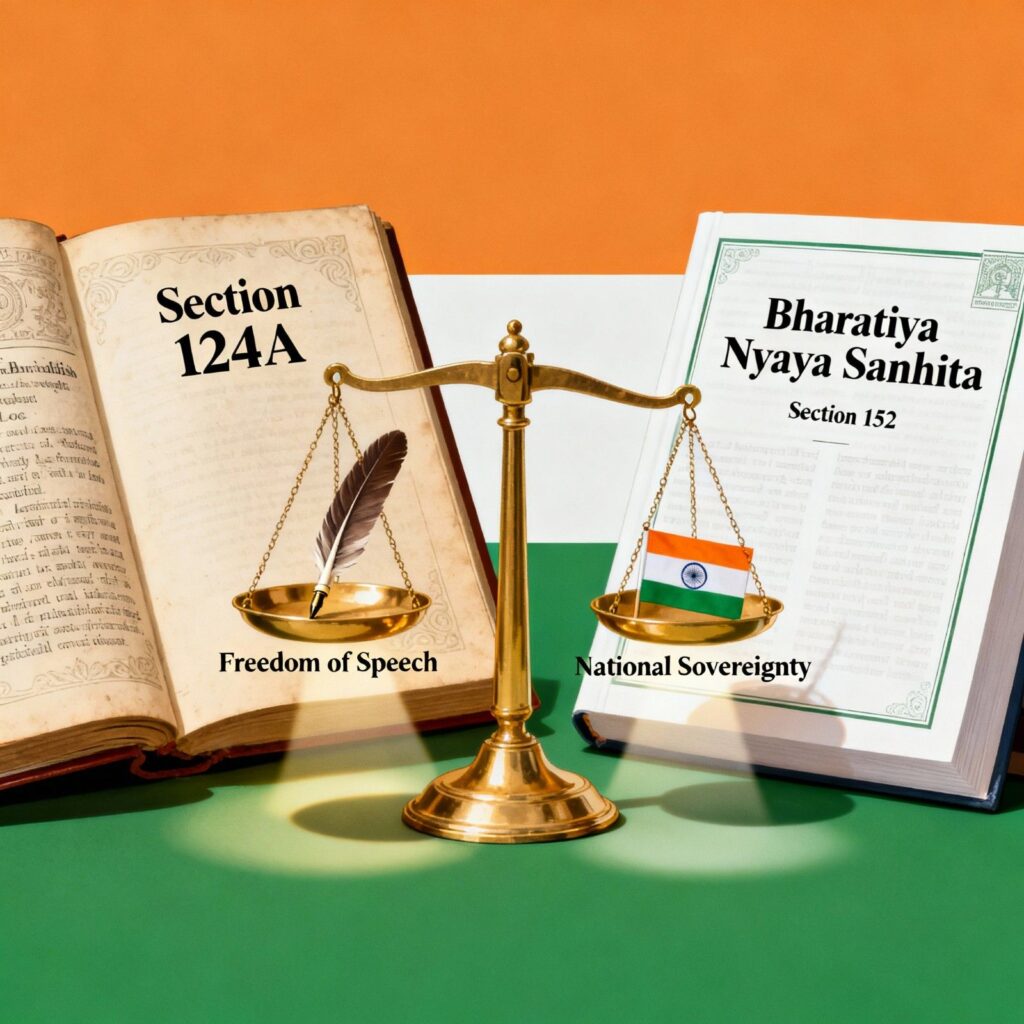
India’s transition from the colonial-era sedition law under Section 124A of the Indian Penal Code (IPC) to the sweeping “sovereignty” provision in Section 152 of the Bharatiya Nyaya Sanhita (BNS) is more than linguistic revision. It signals a shift in our fundamental conception of national security, state authority, and civil liberties—but also stirs new anxieties about the boundaries of dissent. Let’s explore this legal evolution through layered, reader-friendly subheadings.
The Colonial Roots of Sedition Law
Section 124A of the IPC—introduced in 1870 by British administrators—was designed as a shield for colonial rule, punishing anyone who brought “hatred, contempt, or disaffection” towards the government. This broad phrasing was wielded not just against incitement to revolt, but also against passionate criticism and public activism, ensnaring figures like Gandhi and Tilak. Through decades, the scars of this law ran deep in India’s legal and political culture.
Constitutional Challenges and Changing Judicial Attitudes
After Independence, Section 124A quickly became a flashpoint for debate. Was it compatible with the right to free speech under Article 19(1)(a) of the Constitution? The Supreme Court in Kedar Nath Singh v. State of Bihar (1962) narrowed its use, declaring that only acts inciting violence or public disorder would count as sedition. Nevertheless, in practice, law enforcement often invoked sedition for criticism or protests, leading to allegations that the law chilled democracy.
From Section 124A to Section 152: The New Paradigm
Under the Bharatiya Nyaya Sanhita, Section 124A is gone—a symbolic break with colonial baggage. In its place, Section 152 targets acts that endanger the “sovereignty, unity, and integrity of India.” The language is modernized: mere criticism or dissent is protected, unless it “purposely or knowingly” incites secession, armed rebellion, or subversive activities. Now, the law specifically covers electronic and financial means as potential tools for these offences, reflecting new technological realities.
What Really Changes? And What Doesn’t?
Section 152 of the BNS offers, on paper, clearer protection for robust criticism and lawful dissent. No longer should a sharp editorial or protest slogan bring a charge of sedition. At the same time, the law’s ambiguous references to “subversive activities” and “attempts at separatism” worry civil rights advocates, who fear these could serve as new catch-alls for stifling free expression. The punishments are also stricter—life imprisonment or up to seven years—underscoring the seriousness with which the State approaches threats to unity.
The Ongoing Legal and Democratic Battle
Legal scholars, journalists, and many in civil society see Section 152 as a glass half-full, half-empty. Its success will depend not just on text but on interpretation: Can the courts carve out strong safeguards so legitimate dissent is not suppressed? Or will vague language once again become a tool to silence uncomfortable speech under the guise of national security? The first cases under BNS, and upcoming Supreme Court scrutiny, will be crucial in revealing the true impact of this legal overhaul.
India’s journey from Section 124A to Section 152 is both a step forward and a cautionary tale. The protection of sovereignty and integrity must not come at the expense of free expression—the very foundation of our democracy. As this new chapter unfolds, vigilance from citizens, the press, and the judiciary will remain the nation’s best safeguard.