
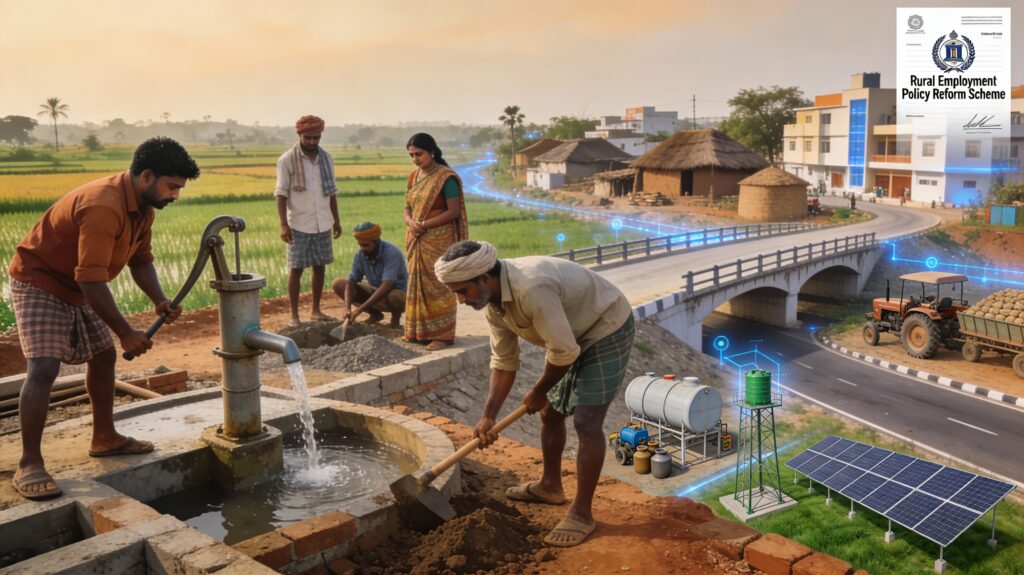
The Government of India introduced a landmark legislative overhaul on December 16, 2025, when the Viksit Bharat – Guarantee for Rozgar and Ajeevika Mission (Gramin) (VB-GRAMG) Bill was tabled in the Lok Sabha. This proposed legislation seeks to fundamentally reshape two decades of rural employment policy by replacing the Mahatma Gandhi National Rural Employment Guarantee Act (MGNREGA), 2005, with a modernised statutory framework aligned with India’s long-term development vision of Viksit Bharat @2047. While the Bill promises enhanced employment guarantees and transformative infrastructure creation, it simultaneously triggers intense debate about the nature of rural entitlements, federalism, and workers’ rights in contemporary India.newsonair+1
From MGNREGA to VB-GRAMG: The Philosophical Shift
The MGNREGA, enacted in 2005, established a revolutionary principle in Indian labour law: rural households possessed a statutory right to demand work. This demand-driven employment guarantee meant that any rural adult willing to undertake unskilled manual labour could claim 100 days of work annually, with unemployment allowances payable if employment was not provided within 15 days. The scheme represented a constitutional commitment to livelihood security in rural India, serving as a critical social safety net during economic downturns and natural disasters.pib+1
The VB-GRAMG Bill does not merely enhance this existing framework; it introduces a distinctly different philosophical foundation. Rather than positioning employment as a universal right, the new legislation frames public employment as a development tool integrated into broader infrastructure creation objectives. Rural Development Minister Shivraj Singh Chouhan articulated this reorientation, emphasising that the new Bill advances the government’s vision of building a prosperous and resilient rural Bharat through “empowerment, growth, convergence and saturation” rather than solely addressing livelihood security.indiatoday+2
Key Provisions: Enhancement or Transformation?
Enhanced Employment Guarantee
On the surface, the Bill appears expansionary. The guaranteed days of employment increase from 100 to 125 days per financial year per rural household—a 25 percent enhancement. However, this apparent expansion must be contextualised against implementation realities. Official data reveals that despite MGNREGA’s statutory guarantee of 100 days, rural households actually received only 50.35 days of employment annually over the past five years. This implementation gap raises critical questions about whether a higher statutory ceiling translates into meaningful livelihood improvement when actual delivery has historically fallen short by approximately 50 percent.indiatoday+2
Four Thematic Verticals and Asset-Focused Work
The Bill narrows the scope of permissible works to four carefully defined verticals: water security, core rural infrastructure, livelihood-related assets, and climate resilience and disaster preparedness. Under MGNREGA, panchayats enjoyed considerable flexibility in identifying works responsive to immediate community needs. The VB-GRAMG’s thematic prioritisation represents a significant centralisation of work selection, ensuring that public works align with national infrastructure frameworks while potentially limiting responsiveness to local priorities outside these categories.newsonair+2
All works undertaken will be aggregated into the Viksit Bharat National Rural Infrastructure Stack (VB-NRIS), creating a unified national framework for rural public works. This approach reflects the government’s conviction that employment generation must simultaneously create durable, productive assets aligned with long-term development objectives rather than serving primarily as temporary income support.newsonair
Planning Through Viksit Gram Panchayat Plans (VGPPs)
The Bill retains gram panchayats as primary planning institutions but subordinates their planning to a hierarchical integration system. Gram panchayats will prepare Viksit Gram Panchayat Plans (VGPPs), which will be consolidated at block, district, and state levels, and ultimately integrated with the PM Gati Shakti National Master Plan. While this promises better coordination and alignment with national spatial planning, critics argue it fundamentally alters local governance autonomy, transforming panchayats from autonomous planning bodies into implementers of centrally-determined frameworks.indiatoday+2
Agricultural Season Pause
Recognising the historical tension between public employment schemes and agricultural labour availability during peak seasons, the Bill empowers state governments to notify periods aggregating to 60 days annually when works will not be undertaken. This provision attempts to address farmer concerns about wage inflation and labour scarcity during critical sowing and harvesting periods. However, critics argue that a mandatory 60-day work pause could disproportionately affect tribal and marginalised communities whose livelihoods depend on accessing employment during agricultural lean seasons.downtoearth+2
Funding Restructuring: The Controversial 60:40 Division
Perhaps the most contentious provision concerns the revised funding architecture. Under MGNREGA, the Central Government bore the entire cost of unskilled wages and 75 percent of material costs, with states contributing the remaining 25 percent. The VB-GRAMG Bill shifts to a Centrally Sponsored Scheme model with a 60:40 funding split between Centre and states for most states, with a more favourable 90:10 split reserved for northeastern, Himalayan states, and Union Territories.prsindia+1
This fundamental restructuring has triggered substantial opposition. Leader of Opposition Rahul Gandhi characterised the shift as undermining MGNREGA’s core principle of full Central funding for wages, warning that “once funds run out, or during harvest season, workers will be denied employment for months.” More fundamentally, the Bill stipulates that any state expenditure exceeding the centrally-determined “normative allocation” will be the state government’s responsibility. This creates a fiscal ceiling that could constrain employment opportunities, particularly in poorer states receiving adverse allocations.business-standard+2
The Centrality Question: Selective Coverage and Universal Rights
Perhaps the most troubling provision from a rights perspective concerns geographic coverage. Under MGNREGA, the employment guarantee applies universally to all rural areas by default. The VB-GRAMG Bill fundamentally alters this by empowering the Central Government to determine “the state government shall in such rural areas in the state as may be notified by the Central Government” provide employment.indianexpress
This selective notification mechanism effectively converts a universal legal entitlement into a discretionary scheme. Workers in rural areas not notified by the Centre may possess no legal right to employment under the scheme, even during periods of acute distress. Legal scholar and rights activist Nikhil Dey, co-author of prominent critiques, argues that this provision “demolishes the idea of a universal entitlement across rural India.”boomlive+1
Implementation Gaps and Credibility Concerns
The implementation record under MGNREGA provides sobering context for evaluating VB-GRAMG’s promises. Despite twenty years of MGNREGA operations and consistent political commitment, the actual employment provided to rural households has chronically fallen short of statutory guarantees. This gap raises legitimate questions about whether enhanced statutory promises under VB-GRAMG can be operationalised given persistent structural constraints.
State governments’ willingness to contribute 40 percent of scheme costs under a centrally-controlled framework represents another credibility challenge. Critics argue that states lacking ideological alignment with Central policies, particularly opposition-ruled states, may prove reluctant to fund schemes where all controls lie with the Centre. This potential politicisation of scheme coverage could fragment rural employment opportunities along partisan lines.indianexpress+1
Supporting Arguments: Modernisation and Development Focus
The government’s rationale for legislative replacement merits serious consideration. Official backgrounders acknowledge MGNREGA’s achievements over two decades while arguing that the rural economy has fundamentally transformed. Indicators including declining poverty rates, increased financial inclusion, expanded rural connectivity, and diversified livelihood sources suggest that an open-ended demand-driven model designed for 2005’s rural challenges may require recalibration for 2025’s realities.pib
The Bill’s emphasis on asset creation appeals to development economists who argue that temporary income support, while valuable, cannot generate sustainable rural prosperity without simultaneous infrastructure development. Stronger water systems, improved rural roads, better storage facilities, and climate-resilient structures create lasting foundations for rural livelihoods beyond temporary wage employment.moneycontrol+1
The technology-enabled governance framework—featuring biometric authentication, geospatial planning, mobile dashboards, and weekly public disclosure systems—represents a genuine modernisation attempt addressing longstanding transparency and accountability challenges in rural employment programmes.prsindia+2
Critical Concerns: Rights Erosion and Centralisation
Despite modernisation rhetoric, scholars and labour rights organisations raise fundamental constitutional concerns. The National Rural Employment Guarantee Scheme Sangharsh Morcha, a coalition of labour organisations and activists, characterises the Bill as “granting excessive discretionary power to the central government,” with Section 5(1)’s selective notification power standing as the primary mechanism through which this discretion operates.downtoearth
This concern transcends narrow policy debates about scheme architecture. The right to work represents a constitutional principle rooted in Articles 39(a) and 41 of the Indian Constitution, which commit the state to providing work within its economic capacity to all citizens unable to earn their livelihood. Converting this constitutional commitment into a selectively notified scheme backed by budget allocations rather than statutory entitlement arguably represents a regression in constitutional labour protection.indianexpress+1
The Bill also raises federalism concerns. While framed as promoting “cooperative federalism,” the 60:40 funding split coupled with Central determination of work categories and planning frameworks effectively subordinates state governance autonomy to Central bureaucratic decisions. States must notify implementation schemes within six months but operate within a tightly prescribed normative allocation framework.nextias
The Implementation Question: From 100 to 125 Days
The centrepiece claim—that workers will receive 125 days of employment annually—confronts a formidable empirical challenge. If MGNREGA’s 100-day guarantee yielded only 50 days of actual employment, the VB-GRAMG’s 125-day promise must address why structural constraints that prevented MGNREGA’s full implementation will not similarly limit the new scheme.indiatoday
Potential factors constraining implementation include administrative capacity limitations, fund availability, work planning constraints, and seasonal factors. The 60-day mandatory pause during agricultural seasons effectively reduces the theoretical 125-day guarantee to 65 potential working days outside peak seasons—a modest improvement over MGNREGA’s already-unfulfilled 100-day promise when accounting for agricultural pauses.indiatoday
Parliamentary Opposition and Constitutional Questions
The Bill’s introduction triggered immediate parliamentary opposition from Congress leadership. Priyanka Gandhi questioned the necessity of removing Mahatma Gandhi’s name from the scheme, while party general secretary Jairam Ramesh demanded the Bill’s referral to a Parliamentary Standing Committee for detailed scrutiny, emphasising that “such far-reaching legislation requires deep study and wide consultations.” The Labour and allied movements, through organisations like the All India Kisan Sabha, issued statements calling for the Bill’s comprehensive rejection.timesofindia.indiatimes+2
This opposition transcends partisan politics. Legal and social science experts express genuine concern that replacing a constitutionally-grounded rights framework with a budgeted, centrally-controlled scheme represents a problematic precedent for other social entitlements.boomlive+1
Conclusion: Development Without Rights or Rights-Based Development?
The VB-GRAMG Bill represents a defining moment in Indian rural development policy, forcing society to articulate whether rural employment should function primarily as a constitutional right or as a development instrument. The government argues these objectives can be simultaneously achieved through enhanced guarantees and asset creation. Critics contend that subordinating employment entitlements to central planning frameworks and budget allocations inevitably undermines rights protections, particularly for marginalised communities historically dependent on demand-driven schemes.
The Bill’s fate in Parliament will reveal contemporary political consensus regarding rural India’s entitlements. Whether MGNREGA’s demand-driven, rights-based framework represents an outdated model requiring modernisation, or whether its erosion signals constitutional regression, will shape India’s rural social contract for decades ahead. Rather than rhetorical competition between “development” and “rights,” the legislative process would benefit from genuine engagement with whether reformed MGNREGA could simultaneously address modernisation imperatives while preserving the constitutional guarantees that have protected rural livelihoods for two decades.
References
Government of India, Ministry of Rural Development (2025). Viksit Bharat – Guarantee for Rozgar and Ajeevika Mission (Gramin) Bill, 2025.newsonair
India Today, “VB-G RAM G Bill vs MGNREGA: 5 big changes explained” (December 16, 2025).indiatoday
PRS Legislative Research, “Bill Summary – Viksit Bharat GRamG Bill, 2025” (December 16, 2025).pib
News18, “‘Aligning Rural Development With Viksit Bharat’: What Are the Key Features?” (December 14, 2025).prsindia
Government of India, PIB, “BACKGROUNDER: Viksit Bharat – Guarantee for Rozgar and Ajeevika Mission (Gramin) Bill, 2025” (December 16, 2025).prsindia
NextIAS, “Viksit Bharat – Guarantee for Rozgar and Ajeevika Mission (Gramin) Bill” (December 15, 2025).nextias
Nikhil Dey and Aruna Roy, “VB-G RAM G Bill annihilates MGNREGA and undermines rural India’s right to work,” Indian Express (December 15, 2025).indianexpress
Times of India, “Rural jobs scheme: MGNREGA to be replaced by VB–G RAM G—What it is and what changes” (December 14, 2025).timesofindia.indiatimes
Business Standard, “40% cost on states under VB-G RAM G Bill to weaken rural employment security,” citing Rahul Gandhi (December 15, 2025).business-standard
Times of India, “MGNREGA renaming row: New VB-G RAM G Bill sparks opposition backlash” (December 14, 2025).timesofindia.indiatimes
Boom Live, “Will The Bill Replacing MGNREGA End Rural India’s Right To Work?” (December 15, 2025).boomlive
Moneycontrol, “From MNREGA to VB–G RAM G: Why the government is changing the rural jobs model” (December 14, 2025).moneycontrol
All India Kisan Sabha (AIKS), “Scrap the VB-G-RAM-G Bill 2025” (December 15, 2025).kisansabha
Down to Earth, “New wage programme set to replace MGNREGA: No longer demand-driven, critics warn” (December 14, 2025).downtoearth
Morung Express, “Rethinking Rural Job Guarantees in a Changing India” (December 15, 2025).morungexpress
India Today, “Will VB-G RAM G miss 125-day rural work target?” (December 15, 2025).indiatoday
- https://www.newsonair.gov.in/government-introduces-viksit-bharat-guarantee-for-rozgar-and-ajeevika-mission-gramin-bill-2025-in-lok-sabha/
- https://www.indiatoday.in/india/story/new-bill-mgnrega-vs-vb-gram-g-bill-mahatma-gandhi-main-points-difference-explained-2837181-2025-12-17
- https://static.pib.gov.in/WriteReadData/specificdocs/documents/2025/dec/doc20251216733301.pdf
- https://prsindia.org/files/bills_acts/bills_parliament/2025/Viksit_Bharat%E2%80%93Guarantee_for_Rozgar_and_Ajeevika_Mission_(Gramin)_VB%E2%80%93G_RAM_G_Bill,2025.pdf
- https://www.indiatoday.in/amp/india/story/mgnrega-revamp-increase-guaranteed-rural-employment-vbgramg-bill-parliament-2837000-2025-12-16
- https://www.downtoearth.org.in/governance/new-wage-programme-set-to-replace-mgnrega-no-longer-demand-driven-critics-warn
- https://prsindia.org/files/bills_acts/bills_parliament/2025/Summary-Viksit_Bharat_GRamG_Bill_2025.pdf
- https://www.business-standard.com/economy/news/vb-gramg-mgnrega-rahul-gandhi-state-funding-rural-employment-125121600848_1.html
- https://www.morungexpress.com/rethinking-rural-job-guarantees-in-a-changing-india
- https://indianexpress.com/article/opinion/columns/vb-g-ram-g-bill-annihilates-mgnrega-right-to-work-10421788/
- https://www.boomlive.in/explainers/will-the-bill-replacing-mgnrega-end-rural-indias-right-to-work-30276
- https://www.moneycontrol.com/news/economy/policy/from-mnrega-to-vb-g-ram-g-why-the-government-is-changing-the-rural-jobs-model-and-how-it-will-work-13725830.html/amp
- https://www.nextias.com/ca/current-affairs/16-12-2025/viksit-bharat-rozgar-ajeevika-bill
- https://timesofindia.indiatimes.com/india/rural-jobs-scheme-mnrega-set-to-replaced-by-vbg-ram-g-what-it-is-and-what-changes/articleshow/125974086.cms
- https://timesofindia.indiatimes.com/india/mgnrega-renaming-row-new-vb-g-ram-g-bill-sparks-opposition-backlash-kharge-flags-proposal-part-of-bjp-rss-conspiracy/articleshow/125980477.cms
- https://kisansabha.org/aiks/press-releases/resist-conspiracy-to-scrap-mgnrega-scrap-the-vb-g-ram-g-bill-2025/
- https://www.news18.com/india/new-rural-employment-scheme-g-ram-g-bill-viksit-bharat-features-replacing-mgnrega-ws-l-9771489.html
- https://forumias.com/blog/vb-g-ram-g-bill-provisions-significance-explained-pointwise/
- https://www.pib.gov.in/PressNoteDetails.aspx?id=156553&NoteId=156553&ModuleId=3®=3&lang=1
- https://www.gktoday.in/viksit-bharat-guarantee-for-rozgar-and-ajeevika-mission-gramin-bill-to-replace-mgnrega/