Introduction to Computer Networks
A computer network is a system in which two or more computers or digital devices are interconnected to share data, resources, and information. Networking enables communication between users, facilitates resource sharing such as printers and storage, and allows access to centralized data and services. In the modern digital world, computer networks form the backbone of communication, business operations, governance, education, and cyber infrastructure.
A network operates through a combination of hardware components like computers, cables, routers, and switches, and software components such as network operating systems and protocols. The primary objective of networking is to ensure fast, reliable, and secure communication between connected devices.
Basic Components of a Computer Network
A computer network consists of nodes, transmission media, and networking devices. Nodes include computers, servers, and mobile devices that participate in communication. Transmission media may be wired, such as twisted pair cables and optical fiber, or wireless, such as radio waves and microwaves. Networking devices like hubs, switches, routers, and modems manage data transmission and connectivity. Network software and protocols define the rules governing data exchange.
Meaning and Concept of the Internet
The Internet is a global system of interconnected computer networks that enables worldwide communication and information exchange. It connects millions of private, public, academic, business, and government networks using standardized communication protocols. The Internet allows users to access services such as websites, emails, file sharing, online banking, e-commerce, social networking, and cloud computing.
Unlike a single network, the Internet is a “network of networks.” It has no central ownership and operates through cooperation among Internet service providers, governments, and organizations across the world.
How the Internet Works
The Internet works by breaking data into small units called packets. These packets travel through different networks and routers to reach their destination, where they are reassembled. Communication over the Internet is governed by protocols such as TCP/IP, which ensure reliable data transmission and correct addressing. Each device connected to the Internet is identified by a unique IP address, which helps route data accurately.
Relationship Between Networks and the Internet
A computer network can exist independently within a limited area, such as an office or campus. The Internet, however, connects multiple such networks globally. In simple terms, all internets are networks, but not all networks are part of the Internet. When a private network is connected to the global infrastructure using an Internet service provider, it becomes part of the Internet.
Types of Networks
Local Area Network (LAN)
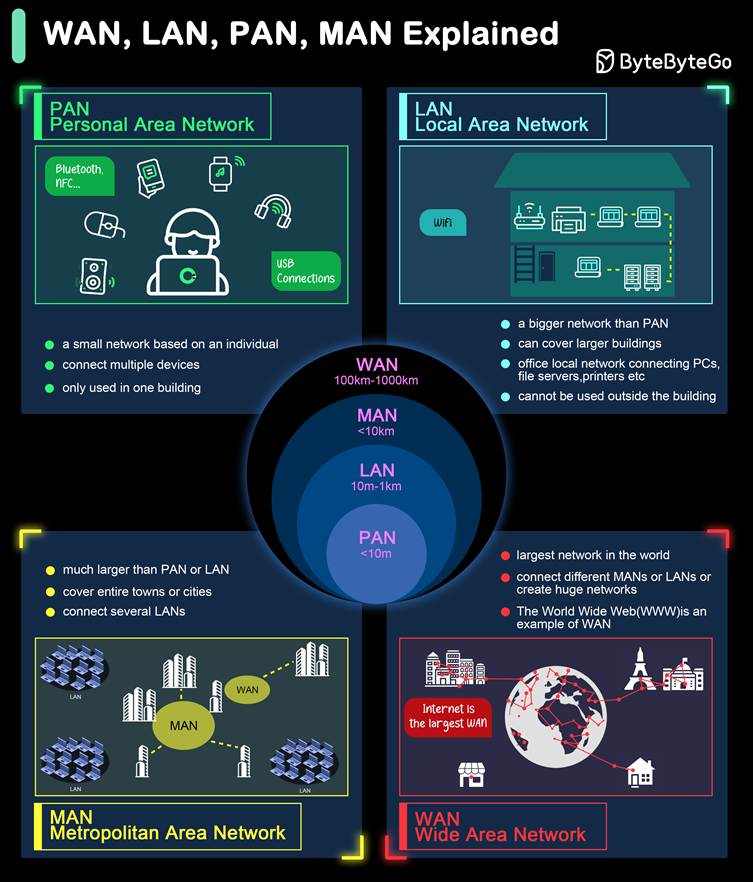
A Local Area Network is a network that covers a small geographical area such as a room, building, office, or campus. LANs are commonly used in schools, colleges, offices, and homes. They provide high-speed data transfer and allow sharing of resources like printers and files. LANs are usually owned and managed by a single organization or individual, making them more secure and easier to control.
Metropolitan Area Network (MAN)
A Metropolitan Area Network covers a larger geographical area than a LAN, typically a city or town. It connects multiple LANs within an urban region. MANs are often used by government bodies, universities, and large organizations to connect offices across a city. Compared to LANs, MANs have moderate speed and are more complex to manage.
Wide Area Network (WAN)
A Wide Area Network spans a large geographical area, such as a country or continent. WANs connect multiple LANs and MANs over long distances using leased lines, satellites, or undersea cables. The Internet itself is the largest example of a WAN. WANs are essential for multinational organizations, banks, and communication networks but involve higher costs and complex security challenges.
Personal Area Network (PAN)
A Personal Area Network is a small network centered around an individual. It connects personal devices such as smartphones, laptops, smartwatches, and wireless earphones. PANs usually operate over short distances using technologies like Bluetooth or infrared and are commonly used for personal data sharing and device synchronization.
Wireless Networks
Wireless networks use radio waves instead of physical cables to connect devices. Wi-Fi networks are common examples used in homes, offices, and public places. Wireless networks provide mobility and flexibility but may face security risks and signal interference if not properly managed.
Client–Server Network
In a client–server network, a central server provides resources and services to multiple client computers. The server manages data, security, and access control. This type of network is commonly used in organizations where centralized control and data management are required.
Peer-to-Peer Network
In a peer-to-peer network, all computers have equal status and can share resources directly with each other without a central server. This type of network is simple to set up and is suitable for small networks but lacks centralized security and management.