
By Kaviya Kannan K
Assistant Professor of Law, The Central Law College, Salem, Tamil Nadu
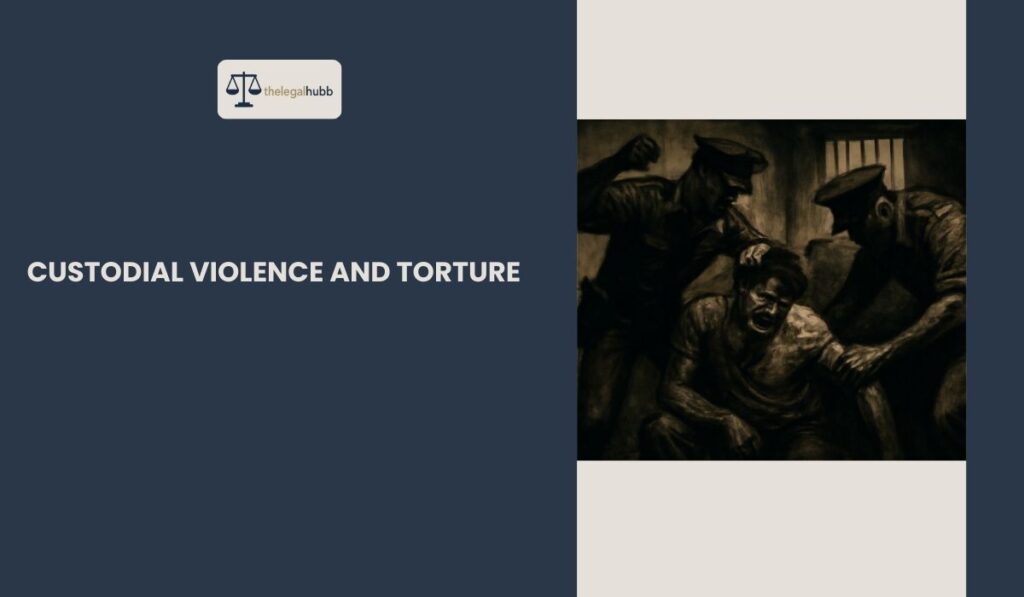
The Silent Epidemic Behind Closed Doors
Imagine being stripped of your dignity, your body subjected to unthinkable pain, and your mind scarred forever, all while being held by those sworn to protect you. This isn’t a scene from a dystopian novel; it’s the harsh reality of custodial violence in India, where torture has become an alarmingly common practice in spaces hidden from public view. Torture represents one of the most heinous violations of basic human rights, leaving deep wounds not just on individuals but on entire families and communities. While international law and the UN Convention against Torture guarantee everyone the fundamental right to be free from such treatment, the reality on the ground tells a different story.
India’s Paradoxical Position on Torture
Here’s a troubling contradiction: India signed the Convention against Torture and Other Cruel, Inhuman or Degrading Treatment or Punishment in 1984, yet never ratified it. It’s like agreeing to the rules of a game but never actually committing to play by them. Despite Article 22 of the Indian Constitution protecting citizens from illegal and arbitrary arrest and detention, and the establishment of the National Human Rights Commission (NHRC) as a symbol of India’s commitment to human rights, custodial torture continues to flourish in the shadows
The Numbers Don’t Lie
The statistics paint a grim picture that should shake us to our core:
- 1,303 people died or disappeared in police custody between 2005 and 2017
- In 2018, Gujarat and Tamil Nadu topped the charts with 14 and 12 custodial deaths respectively
- By 2019, the number had risen to 117 deaths in police custody
- According to data shared by the Ministry of Home Affairs with the Lok Sabha, there were 2,152 deaths in judicial custody and 155 in police custody in 2021–22 alone. Despite these alarming figures, disciplinary action was taken in only 21 cases in five years, with zero prosecutions.
These aren’t just numbers, they represent lives lost, families destroyed, and justice denied.
When Protectors Become Predators
The NHRC recognized early on that custodial torture was among the worst human rights violations. In response, they mandated that District Magistrates and Superintendents of Police report custodial deaths within 24 hours and required video documentation of post-mortems. But why was such an instruction necessary? Because there was a conscious effort to hide the truth. Law enforcement agencies began to see themselves as above the law—as outlaws who could use any unconventional method to get results. This mindset transformation is perhaps the most dangerous aspect of the entire crisis.
The Legislative Graveyard
India’s attempts at addressing this crisis have been half-hearted at best. Two bills aimed at preventing custodial torture were introduced in 2010 and 2017, but both were allowed to lapse. It’s as if the government acknowledged the problem with one hand while letting solutions slip through the other.
Why This Matters More Than Ever
The Contemporary Issue
Custodial Horror in Sivagangai man Ajith Kumar’s death raises chilling parallels with Sathankulam Police brutality continues to haunt Tamil Nadu, with the custodial death of Ajith Kumar surfacing as a grim reminder of the Sathankulam tragedy.
The Marginalized Bear the Heaviest Burden
Those from marginalized communities and lower socioeconomic backgrounds face double jeopardy. Not only are they more likely to experience custodial violence, but they also have limited access to legal aid, counselling, and support when it happens. They’re fighting a battle with one hand tied behind their backs.
Colonial Hangover in Modern India
The root of this problem traces back to the Police Act of 1861—a colonial legacy designed to suppress rather than serve. As one expert noted, “The feudal legacy left by the British… has almost become ingrained in the DNA of the police in India.” After decades of independence, isn’t it time we broke free from this oppressive inheritance?
Recent Shocking Cases
The dismissal of IPS officer Balveer Singh in Tamil Nadu in March 2023 for allegedly pulling suspects’ teeth and crushing testicles during interrogation shows that this isn’t just a problem of the past—it’s happening right now, in our modern, democratic India.
A Global Shame
This isn’t just an Indian problem. The United States faced international criticism for torture at Guantanamo Bay, and tragic deaths like those of George Floyd, Michael Brown, Breonna Taylor, and Eric Garner highlight that custodial violence is a global epidemic. But that doesn’t excuse our failures—it should motivate us to do better.
What Research Tells Us
International legal expert Nigel Rodley emphasizes that torture prohibition is non-derogable under all human rights treaties—meaning it cannot be suspended under any circumstances. The UN Committee against Torture has clear mechanisms to investigate systematic torture, yet these remain underutilized.
Recent studies suggest solutions like:
- Establishing grievance cells and complaint boards
- Removing immunity for officials suspected of torture
- Creating special courts for torture cases
- Implementing comprehensive police reform
The Critical Research Gap
Here’s what most studies miss: the gap between legal provisions and actual implementation. We have laws on paper, but they’re not translating into protection on the ground. There’s also a stunning lack of public awareness about existing protections.
Most importantly, there’s insufficient research on:
- Proper investigation and punishment of perpetrators
- Legitimate sanctions for torturers
- Compensation and rehabilitation for victims
- The intersection of national and international law in addressing custodial torture
The Path Forward
The solution isn’t just about creating new laws—we have enough of those gathering dust. It’s about:
- Accountability: Ensuring that those who torture face real consequences
- Training: Comprehensive human rights education for all law enforcement
- Transparency: Open, monitored processes for arrests and detention
- Support: Robust legal aid and counselling for victims
- Cultural Change: Moving from a colonial mindset to a service-oriented approach
A Call to Conscience
Every custodial death, every act of torture, every moment of preventable suffering is a stain on our collective conscience. The D.K. Basu v. State of West Bengal case in 1997 called for transparency and accountability in the system. More than 25 years later, we’re still waiting. The question isn’t whether we can afford to address custodial violence—it’s whether we can afford not to. In a democracy that prides itself on being the world’s largest, how can we allow our protectors to become predators? The time for half-measures and lapsed legislation is over. The time for genuine, sustained reform is now. Because until every person in custody is safe from torture, none of us are truly free.
References
- National Human Rights Commission of India https://nhrc.nic.in/ (Last Visited 20th August 25)
- National Crime Records Bureau https://ncrb.gov.in/ (Last Visited 20th August 25)
- National Crime Records Bureau https://ncrb.gov.in/ (Last Visited 20th August 25)
- National Crime Records Bureau https://ncrb.gov.in/ (Last Visited 20th August 25)
- Suribabu & Majji, Bail sine qua non prevention of custodial torture a socio legal study, 302-342, (2022) https://hdl.handle.net/10603/381232
- Sharma & Prakriti Bhanwarlal, Torture A,nd Custodial Deaths Role of The Indian Judiciary And National Rights Commission In Building Human Rights Jurisprudence, 766-781, (2016) https://hdl.handle.net/10603/89148
- Custodial horror in Sivagangai Ajith Kumar’s death raises chilling parallels with Sathankulam https://cjp.org.in/ (Last Visited 20th August 25)
- Vijay.V.Muradande, Police torture a critical analysis from human rights perspective, 302-313, (2018) https://hdl.handle.net/10603/441234
- Murders Passed Off As Deaths https://www.thehansindia.com/ (Last Visited 20th August 25)



“Honestly, you put into words exactly what I’ve been thinking. Spot on”