
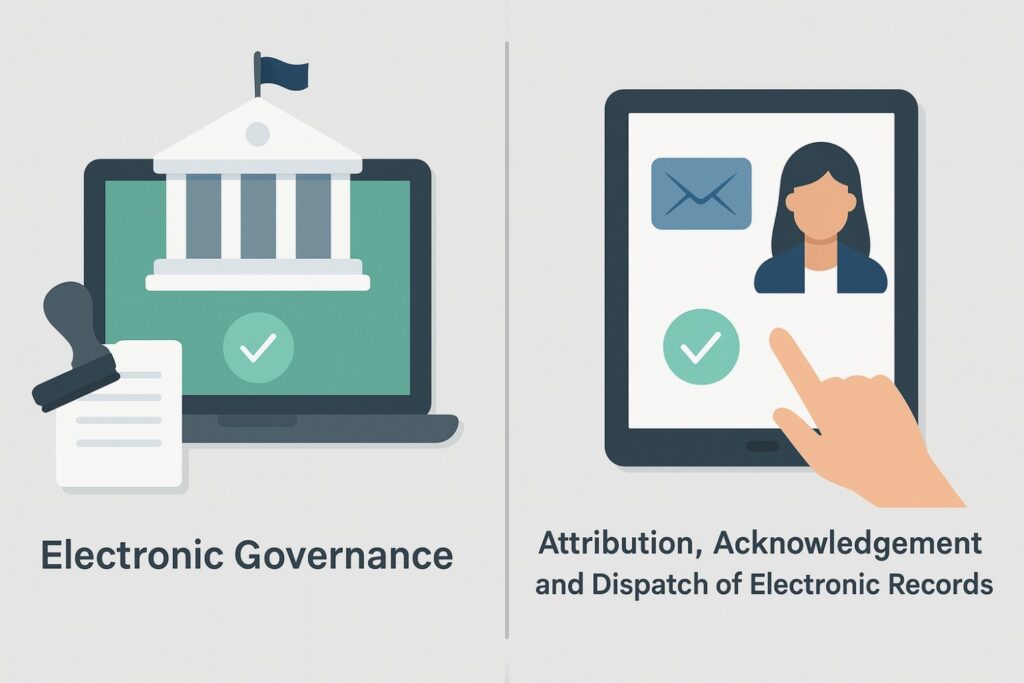
Electronic Governance
Electronic governance, or e-governance, under the Information Technology Act, 2000 represents a significant shift from traditional paper-based administration to a legally recognized digital system of governance. The Act gives full legal validity to electronic records and digital/electronic signatures, allowing government departments to receive, accept, store, and process documents electronically. This enables citizens to file applications, send notices, submit forms, make payments, and receive approvals without physically visiting government offices. In essence, the Act removes the legal barriers that once required written documents, physical signatures, and manual filing.
E-governance enhances transparency, efficiency, accountability, and accessibility within public administration. For example, online income tax filing, digital land record systems, e-courts, online RTI submissions, and digital certificates issued by authorities are all made possible by these provisions. The Act also allows government bodies to issue licences, notifications, and permits electronically, making digital communication a legally recognized mode of government operation. This framework encourages faster decision-making, reduces corruption, minimizes delays, and promotes citizen-friendly governance by integrating technology into administrative processes.
Attribution, Acknowledgement and Dispatch of Electronic Records
The IT Act also lays down important rules governing how electronic records are identified, communicated, and legally recognized in the course of transactions. These rules bring clarity to issues that arise when documents no longer exist in physical form but are transmitted electronically.
Attribution of an electronic record refers to identifying who is responsible for creating or sending a particular electronic record. The Act states that an electronic record is attributed to the originator if they sent it themselves, if it was sent by an authorized person on their behalf, or if it was sent using an automated system programmed by the originator. This provision ensures legal certainty in electronic communication, especially in commercial contracts where it is essential to determine who sent a particular offer, acceptance, or notice.
Acknowledgement of receipt addresses the question of when the recipient has legally received an electronic record. An acknowledgement may be given through an automated response, a manually sent message, or inferred from the recipient’s conduct — for example, when they act on the message without formally acknowledging it. The Act allows parties to specify their own rules for acknowledgement, giving flexibility in electronic dealings. This provision ensures that communication is not treated as legally complete until receipt is confirmed or reasonably inferred.
Dispatch and receipt of electronic records determine when an electronic record is considered sent and when it is deemed received. Under the Act, dispatch occurs when the electronic record leaves the originator’s control and enters a computer resource that is not under their control. Receipt, on the other hand, occurs when the record enters the recipient’s designated computer system. If no system is designated, receipt occurs when the record first enters any computer system of the recipient. These rules are essential in determining when contractual obligations take effect, when deadlines are met, and when notices are considered served.
Together, these principles create a predictable legal structure for electronic communication, ensuring that electronic transactions enjoy the same certainty, enforceability, and clarity as traditional paper-based communications.