
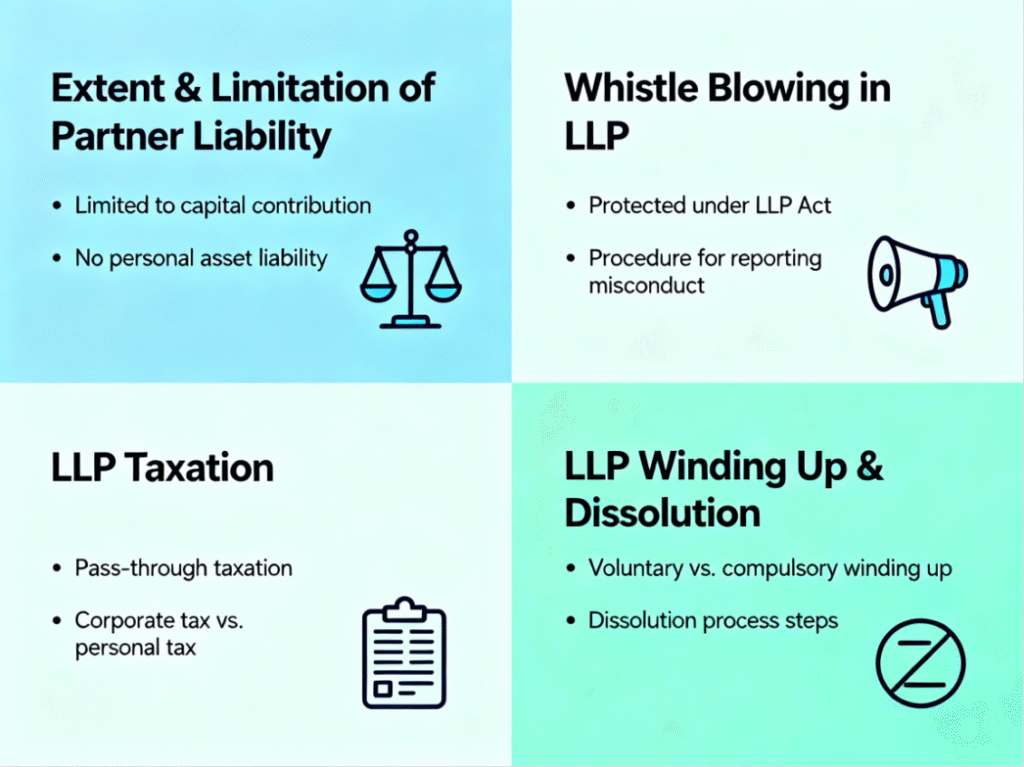
Extent and Limitation of Liability of LLP and Partners
A defining feature of a Limited Liability Partnership (LLP) is the limited liability protection it provides to both the entity and its partners. The LLP, being a body corporate under the LLP Act, 2008, is liable for its obligations to the extent of its assets. Partners, in turn, are not personally liable for the debts or obligations of the LLP merely by virtue of being a partner. This shield of limited liability is central to the LLP’s appeal, especially for professionals and entrepreneurs.
However, this limitation is not absolute. A partner’s liability is limited only to the extent of their agreed contribution, which may be in the form of cash, property, or services. Importantly, the LLP itself is fully liable for any liabilities incurred during the course of business. While a partner is not an agent of other partners, they are considered agents of the LLP. Therefore, the LLP is vicariously liable for acts done by any partner in the course of the LLP’s business or with its authority.
The limitation is overridden in cases involving fraud, willful misconduct, or acts beyond authority. As per Section 30 of the LLP Act, if a partner acts with the intent to defraud creditors or for any fraudulent purpose, their liability becomes unlimited for all debts and obligations arising from such conduct. The LLP itself also becomes liable unless it proves that such conduct was without its knowledge or authority. Thus, while the general rule protects partners from personal liability, the law ensures that such protection is not misused to commit fraud or evade accountability.
Whistle Blowing
The concept of whistle blowing under the LLP framework is an important safeguard against internal misconduct and fraud. Section 31 of the LLP Act provides that any partner or employee of an LLP may report fraudulent or unlawful activities of the LLP or its partners to the appropriate authority. This provision is designed to encourage internal stakeholders to come forward and disclose wrongdoing without fear of retaliation.
To make this mechanism meaningful, the law provides certain protections. A whistle blower is safeguarded against discharge, demotion, suspension, threats, harassment, or discrimination merely because they provided information about violations. Additionally, the Courts and Tribunals may reduce or waive penalties against a partner or employee if they make full disclosure and cooperate in investigations relating to the misconduct.
The whistle-blowing mechanism strengthens internal accountability within LLPs and is especially important in contexts involving financial mismanagement, regulatory violations, or unethical professional practices. By embedding this principle within the statute, the LLP Act aligns itself with broader corporate governance ideals, encouraging transparency and ethical conduct.
Taxation of LLP
LLPs are taxed as partnership firms under the Income Tax Act, 1961, and not as companies. This provides significant advantages over the corporate tax regime. The profits of an LLP are taxed only once, at the LLP level, and the share of profit received by partners is exempt in their hands. This avoids the problem of double taxation, which is common in companies where profits are taxed at the corporate level and again when distributed as dividends to shareholders.
The current income tax rate for LLPs is the flat rate applicable to partnership firms, which is 30% plus applicable surcharge and cess, depending on the level of income. LLPs are not subject to Dividend Distribution Tax (DDT), nor do they suffer Minimum Alternate Tax (MAT), which applies to companies. Moreover, LLPs can claim deductions for remuneration and interest paid to partners, subject to statutory limits under Section 40(b) of the Income Tax Act.
However, LLPs are not eligible for certain start-up incentives and tax exemptions available to private companies, particularly those recognized under Start-up India. Also, LLPs must comply with tax audit requirements if their turnover exceeds the prescribed limit (currently ₹1 crore for business, ₹50 lakhs for professionals), and they must file returns like any other taxable entity.
Overall, the taxation of LLPs is simple, efficient, and cost-effective, making it a preferred form for many small and medium-sized enterprises and professional firms.
Winding Up and Dissolution of LLP
Winding up and dissolution refer to the legal process by which an LLP ceases to exist. It may occur either voluntarily or through the intervention of a Tribunal. Voluntary winding up happens when the partners mutually decide to close the LLP, usually due to cessation of business, financial difficulties, or fulfillment of the LLP’s purpose. The LLP must file a declaration of solvency, stating that it can pay its debts in full within a period not exceeding one year from the commencement of winding up. A resolution must be passed by at least three-fourths of the partners, followed by appointment of a liquidator to carry out the process.
On the other hand, the Tribunal (NCLT) may order winding up under specific circumstances, such as if the LLP has acted against the sovereignty and integrity of India, failed to file annual returns or financial statements for five consecutive years, or if it is just and equitable to wind it up. In such cases, the Central Government, the Registrar, or any creditor or partner may file a petition for winding up. Once the winding up is complete, a formal application for dissolution is submitted, and the LLP stands struck off from the register.
The winding up process includes settling debts, disposing of assets, repaying creditors, and distributing surplus (if any) among partners. Throughout the process, the designated partners and liquidator must ensure compliance with statutory obligations, including filings and public notices. Once the dissolution is confirmed, the LLP loses its legal status and ceases to exist as a corporate body.
This structured process ensures that the LLP is closed in a transparent, lawful, and creditor-friendly manner, balancing the interests of all stakeholders.