
Written by Himanshu Sharma, student of BALLB (Hons.) with specialisation in Criminal Law, currently in 9th semester at KR Mangalam University
Introduction
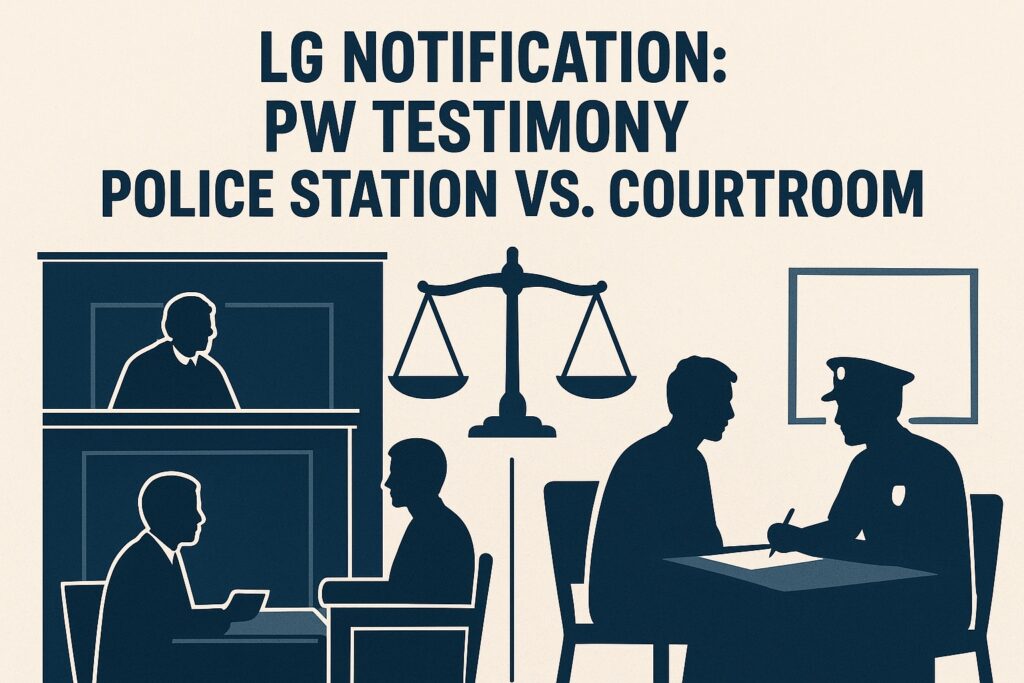
On August 13,2025, the Lieutenant Governor of Delhi, VK Saxena issued a notification under Section 265(3) of the Bharatiya Nagarik Suraksha Sanhita, 2023 (BNSS).The notification declared all 226 police stations in Delhi as “designated places” where police personnel can give testimony in court through video conferencing.
At first glance, this appears to be a forward looking initiative in line with digital reforms aimed at saving time and improving efficiency. However, this seemingly modern measure has raised serious concerns among lawyers, judges, and cicil society. The Key question is: Can administrative convenience justify changes that may impact the accused’s right to a fair trial?
This article examines the legal framework, the concerns raised, and possible solutions that balance efficiency with justice.
The Legal Framework
Section 265(3) of BNSS allows witnesses to give testimony through electronic means at designated places as notifiedby the State Government.
The stated objectives of this notification are:
i. To save time for police officers burdened with court appearances.
ii. To reduce delays in trial processes.
iii. To improve prosecution efficiency.
Earlier, the Delhi High Court had set procedures for recording evidence electronically in certain secure facilities such as prisons and forensic departments. The LG’s order now expands this practice to all police stations in Delhi, significantly altering how trials are conducted.
Why This Notification Matters
Police officers often spend entire days waiting in courtrooms, which disruptstheir investigative work. From an administrative perspective, reducing this burden is a much needed reform. Additionally, proponents argue that timely testimony could lead to faster case resolutions and higher conviction rates.
However, criminal trials are not merely about administrative efficiency- They are judicial processes built on fairness, transparency, and accountability. Shifting testimony to police controlled environments may blur the lines between the executive and judicial branches, potentially weakening safeguards designed to protect the accused.
Concerns from the Legal Community
Leading bar associations such as the Supreme Court Advocates-on-Record Association (SCAORA), Supreme Court Bar Association (SCBA), and Delhi High Court Bar Association (DHCBA), have strongly opposed the notification.
Theirmain concerns include:
1. The Open court Principle
Courtrooms are designed to ensure judicial supervision and public transparency. Police stations, controlled by the executive branch, lack such openness and impartial oversight.
2. Risk of Manipulation
Testimonies recorded in police stations might be influenced by the environment or improper pressures, reducing the effectiveness of cross-examinations—a vital tool for uncovering the truth.
3. The Right of the Accused
Cross-examining prosecution witnesses, particularly police officers, is a fundamental aspect of the defense. Curtailing this right undermines the accused’s constitutional protections under Article 21, which guarantees the right to life and personal liberty.
4. Lack of Consultation
The notification was issued without engaging judicial authorities or legal bodies. Such unilateral action risks disrupting the delicate balance between state institutions.
As one advocate pointed out, “This is not about our interests—it’s about protecting the common citizen on trial, who deserves a fair chance to prove innocence.”
Legal Community’s Response and Government Engagement
The notification’s implications quickly resonated beyond courtroom discussions, prompting a strong, organized response from the legal fraternity. On 27 August 2025, the Coordination Committee of all District Court Bar Associations unanimously resolved to protest the notification by abstaining from work and conducting public demonstrations. Legal bodies, including the Rohini Court Bar Association, emphasized that the notification threatened citizens’ fundamental right to access justice and called for widespread awareness.
The protests soon drew the attention of the Union Government. A series of meetings were held with senior ministers, including Union Home Minister Shri Amit Shah, who assured that the notification would not be implemented without hearing all stakeholders. Written communications from the Office of the Commissioner of Police confirmed that no steps would be taken without due consideration of the concerns raised by the legal fraternity.
However, conflicting circulars issued later added uncertainty, further intensifying protests and calls for indefinite abstention from court proceedings. These developments reveal how deeply the notification has unsettled judicial independence and public trust, underscoring the urgent need for reforms that are transparent, consultative, and rooted in constitutional safeguards.
The Judicial Perspective
While judges are cautious in making public statements, the underlying concern is evident. Courtrooms symbolize neutrality, where evidence is tested in an environment free from institutional influence. Any shift toward testimony in police-controlled locations could compromise this neutrality and, by extension, public trust in the justice system.
The judiciary’s stance is clear: speed and efficiency should never compromise fairness and justice.
The Police Perspective
Police officials, unsurprisingly, welcome the order. They highlight how much time is lost in travel and court appearances—often costing an entire day of investigative work.
From their viewpoint:
•The notification offers much-needed administrative relief.
•Faster proceedings may improve case disposal rates.
•Reducing procedural delays could lead to better prosecution outcomes.
However, this reflects a classic conflict between executive efficiency and judicial fairness—a tension that must be carefully managed to prevent one from undermining the other.
A Possible Middle Path
Recognizing both the need for efficiency and the importance of fairness, the Delhi Police Headquarters proposed a cautious approach in a communication dated September 4, 2025:
1. Allow testimony through video conferencing only for formal witnesses, such as officers testifying on procedural matters.
2. Require material witnesses—those directly involved in the case—to appear physically in court.
3. Empower trial judges to order physical appearances if requested by the defense. This approach, if implemented with proper safeguards, could balance the need for efficiency with the protection of constitutional rights
Best Practices for Implementation
To ensure that reforms strengthen rather than weaken justice, the following safeguards could be considered:
•Testimonies should be recorded in the presence of judicial or neutral monitors.
• Proceedings must be fully recorded and accessible for review.
•Cross-examination via secure channels should be permitted in real time.
•Infrastructure and access issues, especially in marginalized communities, must be addressed.
•Consultation with the judiciary, bar associations, and civil society must be mandatory before policy changes.
Conclusion
The LG’s notification represents both an opportunity and a challenge. It reflects an urgent need to modernize procedures but raises serious concerns about trial fairness, judicial independence, and constitutional protections.
Efficiency is welcome—but it must serve justice, not override it. Reforms of this scale require dialogue, transparency, and accountability. Justice cannot be reduced to administrative convenience. The law must always protect those whose liberty is at stake.
Technology can enhance the judicial process—but only if applied thoughtfully, with safeguards that preserve fairness, dignity, and public trust.


Well written, raises the right questions about convenience vs. transparency.