Written by Prashant Panwar
Introduction
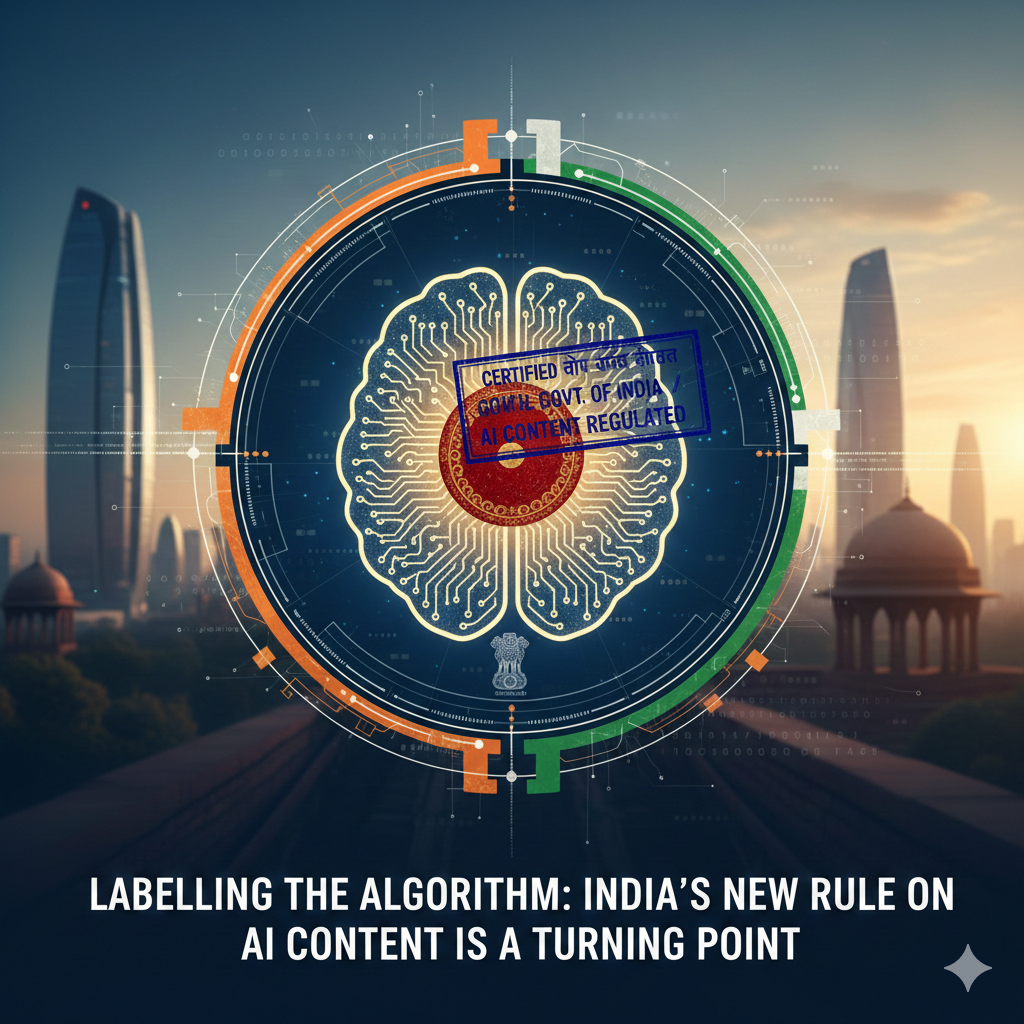
From 20 February 2026, India’s digital ecosystem will enter a new regulatory phase. The Union Government’s amendment to the Information Technology (Intermediary Guidelines and Digital Media Ethics Code) Rules mandates clear labelling of photorealistic AI-generated content and drastically shortens takedown timelines for deepfakes and unlawful synthetic media.
At first glance, the reform appears technical — another compliance layer for platforms. In substance, however, it represents India’s most direct legal intervention into the age of artificial intelligence.
The Deepfake Moment
The proliferation of photorealistic AI content has blurred the line between fabrication and reality. Deepfake pornography, political misinformation, identity manipulation and financial scams have exposed a regulatory vacuum. The law traditionally addressed speech, defamation and obscenity; it did not anticipate a world where anyone could manufacture a convincing video of a public figure within minutes.
The amended rules now define “synthetic content” as artificially or algorithmically generated audio, visual or audio-visual material that appears authentic and is indistinguishable from reality. Importantly, the definition is narrower than earlier drafts — a deliberate move to avoid constitutional overreach and vagueness.
The target is deception, not creativity.
Transparency as Regulation
The most notable feature is the mandatory labelling requirement. Platforms that allow users to create or share synthetic content must ensure clear and prominent disclosure. AI-generated photorealistic media must not circulate anonymously as “real.”
This marks a subtle but powerful shift. India is not banning AI-generated expression; it is demanding transparency. The state is effectively saying: innovate, but disclose.
Unlike the European Union’s system-based classification under its AI Act, India has adopted a content-centric model. Instead of categorising AI systems as high-risk, it regulates the output when it mimics reality deceptively. It is a harm-focused rather than architecture-focused approach.
The Three-Hour Rule
More controversial is the compression of takedown timelines. Content declared unlawful by government or court must be removed within three hours. Non-consensual nudity and deepfakes must be taken down within two hours.
This is among the shortest compliance windows globally.
The message is unmistakable: when reputational harm and dignity are at stake, delay is damage. In the age of viral dissemination, 24 hours can permanently alter a person’s life. The state has chosen urgency over procedural elasticity.
Yet this acceleration raises difficult questions. Can platforms realistically verify authenticity, assess legality and act proportionately within such compressed timelines? Or will the pressure incentivise over-censorship and algorithmic over-removal to preserve safe harbour protection under Section 79 of the Information Technology Act?
Safe Harbour Under Stress
India’s intermediary liability regime rests on conditional immunity. Platforms are not publishers — but only so long as they comply with due diligence obligations. The amended rules make that condition sharper.
Non-compliance may cost platforms their safe harbour shield. That exposure fundamentally changes risk calculations for digital intermediaries. Content moderation will no longer be merely reputational management; it will be liability management.
This is regulatory hardening in action.
Constitutional Crossroads
Every speech regulation in India must pass the Article 19 test. Freedom of speech is protected under Article 19(1)(a), subject to reasonable restrictions under Article 19(2). Deepfakes implicate defamation, decency, morality and public order — legitimate constitutional grounds.
But proportionality remains key. The Supreme Court’s jurisprudence has consistently insisted that restrictions must be narrowly tailored and procedurally fair. The narrower definition of synthetic content and the carve-out for routine smartphone enhancements suggest that the government has attempted to avoid excessive breadth.
The success of the amendment will depend less on the text and more on implementation. Transparency without arbitrary enforcement will be its constitutional safeguard.
Progressive or Protective?
For years, India’s AI posture has been innovation-first. Policy documents celebrated economic growth, access and efficiency. Binding obligations were minimal. This amendment signals an inflection point.
India is moving — cautiously but decisively — toward a protective model in the specific domain of synthetic media. It is not yet a comprehensive AI statute. It does not regulate AI systems structurally. But it recognises that algorithmic deception is not a neutral technological by-product; it is a governance challenge.
In comparative perspective, the EU regulates systems; the US relies on sectoral and market-driven checks; China embeds AI governance within state control. India is charting a hybrid path — innovation-friendly but increasingly interventionist when digital harm becomes visible.
The Road Ahead
Labelling alone will not end misinformation. Takedown timelines will not eliminate deepfake abuse. But the amendment establishes a foundational principle: realism generated by machines must carry accountability.
The deeper challenge lies ahead. As AI integrates into justice systems, governance tools and legal services, India will need a coherent framework that balances acceleration with responsibility. Today’s labelling rule is an incremental step. Tomorrow’s debate will be about systemic regulation.
In the digital republic, authenticity is no longer assumed. It must now be declared.
And that declaration, however modest it may seem, marks the beginning of India’s serious encounter with AI governance.