
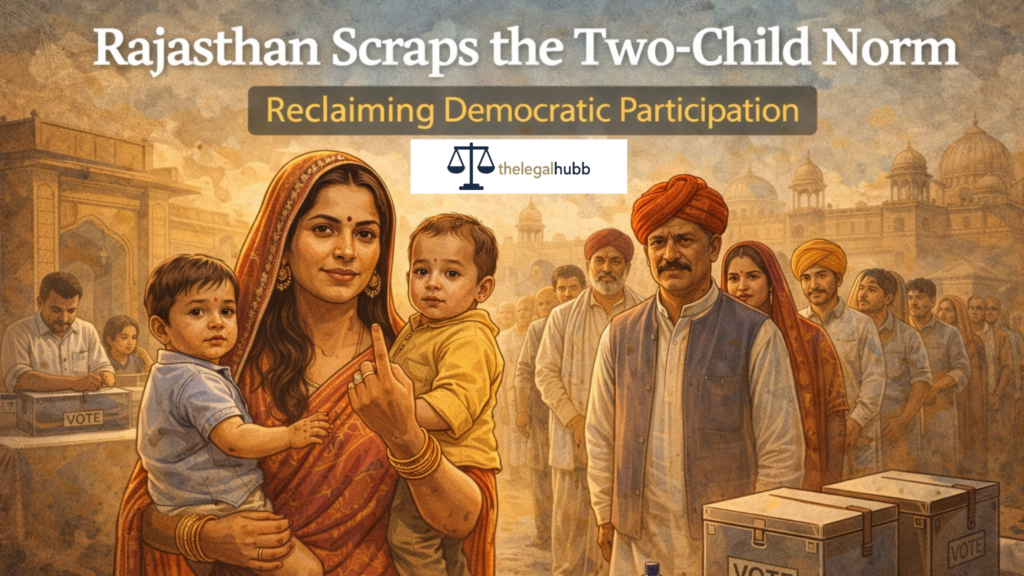
A Policy That Outlived Its Context
After nearly three decades, Rajasthan has decided to remove the two-child norm that disqualified individuals with more than two children from contesting panchayat and urban local body elections. Introduced in the mid-1990s as a population control measure, the restriction reflected the demographic anxieties of its time. India was then grappling with high fertility rates and rapid population growth. Policy responses across several states included eligibility restrictions tied to family size.
However, demographic realities have since evolved. Fertility rates have declined significantly, approaching replacement levels in many parts of the country. Rajasthan’s decision acknowledges this shift. What was once seen as a tool for population stabilisation now appears misaligned with contemporary socio-economic realities.
The repeal, therefore, is not merely administrative. It represents a recalibration of public policy in light of changing evidence.
Democracy and Conditional Representation
The two-child norm operated as a condition on democratic participation. It did not prevent citizens from voting, but it barred certain individuals from contesting local elections. In doing so, it created a linkage between personal reproductive choices and eligibility for public office.
At one level, the measure was justified as a legitimate public policy aimed at promoting smaller families. Yet, it also raised difficult constitutional questions. Should eligibility for local self-government be contingent on family size? Does such a condition disproportionately affect certain socio-economic groups?
Evidence from various states suggested that the norm often had unintended consequences. Reports indicated instances where women were pressured into unsafe abortions, concealment of children or even abandonment, in order to preserve political eligibility. In some cases, the burden of compliance fell disproportionately on women, reinforcing gender inequities.
Public policy that seeks to influence personal decisions must weigh outcomes carefully against rights and dignity.
Panchayati Raj and the Spirit of Decentralisation
The 73rd Constitutional Amendment institutionalised Panchayati Raj Institutions as vehicles of grassroots democracy. It envisioned inclusive representation, periodic elections and decentralised governance. Local bodies were meant to empower communities and strengthen participatory democracy.
Imposing disqualifications based on family size complicated this vision. While states retain authority to prescribe qualifications and disqualifications for local elections, such provisions must align with constitutional values of equality and participation.
By scrapping the two-child norm, Rajasthan appears to be restoring the emphasis on democratic inclusion. Local governance thrives when participation is broad and representative rather than conditional and exclusionary.
Population Policy: Coercion or Incentives?
Population stabilisation remains an important developmental objective. However, the methods employed to achieve it matter. Coercive or punitive measures often produce distortions. In contrast, evidence globally suggests that improvements in education, women’s empowerment, healthcare access and economic security naturally reduce fertility rates.
India’s demographic transition has largely followed this trajectory. Rising literacy levels, greater female workforce participation and improved public health infrastructure have contributed to declining fertility rates without heavy-handed enforcement mechanisms.
In this context, continuing a punitive electoral disqualification appears increasingly redundant. Policy coherence demands that demographic strategies align with current data and social progress.
Gendered Consequences
One of the most significant criticisms of the two-child norm concerned its gender impact. Women aspiring to public office faced particular vulnerability. Decisions regarding childbirth are rarely individual in rural settings; they are shaped by familial and social pressures. When eligibility for elections became contingent on family size, women bore the consequences of decisions often beyond their control.
Furthermore, the norm sometimes clashed with the broader objective of enhancing women’s participation in local governance. With constitutional provisions already reserving one-third of seats for women in Panchayats, disqualifying candidates on reproductive grounds created a contradictory policy environment.
The repeal may therefore contribute to a more enabling atmosphere for women’s political participation.
Electoral Politics and Policy Timing
The timing of the decision, ahead of civic polls, adds a political dimension. Electoral reforms often intersect with political calculations. However, policy motivations do not automatically invalidate policy merit. The key question is whether the reform aligns with constitutional principles and contemporary needs.
On balance, removing a three-decade-old disqualification rooted in outdated demographic assumptions appears consistent with evolving governance priorities.
The Broader Lesson
Rajasthan’s move invites a broader national reflection. Several states had adopted similar norms during the 1990s and early 2000s. As India advances further into demographic transition, policymakers must reassess whether such provisions serve any meaningful purpose today.
Democracy functions best when eligibility criteria are limited to essential qualifications such as age, citizenship and integrity, rather than private family choices. The legitimacy of local governance depends on inclusiveness and fairness.
Conclusion: Restoring Participation
The scrapping of the two-child norm marks a shift from demographic anxiety to democratic confidence. It recognises that social progress and voluntary behavioural change are more sustainable than coercive conditions tied to political rights.
Local self-government is the foundation of India’s democratic architecture. Ensuring that access to it remains broad and equitable strengthens not only Panchayati Raj Institutions but also the larger constitutional promise of participatory governance.
In recalibrating an outdated restriction, Rajasthan has reaffirmed a simple principle: democracy should expand opportunity, not restrict it