A Rare and Stern Judicial Intervention
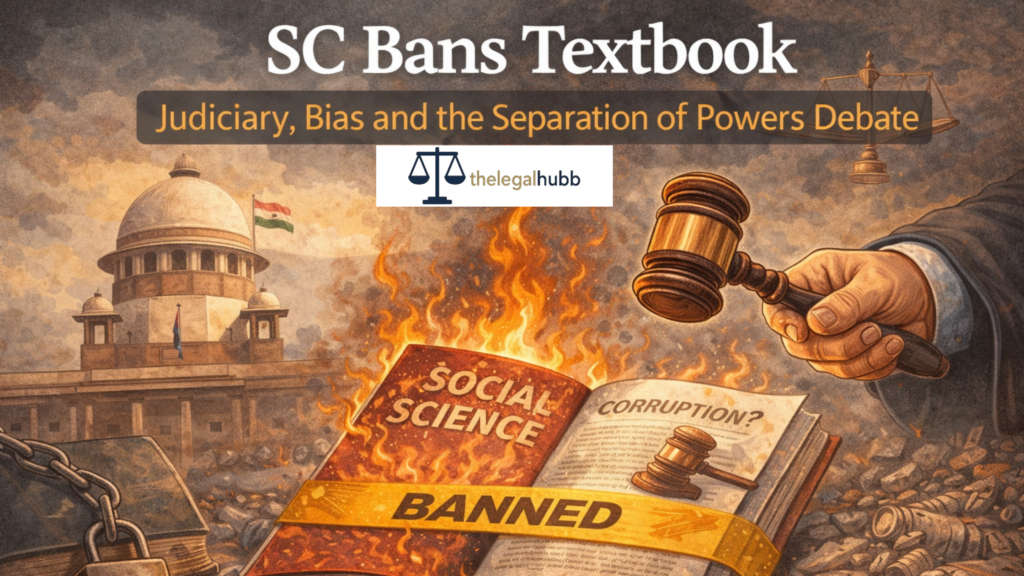
In a significant and unusual move, the Supreme Court ordered a complete ban and seizure of a Class 8 social science textbook that, according to the Bench, portrayed the judiciary in a biased and misleading manner. The Court described the episode as a “very, very calculated move” and even suggested the possibility of a “deep-rooted conspiracy” behind the selective references made about corruption in the judiciary.
The textbook, published by the National Council of Educational Research and Training (NCERT), reportedly included content that the Court believed could instil prejudice against the judiciary in the “impressionable minds” of young students. The Bench made it clear that the issue was not merely about inaccurate content but about the manner and intent behind its presentation.
The order was sweeping. The Court directed a blanket ban on the book and immediate seizure and sealing of every copy, both physical and digital.
Contempt Proceedings and Institutional Dignity
The Court did not stop at banning the textbook. It initiated contempt proceedings and indicated that responsibility must be fixed. The Chief Justice remarked that “heads must roll” if accountability was not established. The government, through the Solicitor General, offered an unconditional and unqualified apology, acknowledging the seriousness of the issue.
However, the Bench made it clear that the matter could not be brushed aside with an apology alone. The Court emphasised that as the head of the judiciary, it was its duty to probe deeper and determine how such content came to be included in a school textbook.
The underlying concern was institutional integrity. The judiciary’s legitimacy rests heavily on public confidence. If educational material projects the institution as corrupt or compromised without proper context, it risks eroding trust at a formative stage in citizens’ lives.
The Question of Separation of Powers
The controversy also revives the broader constitutional principle of separation of powers. India does not follow a rigid separation as seen in some other constitutional systems, but it adopts a framework of checks and balances. The Constitution delineates functions among the Legislature, Executive and Judiciary while ensuring mutual accountability.
Article 50, a Directive Principle of State Policy, specifically directs the State to separate the judiciary from the executive. This constitutional demarcation seeks to prevent concentration of excessive power in any single organ of government.
While Parliament has powers to amend laws and even remove judges through impeachment, the judiciary exercises judicial review to examine legislative and executive actions. This dynamic equilibrium ensures that no branch dominates the constitutional order.
The textbook controversy, therefore, touches upon more than reputational harm. It intersects with how constitutional institutions are represented in civic education.
Education and Constitutional Sensitivity
School textbooks play a formative role in shaping democratic consciousness. Discussions about corruption, accountability and institutional functioning are legitimate subjects of civic education. However, the Court’s concern appears to stem from what it described as selective references that lacked balance and nuance.
Teaching students about institutional accountability must be grounded in constitutional context. The judiciary has, at various points, confronted allegations and controversies, but it has also developed doctrines such as the basic structure principle and judicial review that protect constitutional democracy.
Presenting only one dimension without adequate explanation may distort understanding rather than deepen it.
Checks and Balances in Action
The episode ironically demonstrates the very principle of checks and balances. An educational body functioning under the executive produced content that the judiciary found objectionable. The judiciary then exercised its authority to intervene. The executive, in turn, responded with apology and assurance of corrective action.
This interaction reflects the living nature of constitutional governance. Institutions do not operate in isolation; they engage, correct and respond within the framework established by the Constitution.
Conclusion: Safeguarding Institutional Trust
The Supreme Court’s decision to ban and seize the textbook underscores the sensitivity surrounding institutional representation in public discourse. The judiciary views public confidence as central to its authority. While critical engagement with institutions is essential in a democracy, it must be informed, balanced and contextually grounded.
At a deeper level, the controversy reminds us that constitutional literacy is not merely about memorising provisions. It is about understanding the delicate balance among institutions. The separation of powers is not a rigid wall but a structured relationship built on accountability and mutual respect.
When that balance is perceived to be threatened, constitutional mechanisms respond.