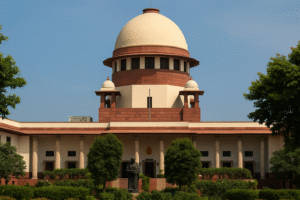
A judge exits office mid-inquiry, a pile of currency notes found during a fire-fighting operation haunts the institution, and the questions that remain are larger than the man who has now resigned.
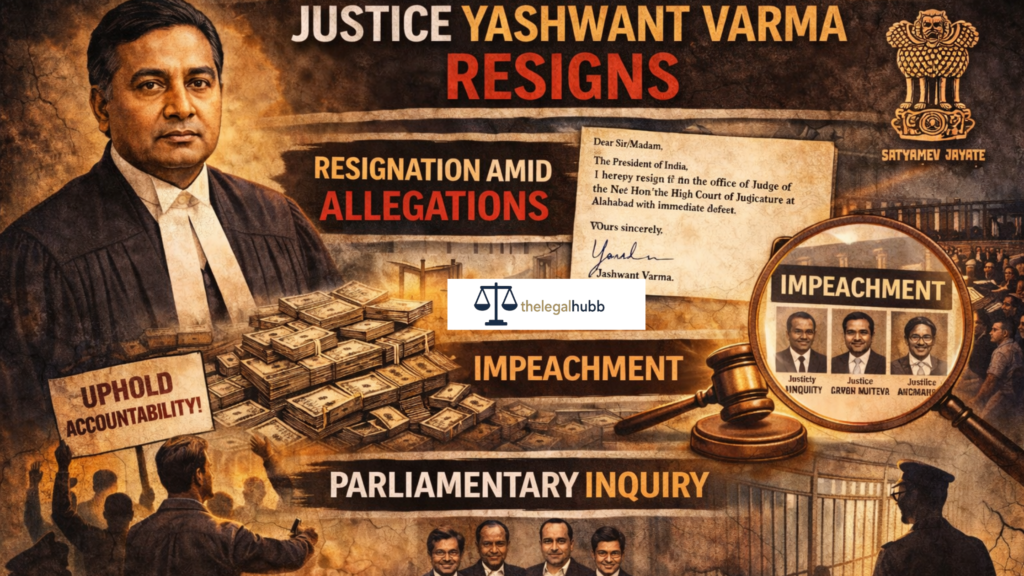
The resignation of a sitting High Court judge in India is not an everyday event. The resignation of a judge facing a formal removal inquiry under the Judges (Inquiry) Act, 1968 — with an impeachment motion signed by 146 members of the Lok Sabha already in motion — is rarer still. And yet that is precisely where the country finds itself today, following the submission of Justice Yashwant Varma’s resignation from the Allahabad High Court to the President of India. In a letter marked by what he described as “deep anguish,” Justice Varma stated that he did not wish to burden the august office of the President with the reasons for his departure. The institution he is leaving behind, however, will have to carry those reasons for a long time to come.
The controversy at the centre of this episode is as dramatic in its specifics as it is alarming in its implications. On the night of March 14, 2025, a fire broke out at the official residence of Justice Varma in Delhi, where he was then serving as a judge of the Delhi High Court. Firefighters responding to the emergency discovered, in an outhouse on the premises, a large cache of unaccounted currency notes. What was a routine fire-fighting operation became, in an instant, a constitutional crisis. The discovery set in motion a chain of events that has now culminated in the resignation of a judge who was subsequently transferred to the Allahabad High Court — a transfer widely read as a first step in the process of institutional distancing.
From Fire to Impeachment Motion: How the Crisis Unfolded
Key Events in the Justice Varma Controversy
March 14, 2025 — Fire breaks out at the official residence of Justice Varma in Delhi. Firefighters discover a large pile of unaccounted cash at an outhouse during operations.
March–April 2025 — Justice Varma is transferred from the Delhi High Court to the Allahabad High Court. The Supreme Court Collegium and the government move swiftly, signalling institutional concern.
Mid-2025 — An impeachment motion signed by 146 members of the Lok Sabha is submitted to the Speaker. This triggers the formal process under the Judges (Inquiry) Act, 1968.
Subsequent — Lok Sabha Speaker Om Birla constitutes a three-member inquiry committee comprising Justice Arvind Kumar of the Supreme Court, Chief Justice Shree Chandrashekhar of the Bombay High Court, and Senior Advocate Vasudeva Acharya of the Karnataka High Court.
April 2025 — While the inquiry is underway, Justice Varma submits his resignation to the President of India, with a copy to Chief Justice of India Surya Kant. The resignation takes effect immediately.
The Judges (Inquiry) Act, 1968 and the Architecture of Accountability
The removal of a judge of a High Court or the Supreme Court is one of the most constitutionally protected processes in India’s legal architecture. Under Article 217 read with Article 124(4) of the Constitution, a High Court judge can only be removed by an order of the President, passed on an address by each House of Parliament supported by a special majority — a majority of the total membership of the House and not less than two-thirds of members present and voting. The Judges (Inquiry) Act, 1968 operationalises this constitutional provision by establishing the procedure for the formation of an inquiry committee, the conduct of its investigation, and the laying of its findings before Parliament.
The three-member committee constituted by the Lok Sabha Speaker in this case follows the statutory prescription precisely: one serving Supreme Court judge, one Chief Justice of a High Court, and a distinguished jurist. Their task is not to convict or punish, but to investigate and report — to determine whether the conduct in question constitutes “misbehaviour” or incapacity within the meaning of the Constitution, and whether it warrants the drastic step of removal. The committee’s report, had the process run its full course, would have been placed before Parliament for a final vote.
“It is with deep anguish that I tender my resignation from the office of Judge of the Hon’ble High Court of Judicature at Allahabad with immediate effect.” — Justice Yashwant Varma, in his resignation letter to the President of India
Does Resignation Settle the Matter — or Sidestep It?
The most consequential question raised by Justice Varma’s resignation is not biographical but institutional: does the resignation of a judge mid-inquiry extinguish the inquiry, or should the process continue to its conclusion regardless? In India’s constitutional scheme, the removal process under the Judges (Inquiry) Act is designed to culminate in a parliamentary address that, if successful, results in removal. Once the judge in question has already resigned, the specific remedy of removal is no longer available. The inquiry committee’s mandate could therefore be argued to have lapsed — its purpose, at least in the narrow constitutional sense, has been superseded by events.
But this framing is deeply unsatisfying from the perspective of institutional integrity. The inquiry was set in motion not merely to remove one judge but to establish, on the record, whether the conduct alleged actually occurred and what it constitutes. A judge who resigns before a finding is made leaves behind no formal determination of guilt or innocence — a vacuum that serves neither his own vindication, if he is innocent, nor the public’s right to know, if he is not. Several legal scholars have argued that inquiry proceedings should be permitted to continue and conclude even after resignation, with their findings placed on the public record. This is the approach that best serves judicial accountability as a value, rather than judicial removal as a mechanical remedy.
Judicial Independence, Judicial Accountability, and the Trust That Binds Them
The Indian judiciary derives its authority ultimately from public trust — from the settled conviction that when a citizen walks into a courtroom, the person on the bench is deciding the matter on the basis of law and evidence, not on considerations that have nothing to do with justice. That trust is not a given; it is earned through the consistent, visible conduct of judges across generations, and it can be damaged in ways that no single appointment or reform entirely repairs. The Yashwant Varma episode — whatever its ultimate factual resolution — has dealt a blow to that trust, and the blow lands at a moment when the institution can ill afford it.
It is important, in this context, to distinguish between judicial independence and judicial unaccountability. The Constitution’s protections for judges — security of tenure, insulation from executive pressure, the demanding threshold for removal — exist to preserve independence, not to create a class of public servants immune from scrutiny. When independence shades into unaccountability, the protection that was designed to serve justice begins to corrode it. The challenge for Parliament, the judiciary, and civil society is to strengthen the mechanisms by which judicial conduct is examined and, where necessary, sanctioned — without crossing into the territory of political interference that the constitutional protections were designed to prevent.
Justice Varma has tendered his resignation. The inquiry committee constituted by the Lok Sabha Speaker, the three judges and jurists tasked with making findings of fact, should be permitted to complete its work and place its conclusions on the public record. India’s democracy, and the judiciary that is one of its essential pillars, deserves nothing less than a full and transparent accounting. An exit from office, however anguished, is not the same thing as an answer.