1. INTRODUCTION
The question of whether machines can think has intrigued scholars since the mid-twentieth century, particularly after pioneering work in artificial intelligence laid the conceptual foundation for machine cognition. Over time, AI has evolved from a theoretical concept into a transformative technological force influencing nearly every sector, including healthcare, transportation, finance, education, and biotechnology.
In recent years, AI has moved beyond being a mere tool to becoming an active participant in the innovation process. By analysing vast datasets and identifying patterns, AI systems are now capable of generating novel solutions traditionally attributed to human ingenuity. This shift has significant implications for patent law, which has historically been designed around human inventors.
While AI enhances efficiency, reduces costs, and minimises human bias in innovation, it also introduces serious challenges. The rapid increase in AI-driven inventions has led to concerns such as patent flooding, decline in patent quality, and the rise of strategic patenting practices. Consequently, existing patent frameworks must be reassessed to accommodate the unique nature of AI-generated inventions.
2. ESSENTIAL REQUIREMENTS FOR PATENTABILITY
To qualify for patent protection, an invention must satisfy certain fundamental criteria recognised under international agreements such as TRIPS and domestic patent laws.
2.1 Patentable Subject Matter
An invention must fall within the categories recognised by patent law. Certain subject matters, such as abstract ideas, mathematical models, and algorithms, are generally excluded unless they demonstrate practical application or technical contribution.
2.2 Novelty
The invention must be new and must not form part of prior art. If the invention has already been disclosed to the public, it cannot be patented.
2.3 Inventive Step (Non-Obviousness)
The invention must involve a technical advancement that is not obvious to a person skilled in the relevant field. Mere modification or rearrangement of existing knowledge does not qualify.
2.4 Industrial Applicability
The invention must be capable of practical application in industry. It should demonstrate utility and economic relevance.
3. KEY ISSUES IN THE PATENTABILITY OF AI INVENTIONS
3.1 Subject-Matter Eligibility
AI-related inventions often face rejection due to their classification as abstract ideas or algorithms. Many jurisdictions impose strict limitations on patenting software-based inventions unless they demonstrate a clear technical effect or practical application.
3.2 Inventive Step and the Role of AI
Traditional patent law evaluates inventiveness from the perspective of a “person skilled in the art.” However, AI systems can process and generate solutions beyond human cognitive limits. This raises a fundamental question: how should obviousness be assessed when AI itself may represent a higher level of skill than human experts?
This creates uncertainty in evaluating whether an AI-generated invention truly involves an inventive step.
3.3 Ownership and Inventorship
One of the most debated issues is whether AI can be recognised as an inventor. Current patent laws generally require the inventor to be a natural person. Since AI lacks legal personality, it cannot be recognised as an inventor under existing frameworks.
This leads to disputes regarding ownership between developers, users, and organisations employing AI systems.
4. COMPARATIVE ANALYSIS OF AI PATENTABILITY
4.1 United States
Under U.S. patent law, patentable subject matter includes processes, machines, manufactures, and compositions of matter. However, abstract ideas, including algorithms, are excluded unless they demonstrate practical application.
The judicially developed “Alice test” is used to determine patent eligibility. If an invention is directed toward an abstract idea, it must include additional elements that transform it into a patent-eligible application.
4.2 European Union
The European Patent Convention excludes computer programs “as such” from patentability. However, AI-related inventions may be patented if they demonstrate a technical character.
The focus is on whether the invention contributes to a technical solution rather than merely implementing an algorithm.
4.3 Japan
Japanese patent guidelines require AI inventions to demonstrate novelty beyond routine improvements. Incremental modifications in machine learning models are generally not considered sufficient unless they represent a previously unknown method.
4.4 India
Indian patent law excludes mathematical methods, business methods, and computer programs per se from patentability. However, AI inventions may be granted patents if they demonstrate a technical effect or technical contribution.
Indian patent practice emphasises practical application, as seen in cases where inventions showing real-world impact have been granted patents, while abstract computational methods have been rejected.
5. INVENTORSHIP AND THE DABUS CONTROVERSY
A major global debate on AI inventorship arose from applications filed by Dr. Stephen Thaler, who named his AI system as the inventor of certain inventions.
Patent authorities across multiple jurisdictions rejected these applications on the ground that only natural persons can be recognised as inventors. Courts in the United States, Europe, the United Kingdom, Germany, and Australia have consistently upheld this requirement.
However, some jurisdictions have shown limited flexibility by allowing AI to be acknowledged as contributing to the invention, provided a human is named as the inventor.
An exception was observed in South Africa, where a patent was granted to an AI-generated invention. However, the absence of substantive examination in that system limits the broader significance of this decision.
The DABUS controversy highlights the tension between technological advancement and traditional legal definitions.
6. INTERNATIONAL COOPERATION AND POLICY RESPONSES
The global nature of AI innovation necessitates international cooperation. Various organisations and patent offices are actively engaging in collaborative efforts to address AI-related challenges.
Initiatives involving major patent offices have focused on examining the impact of AI on patent systems, sharing best practices, and developing harmonised approaches.
International organisations have also initiated consultations to explore future policy directions, including potential reforms to intellectual property frameworks.
7. FUTURE CHALLENGES AND NEED FOR REFORM
The rise of AI-generated inventions exposes limitations in existing patent laws. Key challenges include:
- Defining inventorship in the absence of human creators
- Assessing inventiveness in AI-driven innovation
- Preventing abuse of patent systems through excessive filings
- Ensuring balance between innovation and public interest
There is an increasing need to develop new legal frameworks or adapt existing ones to accommodate AI while preserving the core objectives of patent law.
8. CONCLUSION
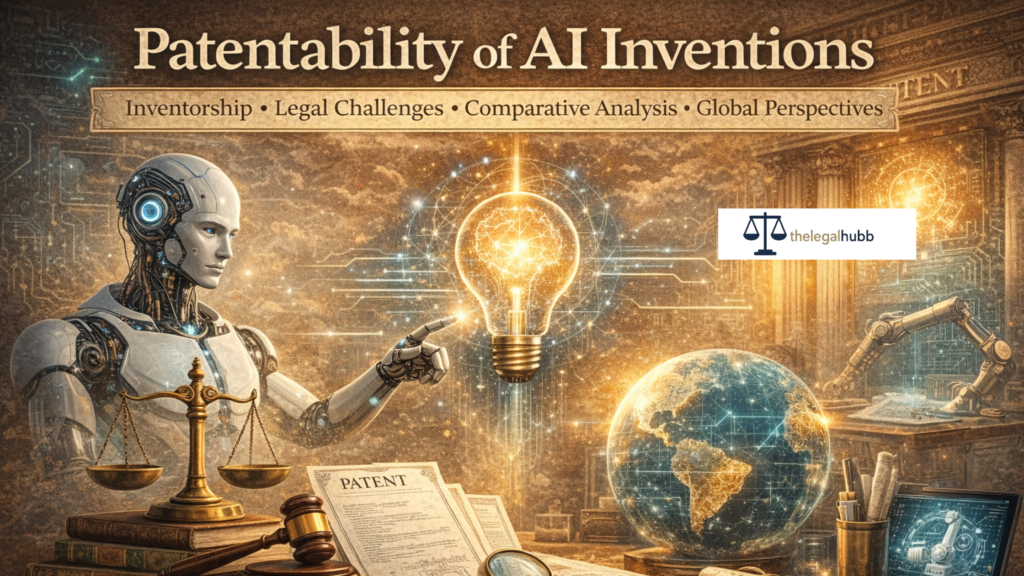
The patentability of AI inventions represents one of the most complex challenges in contemporary intellectual property law. While AI enhances innovation, it disrupts traditional legal concepts of authorship, inventorship, and originality.
Most jurisdictions continue to rely on existing legal frameworks, requiring human inventorship and technical contribution. However, as AI systems become more autonomous, these frameworks may require significant reform.
A balanced approach is essential—one that encourages technological advancement while maintaining the integrity of intellectual property systems. Greater international collaboration and policy innovation will play a crucial role in shaping the future of AI patent law.