
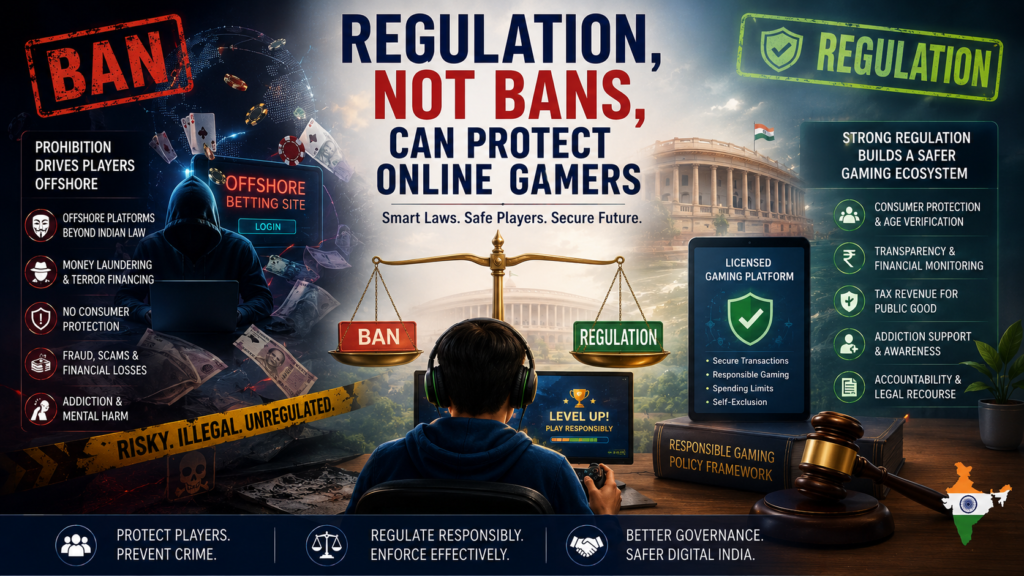
India’s attempt to regulate online gaming through prohibition has triggered an important national debate on digital governance, consumer protection and the limits of state control in the internet age. The implementation of the Promotion and Regulation of Online Gaming Act, 2025 (PROG Act) was intended to protect users — particularly youth and vulnerable groups — from the social and financial harms associated with online betting and gambling. However, emerging evidence suggests that the law may be producing consequences opposite to those it intended to prevent.
Instead of eliminating risky online gaming behaviour, the ban appears to have pushed users toward unregulated offshore platforms operating beyond Indian legal oversight. This raises a larger constitutional and policy question: in the digital age, can blanket prohibitions truly work, or does effective governance require strong regulation instead of outright bans?
The Shift from Domestic Platforms to Offshore Networks
One of the most concerning developments after the implementation of the PROG Act has been the rapid migration of users from regulated domestic gaming platforms to illegal offshore betting websites. According to studies cited in the article, participation in offshore platforms increased significantly across multiple Indian States after the law came into force.
This shift demonstrates an important reality of internet-based industries: digital platforms are far more difficult to suppress through territorial bans alone. Users can easily bypass restrictions through:
- VPN services
- Mirror websites
- Encrypted applications such as Telegram and WhatsApp
- Proxy servers and private links
As a result, prohibition may reduce regulatory visibility without actually reducing user participation.
The internet does not operate within rigid geographic boundaries, and laws designed for physical marketplaces often struggle to control borderless digital ecosystems.
Why Blanket Bans Often Fail
History repeatedly shows that paternalistic bans rarely eliminate demand. Instead, they frequently drive activities underground where oversight becomes weaker and risks become greater.
The same pattern now appears to be emerging in online gaming.
When regulated domestic platforms are restricted, users do not necessarily stop participating. Instead, they migrate to platforms that:
- Operate outside Indian jurisdiction
- Lack consumer protection mechanisms
- Avoid taxation and compliance obligations
- Provide no effective grievance redressal
This creates a dangerous environment where users face increased risks of:
- Fraud
- Financial exploitation
- Identity theft
- Money laundering
- Cybercrime
Ironically, a law intended to protect users may end up exposing them to even greater harm.
Offshore Platforms and National Security Concerns
The issue extends beyond gambling alone. Offshore betting platforms also raise serious concerns regarding financial integrity and national security.
The article notes that illegal operators may become channels for:
- Money laundering
- Hawala transactions
- Fraudulent investment schemes
- Terror financing
Because these platforms function outside domestic regulatory systems, Indian authorities face significant limitations in monitoring transactions and enforcing accountability.
The challenge becomes even more severe when operators continuously shift domains and exploit encrypted communication systems.
This creates a governance vacuum where illegal networks remain technologically ahead of enforcement agencies.
The Failure of Enforcement Alone
The Government has reportedly blocked thousands of URLs connected to illegal offshore betting activity. Yet enforcement alone has not eliminated access.
The core problem is structural: digital ecosystems are highly adaptive.
When one domain is blocked, another appears almost immediately. Users are redirected through:
- Alternate links
- Private channels
- VPN-based access
- International servers
As long as demand exists, technological circumvention will continue.
This reveals the limitations of prohibition-based policy in the digital age. Legal suppression without viable regulated alternatives often weakens oversight rather than strengthening it.
The Constitutional Perspective
The debate also raises broader constitutional questions regarding state regulation and individual autonomy.
A constitutional democracy certainly possesses the authority to regulate harmful activities in the public interest. However, regulation must remain:
- Effective
- Proportionate
- Practical
- Rights-compatible
When blanket bans fail to achieve their intended objectives while simultaneously increasing illegal activity, policymakers must reconsider whether prohibition remains constitutionally and administratively justified.
The objective of governance should not merely be symbolic control. It should be meaningful regulation capable of reducing harm while preserving accountability.
Lessons from International Approaches
Several countries have increasingly recognised that controlled regulation may be more effective than absolute prohibition.
The article highlights examples such as:
United Arab Emirates
Despite historically strict prohibitions, the UAE introduced a tightly controlled federal licensing system in 2023 to address risks arising from offshore activity.
Sri Lanka
Sri Lanka is moving toward establishing a centralised Gambling Regulatory Authority aimed at regulating and monitoring online gaming activity within a formal legal framework.
The emerging global trend suggests that governments are recognising a practical reality: unregulated offshore dominance may be more dangerous than carefully supervised domestic regulation.
The Case for Strong Regulation
A robust regulatory framework could potentially achieve multiple objectives simultaneously:
Consumer Protection
Licensed platforms can be required to implement safeguards such as:
- Age verification
- Spending limits
- Addiction monitoring
- Self-exclusion mechanisms
Financial Transparency
Regulated systems allow authorities to monitor transactions and reduce illicit financial flows.
Tax Revenue
A regulated ecosystem can generate significant tax revenue that may be reinvested into enforcement, awareness campaigns and digital monitoring systems.
Legal Accountability
Domestic operators remain subject to Indian jurisdiction, making grievance redress and compliance enforcement possible.
Data Protection and Cybersecurity
Formal regulation can impose standards regarding user privacy, cybersecurity and responsible advertising.
Balancing Regulation and Responsibility
This does not mean online gaming should remain entirely unrestricted. The social and psychological harms associated with addictive gambling behaviour are genuine and cannot be ignored.
The challenge is therefore not whether regulation should exist, but how it should be structured.
An effective framework must balance:
- Consumer freedom
- Public health concerns
- Financial integrity
- Digital innovation
- Constitutional governance
Excessive liberalisation may encourage exploitation, while excessive prohibition may drive activities underground.
The objective should be harm reduction rather than symbolic criminalisation.
The Need for Coordinated Digital Governance
Because online gaming transcends territorial boundaries, isolated enforcement efforts are unlikely to succeed. Effective governance requires coordination between:
- Central and State governments
- Financial regulators
- Cybersecurity agencies
- Law enforcement authorities
- Digital platforms
India’s regulatory response must also remain technologically adaptive. Traditional enforcement models alone cannot adequately address rapidly evolving digital ecosystems.
Conclusion
The experience of the PROG Act demonstrates a larger lesson about governance in the digital era: prohibition without practical enforceability often produces unintended consequences.
The rise of offshore betting platforms after the ban suggests that absolute restrictions may weaken oversight rather than strengthen public protection.
A carefully regulated framework, supported by strong safeguards and technological monitoring, may offer a more realistic and constitutionally balanced solution.
The debate is therefore no longer simply about online gaming. It is about how democratic states should govern digital spaces where technology evolves faster than traditional legal systems.
In the end, effective governance lies not in denying reality, but in regulating it responsibly.