From Platform Moderation to Direct Law-Enforcement Reporting
The protection of children in the digital environment has become one of the most pressing challenges for modern legal systems. Social-media platforms are no longer merely spaces for communication and entertainment; they are also environments in which children can be exposed to sexual exploitation, grooming, abuse and unlawful digital content.
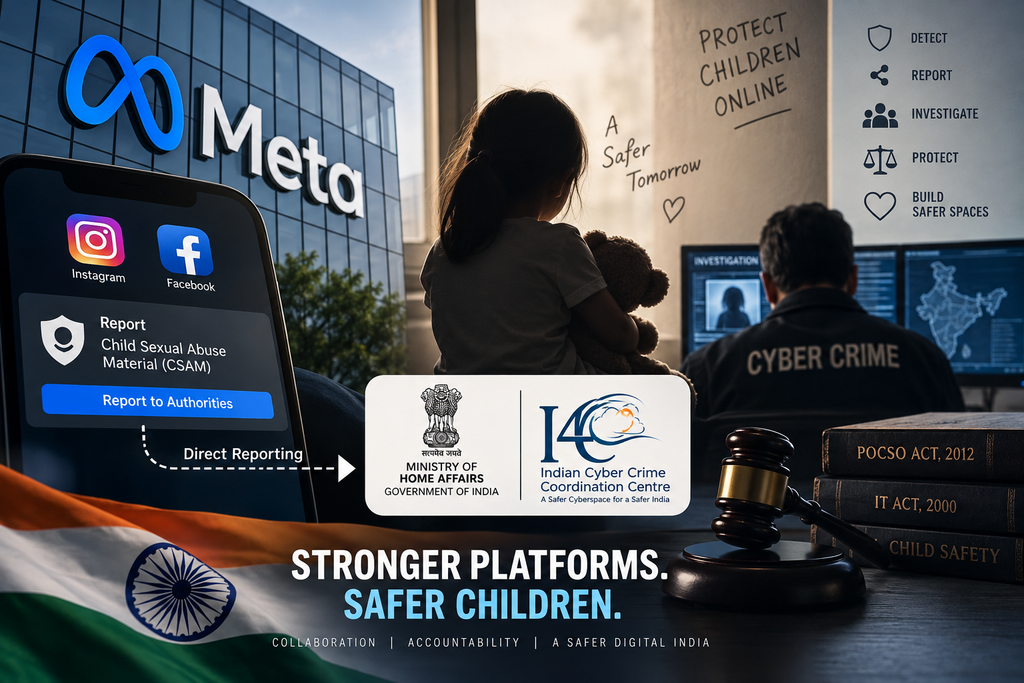
Against this background, Meta has announced that it will report child-safety matters directly to India’s cybercrime portal operated by the Indian Cyber Crime Coordination Centre (I4C). The announcement comes amid heightened scrutiny of Meta over allegations concerning child sexual abuse material (CSAM) appearing in paid advertisements on Instagram.
The development is significant because Meta had previously relied primarily on reporting apparent child-exploitation cases to the U.S.-based National Center for Missing & Exploited Children (NCMEC), which coordinates with law-enforcement authorities. Meta has now committed to establishing a direct reporting route to Indian law enforcement through I4C.
This raises an important legal question: What does direct reporting mean for the responsibility of social-media platforms under Indian law?
Understanding CSAM
Child Sexual Abuse Material refers broadly to visual or other material depicting the sexual exploitation or abuse of children.
Indian law already criminalises several forms of such conduct.
Section 67B of the Information Technology Act, 2000
Section 67B specifically deals with electronic material depicting children in sexually explicit acts or conduct. Its scope extends beyond simply publishing such material. It also covers activities including creating, collecting, seeking, browsing, downloading, advertising, promoting, exchanging or distributing certain prohibited material involving children.
This demonstrates that India’s legal framework treats online child sexual exploitation as a serious cybercrime rather than merely a violation of platform terms of service.
The POCSO Act and Online Child Protection
The Protection of Children from Sexual Offences Act, 2012 (POCSO) provides another important layer of protection.
POCSO was enacted specifically to protect children from sexual assault, sexual harassment and pornography and to establish Special Courts for such offences.
Importantly, the Act also recognises the digital dimension of child sexual abuse.
For example, Section 11 includes certain forms of sexual harassment conducted through electronic or online means, while Section 13 deals with the use of children for pornographic purposes.
This means that child protection cannot be separated from the responsibilities of digital platforms.
Why Reporting Matters
Removing harmful content is only one part of the response.
Suppose a platform detects material indicating the sexual exploitation of a child. Simply deleting the content may prevent further circulation, but it does not necessarily identify:
- the person who uploaded it;
- the person who created it;
- individuals distributing it;
- associated accounts;
- financial transactions;
- communication networks; or
- other children who may be at risk.
This is why reporting to law enforcement is critical.
A direct reporting mechanism can potentially shorten the chain between detection → reporting → investigation → identification of offenders.
Meta’s new commitment therefore represents a shift from viewing child safety primarily as a content-moderation problem toward treating it as a law-enforcement and child-protection issue.
What Is I4C?
The Indian Cyber Crime Coordination Centre (I4C) operates under the Ministry of Home Affairs and provides an institutional framework for coordinating responses to cybercrime.
The National Cyber Crime Reporting Portal provides mechanisms for reporting cyber offences, including offences affecting women and children. I4C also operates technological systems designed to facilitate coordination between platforms and law-enforcement agencies.
Direct reporting to this ecosystem can therefore make the response more closely connected to India’s own investigative and prosecutorial framework.
The IT Rules and Intermediary Responsibility
Social-media platforms operating in India are also subject to the Information Technology (Intermediary Guidelines and Digital Media Ethics Code) Rules, 2021.
The framework establishes due-diligence obligations for intermediaries and requires platforms to maintain mechanisms for dealing with unlawful content and user grievances.
The regulatory environment has also been evolving rapidly.
In 2026, the Government has pursued further amendments and consultations concerning intermediary compliance and emerging forms of harmful digital content, including synthetically generated information.
The direction of regulation is therefore increasingly towards greater accountability for platforms operating within India’s digital ecosystem.
The Meta Decision Comes Amid Increased Scrutiny
The timing of Meta’s announcement is important.
The company has faced government and child-rights scrutiny following reports alleging that paid advertisements associated with CSAM appeared on Instagram. The National Commission for Protection of Child Rights (NCPCR) has also engaged with Meta regarding the allegations.
The government has described children’s online safety as a fundamental requirement for platforms operating in India and has indicated that further engagement with other platforms is underway.
Thus, Meta’s announcement should be viewed within a broader regulatory conversation about the responsibilities of large technology companies.
From Safe Harbour to Responsible Intermediary Governance
One of the deeper legal issues raised by this development concerns the relationship between intermediary protection and intermediary responsibility.
Digital platforms have historically argued that they are intermediaries rather than publishers of every piece of content uploaded by users.
Indian law provides conditional protection to intermediaries through Section 79 of the Information Technology Act, subject to statutory requirements and due diligence.
But the increasing use of algorithmic recommendation systems creates a more complicated environment.
A platform may not merely host content. Its systems can determine:
- what users see;
- what content is recommended;
- which advertisements reach particular audiences;
- how quickly harmful material spreads; and
- which accounts are amplified.
Consequently, modern platform governance increasingly requires examination of systems, processes and safeguards, rather than focusing only on individual pieces of unlawful content.
Artificial Intelligence Adds Another Layer
The challenge becomes even more complicated with generative AI.
Child sexual abuse material can increasingly be manipulated or synthetically generated using sophisticated technologies. India’s regulatory framework has begun addressing risks associated with synthetic content, including concerns involving child sexual exploitation material. The Government has stated that amendments to the IT Rules addressing synthetically generated information came into force in February 2026.
This creates difficult questions for platforms and investigators:
Who is responsible when unlawful material is AI-generated?
Potentially relevant actors could include:
- the person generating the material;
- the person distributing it;
- the person operating an account;
- the platform hosting or recommending it; and
- technology providers whose systems facilitate its creation.
The law will increasingly have to distinguish between these different forms of participation.
Privacy and Due Process Must Also Matter
Stronger reporting obligations should not mean abandoning safeguards concerning personal data and due process.
Child-safety investigations can involve extremely sensitive information, including:
- identities of children;
- private communications;
- IP addresses;
- account information;
- device information; and
- financial or location-related records.
Such information must be handled carefully.
The objective should therefore be a system in which child protection, effective investigation and privacy safeguards operate together, rather than one being pursued at the complete expense of another.
What Should Platforms Do?
A responsible digital child-safety framework requires more than responding after harmful material becomes public.
Platforms should invest in:
1. Proactive Detection
Artificial intelligence and human review mechanisms should be used to detect suspected child exploitation material before it spreads widely.
2. Rapid Reporting
Where legally required or appropriate, suspected offences should reach the relevant law-enforcement authorities without unnecessary delay.
3. Preservation of Evidence
Evidence necessary for investigation should be preserved according to applicable law and lawful requests.
4. Stronger Advertising Controls
Paid advertising systems require particular attention because advertising creates a commercial pathway for harmful material to reach users.
5. Cross-Platform Cooperation
Online exploitation rarely respects platform boundaries. Information-sharing mechanisms can help identify repeat offenders and coordinated networks.
A Larger Question of Digital Governance
The Meta development illustrates a fundamental transformation in the relationship between technology companies and governments.
For years, content moderation was often treated primarily as an internal platform responsibility. Increasingly, governments are insisting that certain forms of online harm must also trigger engagement with public law-enforcement institutions.
This does not mean that technology companies should become investigators or law-enforcement agencies.
Rather, it highlights the need for a clear division of responsibility:
Platforms detect and preserve; authorities investigate and prosecute; courts determine criminal liability.
That separation is important for both effective enforcement and the rule of law.
Conclusion
Meta’s decision to report child-safety matters directly to India’s I4C cybercrime portal represents an important development in India’s evolving approach to online child protection.
But direct reporting is only one component of an effective child-safety framework.
India already possesses significant legal tools through the POCSO Act, the Information Technology Act and the IT Rules. The larger challenge lies in ensuring that these laws translate into effective detection, timely reporting, professional investigation, evidence preservation and successful prosecution.
Ultimately, the digital safety of children cannot depend solely on the goodwill or technological capacity of private companies. Child protection is a legal and institutional responsibility. The emerging framework must therefore ensure that technology, corporate accountability and criminal justice work together to make the digital environment safer for children.