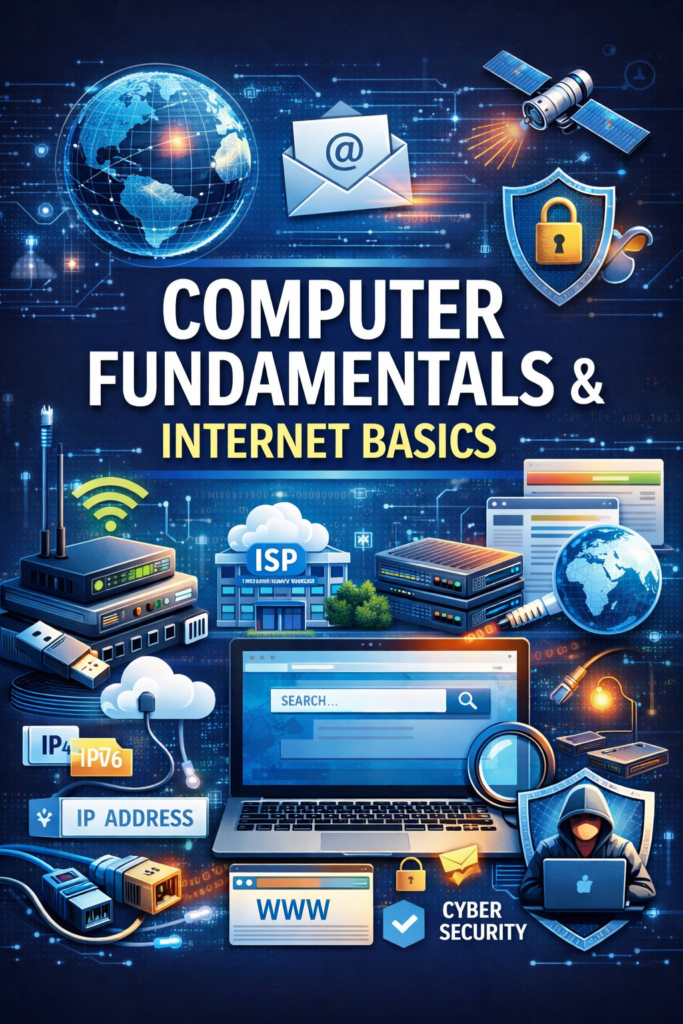
Cyber security refers to the protection of computers, computer systems, networks, programs, and data from unauthorized access, misuse, attacks, disruption, or damage. It involves the use of technological tools, policies, and practices designed to safeguard digital information and infrastructure from cyber threats such as hacking, malware, data breaches, and denial-of-service attacks.
The primary objective of cyber security is to ensure the confidentiality, integrity, and availability of information, thereby enabling safe and reliable use of digital technologies in personal, commercial, and governmental environments.
Search Engines
A search engine is a software system or online tool designed to search, retrieve, and organize information available on the internet based on user-entered keywords or queries. It systematically scans web pages, databases, and online resources, indexes their content, and displays relevant results in an ordered manner.
Search engines help users quickly locate information, websites, images, videos, and documents, making them an essential tool for accessing and navigating the vast amount of information available on the World Wide Web.
E-mails and World Wide Web (WWW)
Electronic mail, commonly known as e-mail, is a method of exchanging digital messages over the internet between users. It allows individuals and organizations to send and receive text, documents, images, and other files instantly across the globe. E-mail operates through mail servers using standard protocols and is widely used for personal communication, official correspondence, business transactions, and information sharing due to its speed, reliability, and cost-effectiveness.
World Wide Web (WWW)
The World Wide Web, commonly referred to as WWW or the Web, is a vast collection of interlinked web pages and digital resources available on the internet. These web pages are accessed using web browsers and are connected through hyperlinks. The WWW enables users to access information in the form of text, images, audio, and video, making it one of the most important services of the internet for education, communication, commerce, and entertainment.
Internet Working Devices
- Modem
- Router
- Switch
- Hub
- Gateway
Internet Working Devices
Internet working devices are hardware components that enable communication between computers, networks, and the internet. These devices manage data transmission, routing, and connectivity to ensure smooth flow of information across networks.
Modem
A modem (Modulator–Demodulator) is a device that enables a computer or network to connect to the internet by converting digital data into analog signals and vice versa. It acts as a bridge between the user’s device and the Internet Service Provider (ISP). Modems are commonly used in homes and offices to access the internet through telephone lines, cable lines, or optical fiber.
Router
A router is a networking device that forwards data packets between different networks. It connects multiple devices to the internet and directs incoming and outgoing data to the correct destination using IP addresses. Routers are essential in both home and enterprise networks and often provide additional features such as firewall protection and wireless connectivity.
Switch
A switch is a network device used to connect multiple devices within a local area network (LAN). It receives data packets and forwards them only to the intended recipient device, thereby improving network efficiency and reducing traffic congestion. Switches are commonly used in offices, institutions, and data centers.
Hub
A hub is a basic networking device that connects multiple computers in a network. Unlike a switch, a hub broadcasts incoming data packets to all connected devices, regardless of the intended destination. Due to inefficiency and security limitations, hubs are now largely replaced by switches in modern networks.
Gateway
A gateway is a network device that connects two different networks using different communication protocols. It acts as an entry and exit point for network traffic and translates data between incompatible systems. Gateways are commonly used to connect local networks with external networks such as the internet.
Internet Service Provider (ISP)
An Internet Service Provider (ISP) is an organization or company that provides access to the internet to individuals, institutions, and businesses. ISPs enable users to connect to the global network through various technologies such as broadband, fiber optic, mobile data, or satellite connections. In addition to internet access, ISPs may also offer related services such as email accounts, web hosting, domain registration, and network security support.
IP Address
An IP address, or Internet Protocol address, is a unique numerical identifier assigned to each device connected to a computer network that uses the Internet Protocol for communication. It serves two main purposes: identifying the host or network interface and providing the location of the device in the network, enabling proper routing of data across the internet.
Types of IP Address
IPv4
Internet Protocol version 4 (IPv4) uses a 32-bit numerical addressing system, written in decimal format as four numbers separated by dots. It allows a limited number of unique addresses and is the most widely used IP version.
IPv6
Internet Protocol version 6 (IPv6) uses a 128-bit addressing system, written in hexadecimal format. It was developed to overcome the address shortage of IPv4 and provides a vastly larger address space along with improved security and efficiency.