Introduction to Computers
A computer is an electronic device capable of accepting data as input, processing that data according to a predefined set of instructions, storing the processed data, and producing meaningful information as output. The working of a computer is based on the Input–Process–Output (IPO) cycle, where raw data is transformed into useful information. In modern society, computers are indispensable in education, business, governance, communication, and security systems.
Components of a Computer System
A computer system is an integrated combination of various components that work together to perform computing tasks. These components include hardware, software, data, and users. Among these, hardware forms the physical structure of the computer and plays a central role in its functioning.
Input Unit
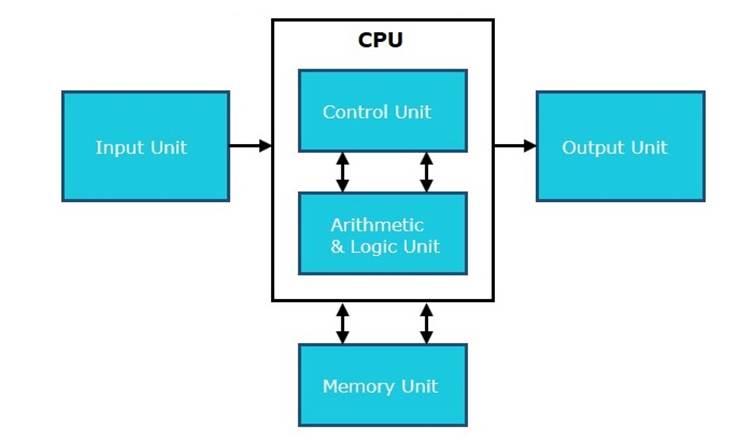
The input unit is responsible for feeding data and instructions into the computer system. It acts as a bridge between the user and the computer by converting human-readable information into machine-readable form. Devices such as the keyboard and mouse allow users to interact directly with the computer, while devices like scanners, microphones, and webcams enable the input of images, sound, and video. Without input devices, the computer would have no means to receive instructions or data for processing.
Central Processing Unit (CPU)
The Central Processing Unit is regarded as the brain of the computer. It performs all calculations, decision-making, and control functions. Every instruction given to the computer passes through the CPU. The CPU consists of three main parts: the Arithmetic Logic Unit (ALU), the Control Unit (CU), and registers.
The Arithmetic Logic Unit (ALU) carries out all arithmetic operations such as addition, subtraction, multiplication, and division, along with logical operations like comparison and decision-making. The Control Unit (CU) coordinates and manages the activities of all other components by directing the flow of data and instructions. Registers are small, high-speed memory units within the CPU that temporarily store data and instructions during processing, enabling faster execution.
Memory Unit
The memory unit stores data, instructions, and results during processing. It plays a vital role in ensuring smooth and efficient functioning of the computer. Memory is broadly classified into primary memory and secondary memory.
Primary memory is directly accessible by the CPU and includes RAM and ROM. Random Access Memory (RAM) is volatile in nature, meaning that it loses its contents when the power is turned off. It stores data and programs that are currently in use. Read Only Memory (ROM) is non-volatile and permanently stores essential instructions required to start the computer, such as the booting process.
Secondary Storage Devices
Secondary storage devices are used to store data permanently for long-term use. Unlike primary memory, they are not directly accessed by the CPU but provide large storage capacity at a lower cost. Devices such as hard disks, solid-state drives, pen drives, CDs, DVDs, and external hard disks are commonly used for storing software, documents, multimedia files, and backups. Secondary storage ensures data security and availability even when the computer is switched off.
Output Unit
The output unit presents processed information to the user in a comprehensible form. It converts machine-generated results into human-readable output. Common output devices include monitors, which display text and graphics; printers, which provide hard copies of documents; speakers, which output sound; and projectors, which display information on large screens. Output devices complete the IPO cycle by delivering the final results of processing.
Motherboard
The motherboard is the main circuit board of the computer system. It houses and connects essential components such as the CPU, memory, storage interfaces, and expansion cards. All communication between different hardware components takes place through the motherboard, making it the backbone of the computer system.
Power Supply Unit (PSU)
The Power Supply Unit provides electrical power to all components of the computer. It converts alternating current (AC) from the main power source into direct current (DC) required by internal components. A stable power supply is essential for the reliable functioning and longevity of computer hardware.
Conclusion
A computer is a coordinated system of multiple components working together to perform data processing tasks efficiently. The input unit supplies data, the CPU processes it using memory, storage devices preserve it, and output devices present the final results. Understanding the structure and functioning of computer components forms the foundation of computer fundamentals, cyber security, and advanced computing concepts.