
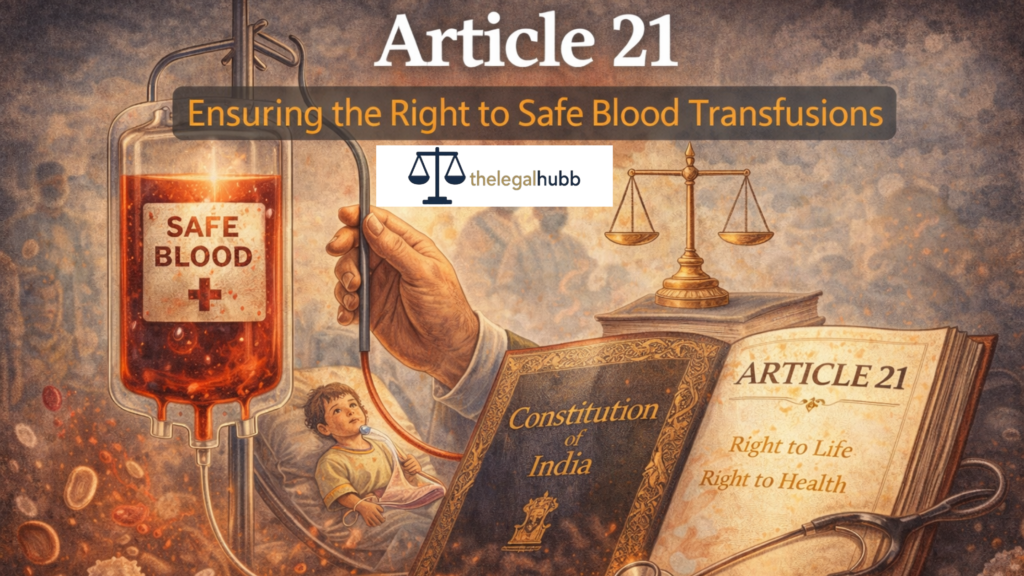
The Expanding Horizon of Article 21
Article 21 of the Constitution of India states that no person shall be deprived of their life or personal liberty except according to procedure established by law. At first glance, the provision appears simple. However, through decades of judicial interpretation, the Supreme Court has transformed Article 21 into one of the most powerful guarantees of human dignity.
The right to life today extends far beyond mere physical survival. It includes the right to live with dignity, the right to health, the right to a clean environment, and the right to safe medical treatment. The judiciary has repeatedly affirmed that the protection of life under Article 21 must adapt to the evolving needs of society.
Recent developments concerning blood transfusion safety illustrate how this constitutional guarantee continues to expand in response to modern healthcare challenges.
The Supreme Court and Blood Safety
The Supreme Court recently agreed to examine whether blood banks should compulsorily conduct the Nucleic Acid Test (NAT) for screening donated blood. NAT is a highly sensitive molecular testing technique that detects the genetic material of viruses such as HIV, Hepatitis B and Hepatitis C in blood samples.
The issue reached the Court through a petition arguing that access to safe and infection-free blood transfusion is a fundamental component of the right to life. The petitioner emphasised that patients receiving blood transfusions, especially those with chronic medical conditions, are extremely vulnerable to contaminated blood.
The Court also raised concerns about the financial implications of implementing NAT nationwide, particularly for economically weaker states. While recognising the importance of blood safety, the Bench questioned whether every state government would be able to bear the additional costs associated with mandatory testing.
This exchange reflects the constant balancing act between constitutional rights and administrative feasibility.
Thalassemia and the Vulnerability of Patients
The case draws particular attention to patients suffering from thalassemia, a genetic blood disorder in which the body cannot produce sufficient hemoglobin. Individuals with thalassemia require frequent blood transfusions to survive. As a result, they face a heightened risk of infection if blood safety protocols are inadequate.
India is often described as the thalassemia capital of the world due to the large number of patients dependent on regular transfusions. For such individuals, the quality of blood screening procedures is literally a matter of life and death.
Recent incidents of contaminated blood transfusions highlight the urgency of stronger screening standards. Reports have indicated cases where children undergoing treatment were infected with HIV after receiving transfusions of infected blood. These tragedies are particularly disturbing because they are preventable.
Preventable medical harm raises serious constitutional concerns under Article 21.
The Right to Health as Part of Article 21
The Supreme Court has consistently interpreted Article 21 to include the right to health and medical care. In numerous judgments, the Court has emphasised that access to safe and adequate healthcare is essential for protecting human dignity.
The debate over NAT testing illustrates how the right to health evolves with technological advancements. As medical science develops more accurate testing methods, the standard of care expected from public health systems also changes.
If a safer and more reliable testing mechanism exists, questions naturally arise about whether failing to adopt it amounts to neglect of the constitutional obligation to protect life.
Balancing Rights and Resources
At the same time, constitutional rights must operate within practical realities. Implementing NAT across all government blood banks may require significant financial investment in laboratory infrastructure, training and equipment.
The Court therefore faces a complex policy question. Should the right to safe blood transfusion mandate the highest available technological standard, or should implementation be gradual based on the financial capacity of states?
This dilemma reflects a broader challenge in socio-economic rights jurisprudence: how to ensure meaningful rights without ignoring resource constraints.
Preventable Tragedies and Constitutional Responsibility
The petition before the Court highlights several cases in which children receiving treatment for thalassemia contracted HIV due to infected blood transfusions. Such incidents illustrate the consequences of gaps in screening systems.
When medical errors occur due to inadequate safety measures, they raise questions about institutional accountability. Article 21 obligates the State to ensure that public health systems do not expose citizens to avoidable risks.
Preventable tragedies strengthen the argument that blood safety should be treated not merely as a policy matter but as a constitutional responsibility.
Conclusion: Article 21 as a Living Guarantee
Article 21 continues to evolve as a living guarantee of human dignity. Its interpretation reflects the changing expectations of society regarding health, safety and welfare. The debate over mandatory NAT testing for blood transfusions represents another chapter in this constitutional journey.
At its core, the issue raises a simple yet profound question: how far must the State go to ensure that medical treatment does not itself become a source of harm?
The answer will shape the future contours of the right to health in India. As the judiciary examines the feasibility and necessity of advanced screening techniques, it will once again define the practical meaning of the constitutional promise that every person has the right to life.