Thirty-four lives lost in two accidents within twenty-four hours. A Supreme Court bench that refused to look away. And a set of directions that could, if implemented with sincerity, change what it means to drive on an Indian highway.
On the night of November 2, a tempo traveller slammed into a stationary truck on a national highway in Phalodi, Rajasthan. The next evening, a passenger bus collided with a gravel-laden truck on a highway in Rangareddy, Telangana. In less than forty-eight hours, thirty-four people were dead. These were not freak events. They were the entirely predictable consequence of conditions that have persisted on India’s national highways for years — illegal encroachments, heavy vehicles parked in the dark on live carriageways, no emergency response within reach, blackspots that everyone knows about and no one has fixed. What was different this time was that the Supreme Court of India took suo motu cognisance, and it did not let go.
The result is an order that is, by any measure, one of the most comprehensive judicial interventions in highway safety in the country’s history. Issued by a bench of Justices J.K. Maheshwari and Atul Chandurkar, invoking the Court’s extraordinary powers under Article 142 of the Constitution, it addresses encroachments, parking, surveillance, emergency response, truck lay-byes, accident blackspots, and institutional coordination in a single sweep. The case — captioned In Re: Phalodi Accident — is a reminder that when the state’s protective machinery fails, the Constitution has its own provisions for compulsion.
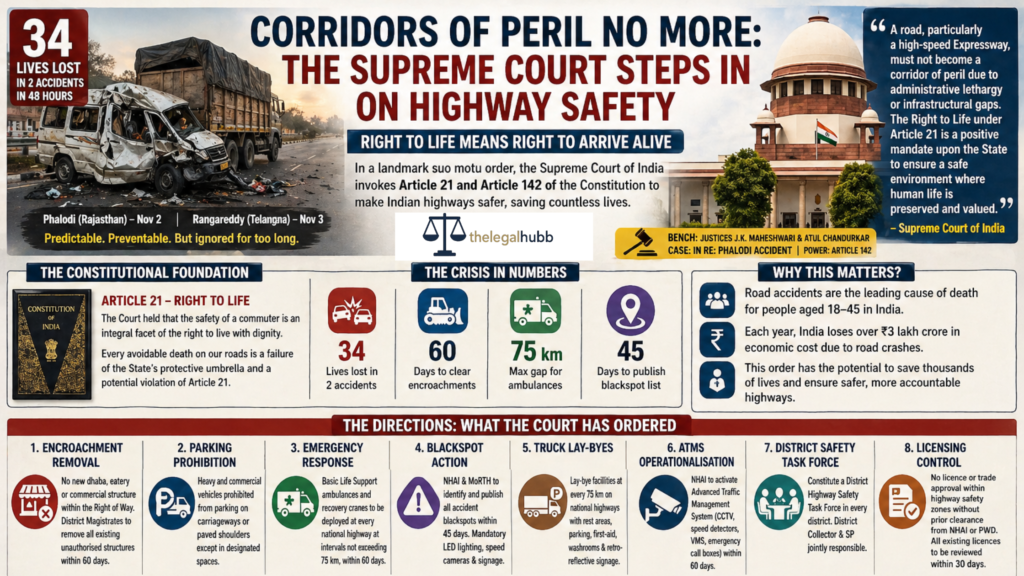
| 34 Lives lost in 2 accidents | 60 Days to clear encroachments | 75 km Max gap for ambulances | 45 Days to publish blackspot list |
Article 21 and the Right to Arrive Alive
The Court’s legal anchor for its intervention is Article 21 — the guarantee of the right to life and personal liberty that stands at the heart of India’s constitutional scheme. In a formulation that deserves to be widely read, the bench declared that the safety of a commuter is an integral facet of the right to live with dignity. A road, the Court observed, particularly a high-speed expressway, must not become a corridor of peril due to administrative lethargy or infrastructural gaps. The loss of even a single life to avoidable hazards — illegal parking, blackspots, the absence of emergency services — represents a failure of the state’s protective umbrella.
This framing matters beyond the immediate facts of the Phalodi case. The Court is making explicit that Article 21 is not merely a passive guarantee against unlawful killing — a prohibition that the state must not take life — but a positive mandate that the state must actively ensure conditions in which life is preserved. Applied to highway safety, this means that every unaddressed blackspot, every ambulance that does not exist, every encroachment that has been tolerated for years becomes a potential constitutional violation. It is a demanding standard, but it is one that the Court has now placed squarely on the record.
“A road, particularly a high-speed Expressway, must not become a corridor of peril due to administrative lethargy or infrastructural gaps. The Right to Life enshrined under Article 21 is not merely a guarantee against the unlawful taking of life, but a positive mandate upon the State to ensure a safe environment where human life is preserved and valued.” — Supreme Court of India
What the Court Has Ordered — and Why It Matters
The directions issued by the Court span the full spectrum of the highway safety problem, from the immediate and visible to the systemic and structural. They are worth examining not merely as a list of instructions to government agencies, but as a diagnosis of everything that has been allowed to go wrong.
| Encroachment Removal No new dhaba, eatery or commercial structure within the Right of Way. District Magistrates to remove all existing unauthorised structures within 60 days. | Parking Prohibition Heavy and commercial vehicles are prohibited from parking on national highway carriageways or paved shoulders except in designated spaces. |
| Emergency Response Basic Life Support ambulances and recovery cranes to be deployed at every national highway at intervals not exceeding 75 km, within 60 days. | Blackspot Action NHAI and MoRTH to identify and publish all accident blackspots within 45 days, followed by mandatory LED lighting, speed cameras and warning signage. |
| Truck Lay-Byes Lay-bye facilities to be constructed at every 75 km on national highways, equipped with rest areas, parking, first-aid, washrooms and retro-reflective signage visible from 500 metres. | ATMS Operationalisation NHAI to activate its Advanced Traffic Management System — CCTV cameras, speed detectors, variable message signboards and emergency call boxes — on all 4/6-lane highways within 60 days. |
| District Safety Task Force A District Highway Safety Task Force to be constituted for every district through which a national highway passes, with the District Collector and SP bearing joint responsibility. | Licensing Control No licence or trade approval for any site within highway safety zones without prior clearance from NHAI or PWD. All existing licences to be reviewed within 30 days. |
Encroachments That Everyone Saw and Nobody Removed
Of all the directions issued by the Court, the prohibition on encroachments within the Right of Way of national highways and the mandate for their removal within sixty days is perhaps the most immediately visible. The proliferation of dhabas, eateries, and petty commercial structures on highway verges is a phenomenon that has developed over decades, often with the tacit approval or active connivance of local authorities who benefit from the presence of these establishments. Truckers rely on them; travellers stop at them; and the political economy around them is deeply entrenched.
The problem they create, however, is well-documented. A truck driver who pulls his vehicle partially onto the carriageway to buy chai, with no lay-bye available and no designated rest area in reach, is creating a lethal obstruction in the dark. The Phalodi accident — a tempo traveller striking a stationary truck — is a textbook illustration of exactly this dynamic. The Court’s direction to NHAI and the Ministry of Road Transport and Highways to have Senior Advocate A.N.S. Nadkarni serve as amicus, and to hold deliberations with Solicitor General Tushar Mehta before tendering interim directions, reflects the seriousness with which the bench has engaged with the structural roots of the problem, rather than merely reacting to its symptoms.
Between Court Order and Ground Reality
The directions are comprehensive and the timelines are tight. The Court has directed that all implementing agencies shall be jointly and severally liable for compliance within their respective areas — a formulation that spreads responsibility across NHAI, the Ministry, District Magistrates, state governments, and the police, and signals that the bench will not accept the ritual passing of the buck that has historically frustrated such interventions. Copies of the order have been directed to be circulated to the Chief Secretary and Director General of Police of every state and Union Territory, as well as to State Legal Services Authorities — a distribution list designed to ensure that no implementing authority can claim ignorance.
The Court has also directed MoRTH to place before it the recommendations of the Road Safety Committee headed by Justice (Retd.) Abhay Sapre on the causes of highway accidents — acknowledging that judicial directions, however detailed, must be grounded in expert analysis if they are to produce durable change. The creation of an Inter-State Highway Safety Coordination Committee to standardise enforcement protocols across states addresses another chronic problem: the patchwork of varying standards that allows trucks to move between states whose safety regimes are entirely inconsistent with one another.
India loses approximately 1.5 lakh people on its roads every year — a toll that dwarfs most natural disasters and receives a fraction of the attention. The Supreme Court’s order in the Phalodi case will not, by itself, end that carnage. But it establishes, with constitutional authority and institutional reach, that the state has a duty of care on its highways that is not being met, and that the failure to meet it is not merely a policy failure but a violation of the most fundamental right the Constitution guarantees. That is a foundation on which genuine reform can be built — if the will exists to build it.