
Justice Swarana Kanta Sharma’s refusal to recuse from the Delhi liquor policy case is not merely a procedural dispute. It is a test of whether Indian courts understand that the appearance of impartiality is as essential as impartiality itself.
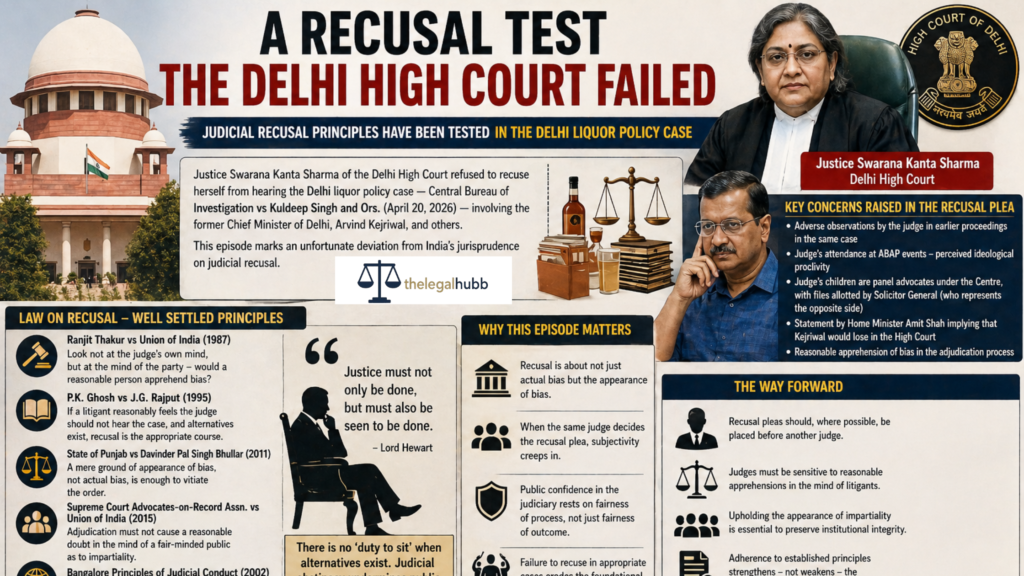
There is a maxim in Anglo-American jurisprudence that has endured for well over a century precisely because it captures something fundamental about the nature of judicial authority. Justice must not only be done — it must be seen to be done. The principle is not merely aesthetic. It goes to the root of why courts are obeyed, why their orders are respected, and why citizens surrender the resolution of their most consequential disputes to a judge rather than settling them by other means. When a court fails to appear impartial, it does not merely risk injustice in a single case. It corrodes the institutional trust on which the entire edifice of adjudication is built. The refusal of Justice Swarana Kanta Sharma of the Delhi High Court to recuse herself from the Central Bureau of Investigation’s challenge to the discharge of accused persons — including former Chief Minister Arvind Kejriwal — in the Delhi liquor policy case is precisely this kind of failure. And it deserves to be examined honestly.
The Grounds
What Arvind Kejriwal Actually Argued
Kejriwal chose to appear as a party in person before the Delhi High Court to argue the recusal plea himself — a choice that underscored the seriousness with which he regarded the matter. The grounds he cited were not vague assertions of hostility or political grievance. They were specific, documented, and legally cognisable. Taken together, they built a case not for actual bias — which is exceptionally difficult to prove against any sitting judge — but for a reasonable apprehension of bias, which is the established and significantly lower threshold that Indian law has consistently applied to recusal questions.
Adverse Prior Findings
The same judge had made adverse observations against the accused in earlier proceedings within the very same case — findings that Kejriwal argued made it impossible for her to approach the CBI’s challenge with an open mind.
Alleged Ideological Proximity
The judge had attended events organised by the Akhil Bharatiya Adhivakta Parishad (ABAP), a lawyers’ body associated with the political philosophy of the ruling dispensation at the Centre — which was the prosecuting side in the case.
Children’s Professional Ties
The judge’s children were working as panel advocates under the Central government, with case file allocations controlled by the Solicitor General — who was appearing as counsel for the opposing side in the very matter before her.
Political Statement by Minister
Home Minister Amit Shah had publicly implied that Kejriwal would lose the case in the High Court — a statement that, however read, created a reasonable perception that the outcome was being anticipated with confidence at the political level.
Kejriwal’s core submission — particularly on the question of his children’s professional relationship with the government — was not that the judge was corrupt or consciously partial. It was that a live, active, and ongoing professional relationship between her family members and the prosecuting side created a structural conflict that no assertion of personal integrity could fully neutralise. As he reportedly stated in his rejoinder, the conflict arises not from prior participation in the present proceedings, but from the admitted existence of that relationship. This is a legally coherent and well-grounded argument, and it deserved more than the treatment it received.
The Law
A Jurisprudence Built on Appearances, Not Certainties
India has no codified law on judicial recusal. The question is governed entirely by judicial precedent, ethical principles, and internationally recognised standards of judicial conduct — most notably the Bangalore Principles of Judicial Conduct, whose draft was finalised at a Round Table of judges from multiple countries at The Hague in 2002. Those principles enumerate independence, impartiality, integrity, and propriety as core judicial values and require explicitly that a judge shall avoid not only impropriety but the appearance of impropriety in all activities. The standard is not what the judge knows about herself. It is what a reasonably informed, fair-minded observer would think about the process.
The Jurisprudential Lineage on Recusal
1889
Leeson vs General Medical Council (UK): Lord Bowen — like Caesar’s wife, judges should be above suspicion. The standard is not guilt but the avoidance of even the appearance of it.
1923
R vs Sussex Justices (UK): Lord Hewart — justice must not only be done but must manifestly and undoubtedly be seen to be done. The foundational statement of the appearances doctrine.
1987
Ranjit Thakur vs Union of India (SC): The proper approach is not to ask “Am I biased?” but to look at the matter through the eyes of the party before the court.
1995
P.K. Ghosh vs J.G. Rajput (SC): When a litigant has a reasonable basis to feel a judge should not hear the matter, and alternatives exist, recusal is the appropriate course to maintain public confidence.
2011
State of Punjab vs Bhullar (SC): A mere appearance of bias — not actual bias — is sufficient to vitiate a judgment or order. The threshold is explicitly set at reasonable apprehension, not proof.
2015
SCAORA vs Union of India (SC): The question is whether adjudication would cause reasonable doubt in the mind of a reasonably informed litigant and fair-minded public as to the judge’s impartiality.
“We may try to see things as objectively as we please. None the less, we can never see them with any eyes except our own.” — Justice Benjamin N. Cardozo
The Judgment
A Self-Defensive Order That Missed the Point
The judgment delivered by Justice Sharma on April 20, 2026 rejecting the recusal plea is, by any fair reading, a document in which the judge responded to the recusal application as though it were a personal attack — rather than engaging with it as the legal and ethical question it was. The judge framed the matter as one in which she had to decide between a litigant and herself, which is precisely the structural problem that the recusal doctrine is designed to avoid. The maxim that no one should sit in judgment in their own cause is among the most settled principles in all of legal ethics. By deciding her own recusal herself, without even referring the question to another judge for an objective evaluation, Justice Sharma created the very appearance of partiality that Kejriwal had raised as a concern.
The judgment’s handling of the children’s employment issue drew particular attention. The judge asked rhetorically whether it would be just to question her children who had studied, struggled, and proved themselves in court to earn their livelihood. It is a question that no one had asked. Kejriwal’s argument was not that her children were undeserving of their positions. It was that their professional relationship with the government’s legal representatives created a structural conflict relevant to her adjudication. The conflation of the two is precisely the kind of subjective defensiveness that Cardozo warned against. The judgment also described the allegations as manufactured and characterised the recusal plea in terms more suited to a personal rebuttal than a dispassionate legal analysis. In doing so, it substituted a well-settled legal standard — reasonable apprehension of bias — with the far higher and legally incorrect requirement of demonstrating actual bias.
The Principle
Why the Appearance of Justice Is Not Optional
The deeper issue raised by this episode goes beyond the liquor policy case, beyond Arvind Kejriwal, and beyond this particular judge. It goes to a question about the institutional culture of India’s higher judiciary at a moment when public trust in that institution is under strain from multiple directions. The Bangalore Principles, the decades of Supreme Court jurisprudence, the accumulated wisdom of common law courts across the world — all of it points in the same direction. Impartiality is not a private conviction. It is a public standard, measured from the outside, by the reasonable observer who must be able to look at the process and trust it.
When a recusal plea raises documented grounds — prior adverse findings, organisational associations, family professional ties, and political statements about the case’s outcome — and those grounds are dismissed in a judgment that reads more like a defence brief than a judicial order, the institutional damage is real. Kejriwal and Sisodia subsequently wrote to the judge stating that they would not participate in further proceedings before her. Whatever one’s politics, that outcome — litigants refusing to engage with a court because they cannot trust the process — represents a failure of the system that the judgment itself created. The Supreme Court will, in all likelihood, be called upon to examine this matter. When it does, it has an opportunity not only to correct a specific error but to reaffirm, with clarity, that the appearance of justice is not a luxury that courts may dispense with when it becomes inconvenient. It is the condition on which their authority rests.