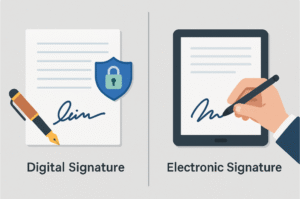
A Digital Signature Certificate (DSC) is an electronic equivalent of a physical identity certificate and serves as the legal proof that a public key used in a digital signature belongs to a particular individual or organisation. Under the Information Technology Act, 2000, DSCs are issued by licensed Certifying Authorities (CAs) and form a critical part of India’s Public Key Infrastructure (PKI). The certificate contains important information such as the subscriber’s name, public key, email address, certifying authority’s details, validity period, and the CA’s own digital signature. Its purpose is to authenticate the identity of the subscriber and provide assurance that the digital signature affixed on an electronic record is genuine, valid, and linked to the identified individual.
A DSC plays an essential role in ensuring authenticity, integrity, and non-repudiation in electronic transactions. Authenticity is established because anyone verifying the certificate can confirm that the public key belongs to the stated subscriber. Integrity is maintained because a digital signature created using the private key cannot be forged or altered without rendering the signature invalid. Non-repudiation arises because the subscriber cannot deny having signed the electronic document if the private key corresponding to the DSC was used. These features make DSCs indispensable for secure online activities like income tax filing, MCA e-forms, e-tendering, online banking transactions, and digital contracts.
The issuance of a DSC involves a thorough identity verification process conducted by the Certifying Authority. The CA checks the applicant’s credentials, ensures that the information furnished is correct, and then generates the certificate with the applicant’s public key. The corresponding private key is held exclusively by the subscriber and must be protected carefully, as any compromise of the private key may lead to misuse of the digital signature. The certificate itself is time-bound and must be renewed periodically to maintain its validity. If there is any suspicion of compromise or misuse, the subscriber or CA may revoke the certificate, and the updated revocation list is made publicly accessible to ensure trust in the system.
Overall, a Digital Signature Certificate serves as the backbone of secure electronic communication by linking a verified identity to a cryptographic key pair. It is the reason electronic signatures gain full legal recognition under the IT Act and are widely used across e-governance, corporate filings, judicial submissions, and high-security online services.