
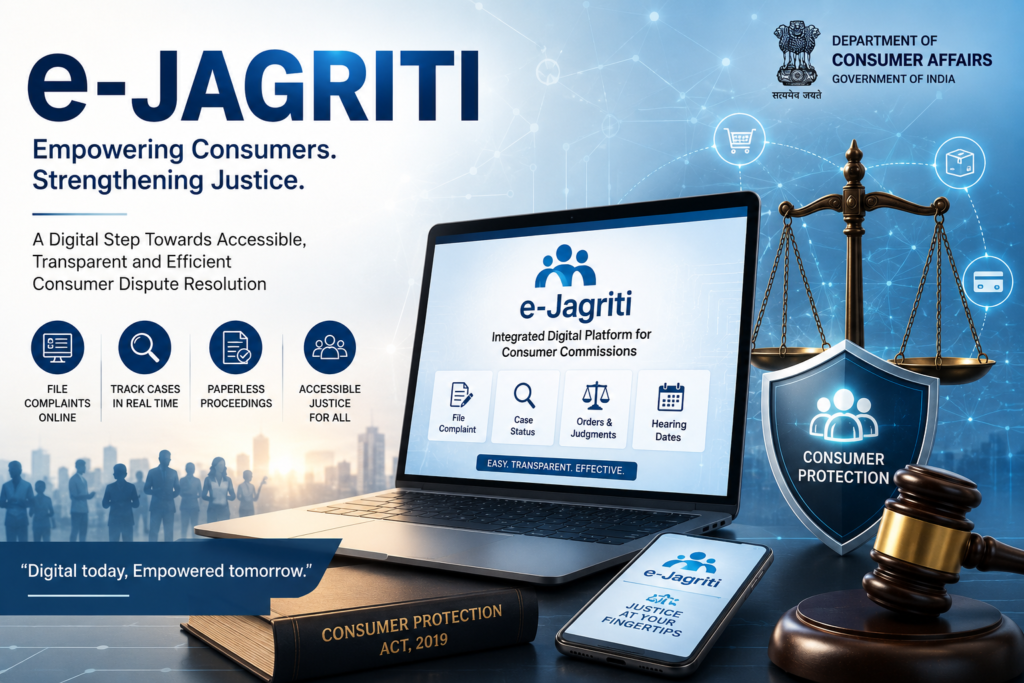
Towards a Smarter and More Accessible Consumer Protection System
India’s justice delivery system is witnessing a significant digital transformation. While much attention has been focused on the digitisation of courts through initiatives such as e-Courts and virtual hearings, a quieter yet equally important revolution is taking place in the field of consumer protection through e-Jagriti. Conceived as a technology-driven platform, e-Jagriti seeks to modernise the functioning of consumer commissions and make consumer dispute resolution more accessible, transparent and efficient.
At a time when digital commerce has become an integral part of everyday life, consumers increasingly face disputes relating to online shopping, digital payments, e-commerce platforms, defective products and unfair trade practices. The traditional paper-based system of filing and tracking consumer complaints often proved cumbersome and time-consuming. e-Jagriti is designed to bridge this gap by leveraging technology to strengthen consumer justice.
What is e-Jagriti?
e-Jagriti is the Government of India’s integrated digital platform for the consumer commissions established under the Consumer Protection Act, 2019. Developed under the aegis of the Department of Consumer Affairs, the platform aims to digitise the entire lifecycle of consumer dispute resolution—from the filing of complaints to case management, hearings, order uploads and execution proceedings.
The initiative seeks to create a seamless and paperless ecosystem connecting District Consumer Disputes Redressal Commissions, State Commissions and the National Consumer Disputes Redressal Commission (NCDRC). It represents an important step towards creating a unified digital infrastructure for consumer justice across the country.
Key Features of e-Jagriti
The e-Jagriti platform offers several user-friendly features designed to simplify the dispute resolution process:
1. Online Filing of Consumer Complaints
Consumers can file complaints electronically without the need to physically visit a consumer commission. This significantly reduces procedural barriers, especially for individuals residing in remote areas.
2. Digital Case Management
The platform enables electronic maintenance of records, reducing paperwork and ensuring that case files are securely stored and easily accessible.
3. Real-Time Case Tracking
Litigants can monitor the status of their complaints online, including hearing dates, orders and procedural developments, thereby improving transparency.
4. Electronic Service of Notices
Digital communication mechanisms help expedite the service of notices and reduce delays traditionally associated with physical delivery.
5. Integration Across Consumer Commissions
By linking district, state and national consumer fora through a common digital platform, e-Jagriti promotes consistency and better administrative coordination.
Why e-Jagriti Matters
Improving Access to Justice
One of the greatest strengths of e-Jagriti is its potential to democratise access to consumer justice. Many consumers avoid pursuing legitimate grievances because of procedural complexity, travel costs and delays. Online filing and digital tracking reduce these barriers and empower citizens to seek remedies more conveniently.
Enhancing Transparency and Accountability
A digitised platform minimises the scope for misplaced files, administrative inefficiencies and lack of information. Consumers are able to track proceedings in real time, fostering greater confidence in the dispute resolution mechanism.
Reducing Pendency and Delays
Paperless workflows, electronic records and streamlined communication can help consumer commissions dispose of cases more efficiently. Faster case management ultimately contributes to reducing the backlog of pending disputes.
Supporting the Digital Economy
As India rapidly expands its digital economy, a modern consumer protection framework is essential. E-commerce, online marketplaces and digital financial services require equally modern mechanisms for dispute resolution. e-Jagriti provides the institutional infrastructure necessary to support this evolving marketplace.
Challenges Before the Platform
While e-Jagriti is a promising initiative, its long-term success depends on addressing several practical challenges.
Bridging the Digital Divide
A large section of the population still faces limitations in digital literacy and internet accessibility. Adequate support mechanisms and facilitation centres are necessary to ensure that technological advancement does not inadvertently exclude vulnerable consumers.
Infrastructure and Capacity Building
Effective implementation requires robust digital infrastructure across all consumer commissions, along with continuous training of judicial officers, staff and legal practitioners.
Data Privacy and Cybersecurity
As consumer disputes often involve sensitive personal and financial information, strong cybersecurity protocols and data protection measures are indispensable. Public confidence in the platform depends upon the security and integrity of digital records.
Integration with Other Digital Platforms
Future success may depend on integrating e-Jagriti with other digital governance initiatives, including e-Courts, e-Daakhil and online dispute resolution (ODR) mechanisms, to create a comprehensive digital justice ecosystem.
The Future of Consumer Justice
The introduction of e-Jagriti reflects a broader shift towards technology-enabled governance and citizen-centric public services. It recognises that justice in the twenty-first century must be not only fair but also accessible, transparent and efficient.
The platform also aligns with the vision of Digital India, where technology is used to strengthen institutions and improve public service delivery. If implemented effectively, e-Jagriti can become a model for integrating digital innovation with legal processes, ensuring that consumer rights are protected in an increasingly online world.
Conclusion
e-Jagriti is more than just a digital portal; it is a significant step towards reimagining consumer justice in India. By simplifying procedures, reducing delays and making dispute resolution more accessible, it has the potential to empower millions of consumers and strengthen trust in the legal system.
However, technology should remain a means to achieve justice, not an end in itself. The success of e-Jagriti will ultimately depend on whether it combines digital innovation with inclusivity, transparency and robust institutional support. If these objectives are achieved, the platform can play a transformative role in building a modern, citizen-friendly and efficient consumer justice system for India.


Новости Украины https://gau.org.ua помогут быть в курсе общественной жизни. Изучайте публикации.
Киевские события https://lentanews.kyiv.ua рассказывают о событиях столицы. В публикациях актуальные городские материалы.
Актуальные события https://gromrady.org.ua рассматриваются на страницах проекта. Узнавайте больше об общественной жизни.
Столичные новости https://newsportal.kyiv.ua собирают важные новости. Будьте в курсе происходящего.
Актуальные материалы https://infotolium.com предлагает актуальные материалы на разные темы. Читайте свежие материалы.
Последние новости https://uamc.com.ua рассказывают актуальные вопросы. Следите за обновлениями.
Автомобильный рынок https://prestige-avto.com.ua представляет машинах и моделях. Сравнивайте автомобили.
Автомир сегодня https://orion-auto.com.ua расскажет о новинках автопрома. Изучайте особенности.
Модернизация авто https://tuning-kh.com.ua представляет комплектующие для автомобиля. Выбирайте подходящие решения.
Мир автомобилей https://reuth911.com освещают интересные события. Читайте обзоры.
Новые сведения https://valkbolos.com публикуются на разные темы. Находите интересную информацию.
Visit https://forextrademaster.com to learn everything about Forex in emerging markets—including who regulates it, who can access it, and its true value. The site offers comprehensive information for both beginners and professionals. It is a non-commercial resource: no trading signals, no forecasts, and no paid listings.
آیا به دنبال انجام معاملات فارکس در ایران هستید؟ وبسایت https://persiancurrency.trade راهنمایی جامع برای کسب درآمد، آموزش و دسترسی به بازارهای جهانی، و همچنین راهنمای کاملی درباره ارزهای دیجیتال برای کاربران ایرانی ارائه میدهد که تمامی مراحل، از مفاهیم پایه تا انجام اولین معامله را پوشش میدهد.
Looking for Forex analysis? Visit https://forexclubpro.com to find comprehensive analysis from professionals—insights that are accessible to beginners yet valuable to seasoned traders. It’s designed for traders who also have day jobs. Pure analysis, no fluff.
Visit https://forextrademasters.com for comprehensive analysis of global markets—including Forex and cryptocurrency—covering execution, liquidity, and risk for traders who already have a trading method. No signals, no forecasts, no paid placements. Just analytics.
Only proven tools—such as those found at https://rhinoforextrader.com — and forex automation solutions. The resources we present—including Expert Advisors, copy trading providers, crypto bots, and their associated brokers—have all undergone the same standardized evaluation process, with the test results published alongside our verdict. No paid rankings, no sponsored placements.
เว็บไซต์รวมประกาศงานและบริการหลากหลายภาษา https://thai.do สำหรับชาวต่างชาติและแรงงานข้ามชาติในประเทศไทย เรารวบรวมตำแหน่งงานล่าสุดและนำเสนอใน 5 ภาษา ได้แก่ ไทย อังกฤษ รัสเซีย จีน และพม่า กำลังมองหางานในประเทศไทยอยู่ใช่ไหม? ไม่ว่าจะเป็นงานออฟฟิศหรืองานช่างฝีมือ thai.do รวบรวมตำแหน่งงานใหม่จากนายจ้างทั่วประเทศ พร้อมระบบค้นหาตามเมืองและตำแหน่งงานที่ใช้งานง่าย เข้าร่วมกับเราและหางานได้เร็วขึ้น
Посетите сайт https://habarov.today и вы найдете рабочее зеркало Вавада, а также получите возможность зарегистрироваться с бонусом от Vavada. Скайчайте мобильное приложение для удобства игры. Узнайте обо всех плюсах платформы на сайте.
Свіжий розбір теми: https://telegra.ph/CHto-vazhnee-dlya-prodvizheniya-krasivyj-dizajn-ili-SEO-09-14
Learn how the Forex market works at https://bestforexhub.com. You will also find information on currency pairs and quotes, leverage and its associated risks, and how to choose the right broker. This professional-grade content is suitable for both beginners and experienced traders.
Visit https://forextantra.com — an educational platform focused on trading in international markets and the associated risks. We do not offer advice; instead, we provide a detailed analysis of trader psychology, risks, trading routines, and profitable cryptocurrency practices.
A helpful website healthfare.ca covering health, balanced nutrition, and daily wellness. The resource provides practical guides on balanced nutrition, along with practical advice. Additional content includes product overviews. Special attention is given to healthier routines, healthy eating and diet, daily activity, wellness routines, and a healthier lifestyle.