Written by Prashant Panwar
A Debate Beyond Elections
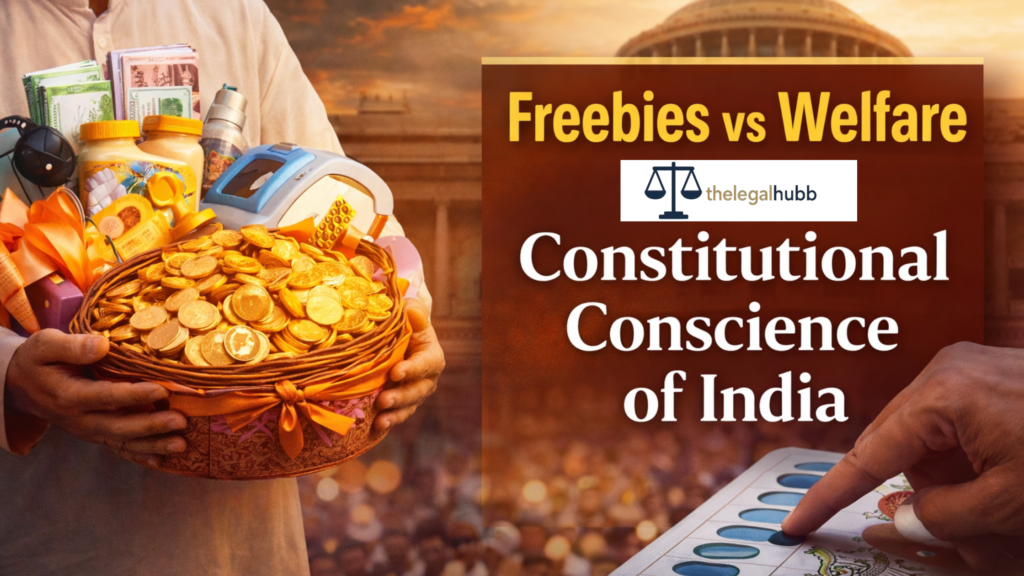
The debate over electoral freebies has once again moved to the centre of India’s constitutional discourse. What appears on the surface to be a political strategy has deeper implications for fiscal prudence, democratic accountability and the very idea of a welfare state. Recent judicial observations questioning indiscriminate distribution of government largesse have reignited an uncomfortable but necessary national conversation: where does welfare end and populism begin?
The Court’s concern was not about denying support to the poor. Rather, it questioned whether governments are distinguishing between those who genuinely need assistance and those who do not. It asked whether states, even when running fiscal deficits, should prioritise consumer giveaways over infrastructure, hospitals, schools and long-term development. These remarks compel us to examine whether competitive populism is slowly distorting public finance and governance priorities.
The Constitutional Vision of Welfare
India was never designed to be a minimalist state. The Constitution envisions a welfare state committed to social and economic justice. Through the Directive Principles of State Policy, the State is obligated to reduce inequality, prevent concentration of wealth, and ensure access to education, healthcare and livelihood. Welfare measures that empower the marginalised are not optional generosity; they are constitutional duties.
Providing scholarships to children who cannot afford education, subsidising healthcare for the poor, ensuring food security and supporting vulnerable groups are foundational to a just society. These measures expand capabilities and promote dignity. They represent investment in human capital, not mere expenditure.
The problem arises when welfare loses its focus and becomes universal consumption. When benefits are extended without assessing economic need, the line between empowerment and appeasement begins to blur.
The Rise of Competitive Populism
In a vibrant electoral democracy, political parties naturally seek to attract voters. Over time, however, electoral competition has intensified into a race of promises—free electricity, loan waivers, cash transfers, consumer goods and other material incentives. While some schemes may address genuine distress, others appear designed primarily for short-term electoral gains.
This pattern creates structural risks. Revenue expenditure increases while capital expenditure suffers. Funds that could build roads, universities, irrigation systems or research institutions are redirected toward consumptive distribution. Fiscal deficits widen, debt burdens rise, and future generations inherit liabilities created for present political advantage.
The deeper concern is not merely economic imbalance but the erosion of governance priorities. Development requires sustained investment. Populism, by contrast, thrives on immediacy.
Fiscal Responsibility and Intergenerational Equity
Public finance is ultimately about responsibility. When states operating under fiscal stress continue expanding largesse, questions of sustainability arise. Borrowing to fund welfare may sometimes be justified, particularly during crises. But borrowing to fund electoral giveaways undermines intergenerational equity.
Every rupee spent carries an opportunity cost. If scarce resources are diverted from public infrastructure to short-term inducements, society forfeits long-term growth potential. Hospitals not built, classrooms not expanded, and research not funded represent invisible losses that accumulate quietly over time.
A responsible welfare state must therefore balance compassion with prudence. Social justice cannot be achieved by weakening the fiscal foundation on which future justice depends.
Empowerment Versus Dependency
There is also a moral dimension to this debate. Welfare policies, at their best, empower individuals to stand independently. They provide a platform from which citizens can rise. Free education for underprivileged children, skill development initiatives and targeted healthcare schemes enhance human capability.
However, indiscriminate distribution of benefits risks creating dependency rather than empowerment. When support is detached from need and productivity, it may dilute incentives and weaken accountability. The goal of welfare is not to create permanent recipients but to create self-reliant citizens.
Equity does not mean identical treatment for all; it means appropriate support for those who need it most.
Democracy and Accountability
A functioning democracy depends on informed citizens making choices beyond immediate gains. When electoral campaigns revolve primarily around material giveaways, public discourse narrows. Structural reforms, institutional strengthening and policy innovation receive less attention. Governance becomes transactional rather than transformational.
Competitive populism can also weaken democratic accountability. If fiscal consequences are deferred while electoral benefits are immediate, the true cost of policies remains obscured. Transparent accounting and public awareness are therefore essential to sustaining democratic integrity.
The judiciary’s intervention has reminded governments that public funds are not political currency but constitutional trust.
Towards a Balanced Approach
The way forward lies not in rejecting welfare but in refining it. Policies must be targeted, data-driven and transparent. Fiscal responsibility frameworks should be respected, and long-term developmental expenditure must remain a priority. Welfare must be designed as investment in human potential rather than distribution of short-term consumption benefits.
Clear distinctions between productive social spending and electoral inducements need to be institutionalised. Technology-enabled targeting, direct benefit transfers and rigorous auditing can reduce leakages and ensure benefits reach those who genuinely require assistance.
Ultimately, however, sustainable governance depends not only on policy but also on political culture and voter expectations.
Conclusion: Choosing Prudence Without Losing Compassion
India’s constitutional ethos demands both social justice and fiscal responsibility. The debate over freebies is not about eliminating support for the poor; it is about safeguarding the integrity of welfare. A mature democracy must resist the temptation to substitute structural reform with short-term largesse.
The challenge before India is to preserve compassion without sacrificing prudence, to promote inclusion without compromising sustainability, and to ensure that public expenditure builds capacity rather than merely purchasing consent.
The true measure of welfare lies not in what is distributed before elections, but in what endures long after them.