A Strong Signal from Davos
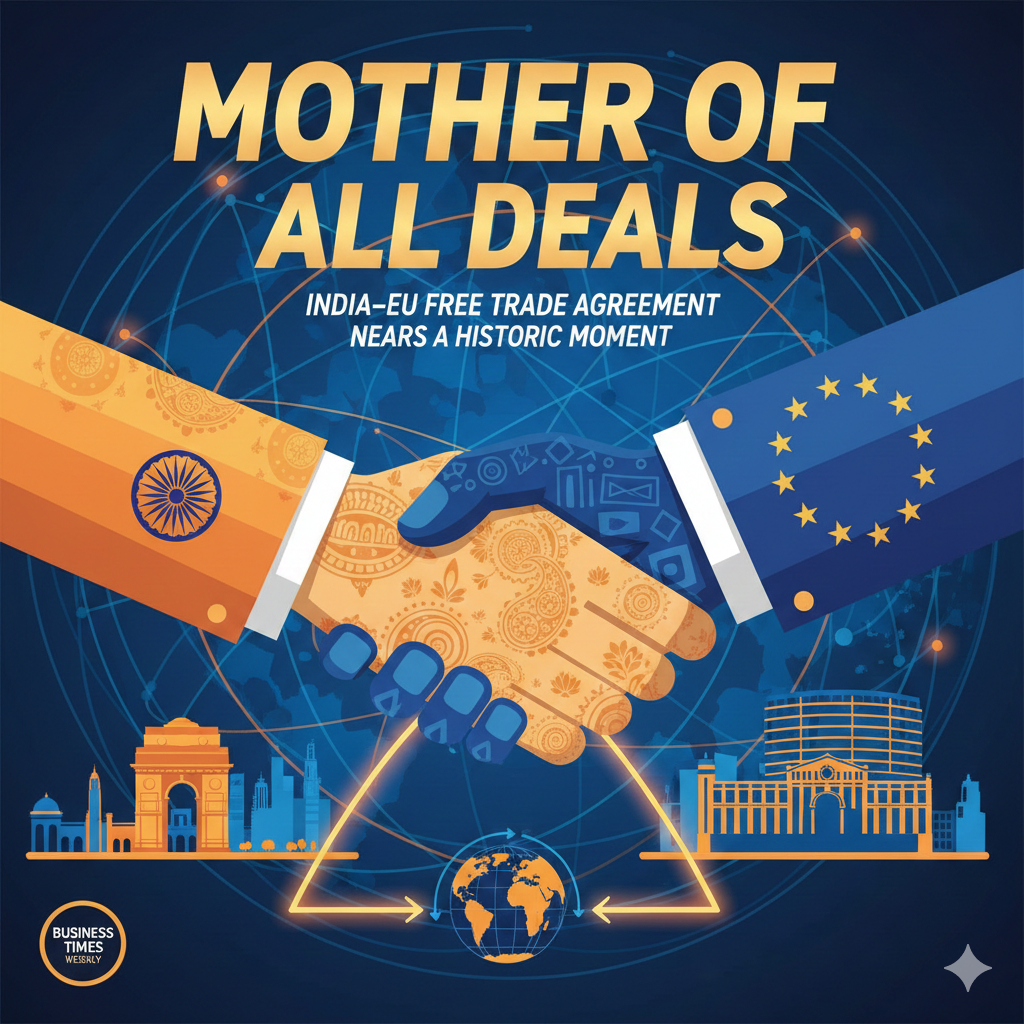
The momentum around the India–European Union Free Trade Agreement (FTA) received a major boost after Ursula von der Leyen, President of the European Union, made a powerful statement at the World Economic Forum in Davos. Describing the proposed agreement as what many have called the “mother of all deals”, she indicated that negotiations are approaching a decisive phase. While acknowledging that some work still remains, her remarks made it clear that the agreement is no longer aspirational—it is now within reach.
The Scale and Significance of the Proposed Agreement
What makes the India–EU FTA truly historic is its sheer scale. If finalised, it would create a combined market of nearly two billion people, accounting for almost one-quarter of global GDP. Such a vast economic space would make it one of the largest and most comprehensive trade agreements ever concluded. The agreement is expected to cover not just goods, but also services, investment, digital trade, sustainability standards, and regulatory cooperation, thereby reshaping economic engagement between the two partners in a holistic manner.
Europe’s Trade Vision and India’s Strategic Role
Von der Leyen placed the India agreement firmly within Europe’s broader commitment to open and rules-based global trade. At a time when protectionism and geopolitical fragmentation are affecting global supply chains, the EU is consciously projecting itself as an outward-looking and reliable trading partner. India, with its rapidly growing economy, large consumer base, and democratic governance structure, fits naturally into this vision. The FTA thus reflects a strategic convergence rather than a purely transactional trade arrangement.
Opportunities for India and the European Union
For India, the agreement promises enhanced access to European markets, particularly in sectors such as information technology, pharmaceuticals, textiles, engineering goods, and professional services. It also offers an opportunity to attract high-quality foreign investment by aligning with EU norms on sustainability, data protection, and regulatory certainty. For the EU, deeper economic integration with India would help diversify supply chains, reduce strategic dependencies, and open new growth opportunities in one of the world’s most dynamic economies.
Energy and Sustainability as Core Pillars
Trade was not discussed in isolation. Von der Leyen highlighted energy security as a key pillar of Europe’s growth strategy. She spoke about building an energy union capable of delivering reliable, affordable, and homegrown energy. This creates significant scope for India–EU collaboration in renewable energy, green hydrogen, climate technology, and sustainable infrastructure. As both partners balance development with climate commitments, energy cooperation is likely to become a defining element of their future engagement.
Defence, Security, and Technological Cooperation
Addressing defence and security, the European Commission President noted that Europe has achieved unprecedented progress over the past year, with defence investments reaching record levels. She also pointed out that several European defence technology startups have attained unicorn status, reflecting growing innovation and strategic capability. These developments open new avenues for India–EU cooperation in defence manufacturing, cybersecurity, and advanced technologies, especially in an increasingly complex global security environment.
Republic Day Diplomacy and High-Level Engagement
The political importance of the India–EU relationship is underscored by the fact that Antonio Luís Santos da Costa and Ursula von der Leyen will be the Chief Guests at India’s 77th Republic Day celebrations. Their three-day State Visit to India, beginning January 25, will culminate in the 16th India–EU Summit on January 27. During the visit, they are scheduled to meet Droupadi Murmu and hold talks with Narendra Modi, alongside an India–EU Business Forum aimed at strengthening industry-level engagement.
From Strategic Partnership to Economic Integration
India and the EU have been strategic partners since 2004, but the depth and breadth of engagement have expanded significantly in recent years. The historic visit of the EU College of Commissioners to India last year marked a turning point, signalling a move towards comprehensive cooperation. The proposed FTA can be seen as the economic backbone of this evolving partnership, translating political intent into tangible economic integration.
A Deal with Global Implications
Beyond tariffs and trade volumes, the India–EU FTA carries wider global significance. It aims to set high standards in areas such as sustainable trade, digital governance, labour protections, and environmental responsibility. At a time when the global trading system is under stress, a successful agreement between India and the EU would demonstrate that large, diverse democracies can still negotiate ambitious, balanced, and forward-looking trade frameworks.
Conclusion: A Defining Moment in Economic Diplomacy
If concluded, the so-called “mother of all deals” may well be remembered as a defining moment in 21st-century economic diplomacy. It has the potential not only to transform India–EU relations but also to influence the future direction of global trade by reaffirming cooperation, openness, and shared prosperity as guiding principles.