
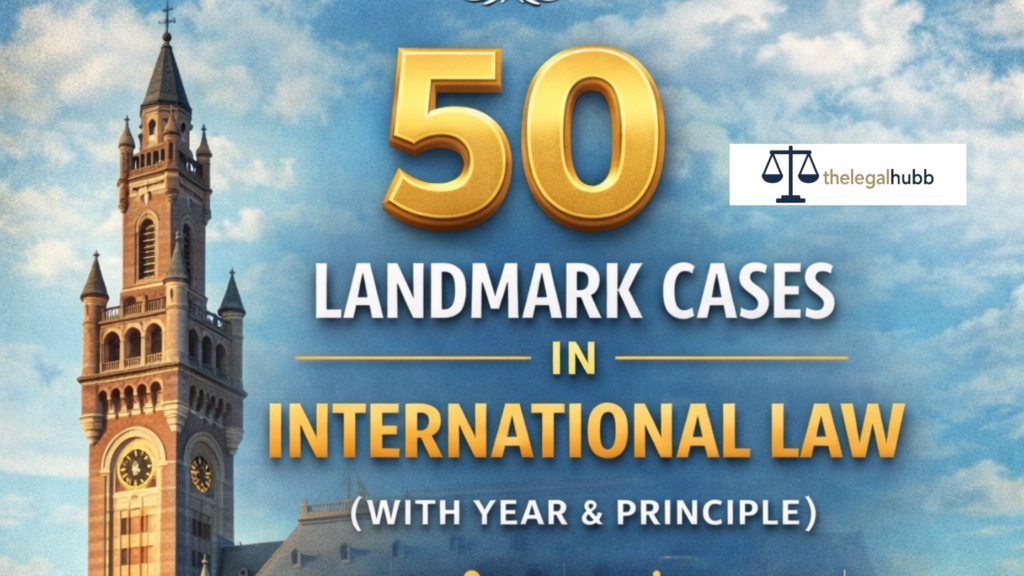
I. Sources of International Law & Custom
1. S.S. Lotus (France v. Turkey) (1927, PCIJ)
The Court held that states may exercise jurisdiction unless expressly prohibited by international law. It emphasized sovereignty and the permissive nature of international law.
2. North Sea Continental Shelf Cases (1969, ICJ)
Clarified formation of customary international law through consistent state practice and opinio juris.
3. Asylum Case (Colombia v. Peru) (1950, ICJ)
Held that regional custom must be consistently practiced and accepted as law.
4. Fisheries Case (UK v. Norway) (1951, ICJ)
Upheld Norway’s straight baseline system based on long-standing usage.
5. Nicaragua v. United States (1986, ICJ)
Confirmed prohibition on use of force and non-intervention as customary law.
II. State Responsibility
6. Chorzów Factory Case (1928, PCIJ)
Established principle of full reparation for internationally wrongful acts.
7. Corfu Channel Case (UK v. Albania) (1949, ICJ)
Albania responsible for failing to warn about sea mines.
8. Barcelona Traction Case (1970, ICJ)
Introduced concept of erga omnes obligations.
9. Rainbow Warrior Arbitration (1990)
France responsible for breaching international obligations after sinking Greenpeace ship.
10. Gabčíkovo-Nagymaros Project (Hungary/Slovakia) (1997, ICJ)
Balanced treaty obligations with environmental necessity.
III. Use of Force & Self-Defense
11. Oil Platforms (Iran v. USA) (2003, ICJ)
Rejected broad interpretation of self-defense.
12. Armed Activities on the Territory of the Congo (2005, ICJ)
Uganda found responsible for unlawful military intervention.
13. Legality of the Threat or Use of Nuclear Weapons (1996, ICJ AO)
Use of nuclear weapons generally contrary to humanitarian law.
14. Wall Advisory Opinion (Israel/Palestine) (2004)
Declared construction of separation wall illegal under international law.
IV. International Criminal Law
15. Prosecutor v. Tadić (1995)
Clarified distinction between international and internal armed conflict.
16. Prosecutor v. Akayesu (1998)
First conviction for genocide; recognized sexual violence as genocide.
17. Prosecutor v. Charles Taylor (2012)
Convicted former head of state for war crimes.
18. Prosecutor v. Omar al-Bashir (2009)
ICC issued arrest warrant against sitting president.
V. Human Rights Law
19. Soering v. United Kingdom (1989)
Extradition may violate human rights if risk of inhuman treatment exists.
20. Velásquez Rodríguez v. Honduras (1988)
State responsible for enforced disappearances.
21. Al-Skeini v. United Kingdom (2011)
Extended human rights obligations extraterritorially.
22. Bosnia and Herzegovina v. Serbia and Montenegro (2007)
First ICJ application of Genocide Convention.
VI. Law of the Sea
23. South China Sea Arbitration (Philippines v. China) (2016)
Rejected China’s nine-dash line claim.
24. ITLOS M/V Saiga Case (1999)
Clarified prompt release principle.
25. Bay of Bengal Maritime Boundary (Bangladesh v. Myanmar) (2012)
Applied equitable principles in delimitation.
VII. Diplomatic & Consular Law
26. United States Diplomatic and Consular Staff in Tehran (1980)
Iran violated diplomatic protection obligations.
27. LaGrand Case (Germany v. United States) (2001)
Recognized individual rights under Vienna Convention.
28. Avena Case (Mexico v. United States) (2004)
US breached consular notification duties.
VIII. Treaty Law & Self-Determination
29. Reservations to the Genocide Convention (1951)
Clarified validity of treaty reservations.
30. Namibia Advisory Opinion (1971)
Declared South Africa’s occupation illegal.
31. East Timor (Portugal v. Australia) (1995)
Affirmed right of self-determination.
32. Kosovo Advisory Opinion (2010)
Declaration of independence not prohibited by international law.
IX. Immunity & Jurisdiction
33. Arrest Warrant Case (DRC v. Belgium) (2002)
Recognized immunity of serving foreign ministers.
34. Jurisdictional Immunities (Germany v. Italy) (2012)
Upheld state immunity even in grave violations cases.
X. International Economic Law & Investment
35. Texaco v. Libya (1977)
Upheld sanctity of contracts in investment disputes.
36. Metalclad v. Mexico (2000)
Recognized indirect expropriation under investment law.
37. Philip Morris v. Uruguay (2016)
Upheld state’s right to regulate for public health.
XI. WTO Jurisprudence
38. US – Shrimp (WTO) (1998)
Environmental measures allowed under trade law if non-discriminatory.
39. EC – Hormones (WTO) (1998)
Science-based standards required under SPS Agreement.
XII. Environmental International Law
40. Trail Smelter Arbitration (1941)
Established principle that states must not cause transboundary harm.
41. Pulp Mills on the River Uruguay (2010)
Recognized obligation to conduct environmental impact assessment.
XIII. Genocide & Crimes Against Humanity
42. Prosecutor v. Jean-Paul Akayesu (1998)
Expanded definition of genocide.
43. Prosecutor v. Lubanga (2012)
First ICC conviction; use of child soldiers.
XIV. Arbitration & Peaceful Settlement
44. Island of Palmas Arbitration (1928)
Effective control prevails over mere discovery.
45. Alabama Claims Arbitration (1872)
Established modern state arbitration practice.
XV. Self-Determination & Humanitarian Law
46. Western Sahara Advisory Opinion (1975)
Affirmed right of self-determination.
47. Military and Paramilitary Activities in and against Nicaragua (1986)
Reaffirmed prohibition on intervention.
48. Certain Expenses of the United Nations (1962)
Clarified UN General Assembly financial powers.
49. Right of Passage over Indian Territory (Portugal v. India) (1960)
Balanced sovereignty with limited rights of passage.
50. Ambatielos Case (Greece v. United Kingdom) (1953)
Clarified interpretation of treaty clauses regarding most-favored nation status.


Hi
I would like to have a copy or pdf file of 50 Landmark Cases in International Law (With Year & Principle) . Is it possible to get it ?
Thanks
Your blog post was fantastic. Thanks for the great content. You may wish to check out a great credit building workbook at: https://voti1.com/The-48-Hour-Credit-Reset-Workbook