The Digital Age and the Crisis of Information
The digital revolution has fundamentally changed how information is produced, consumed and circulated. Social media platforms have transformed citizens into both consumers and creators of information. While this democratisation of communication has strengthened participation in public debate, it has also enabled the rapid spread of misinformation, fake news and manipulated content.
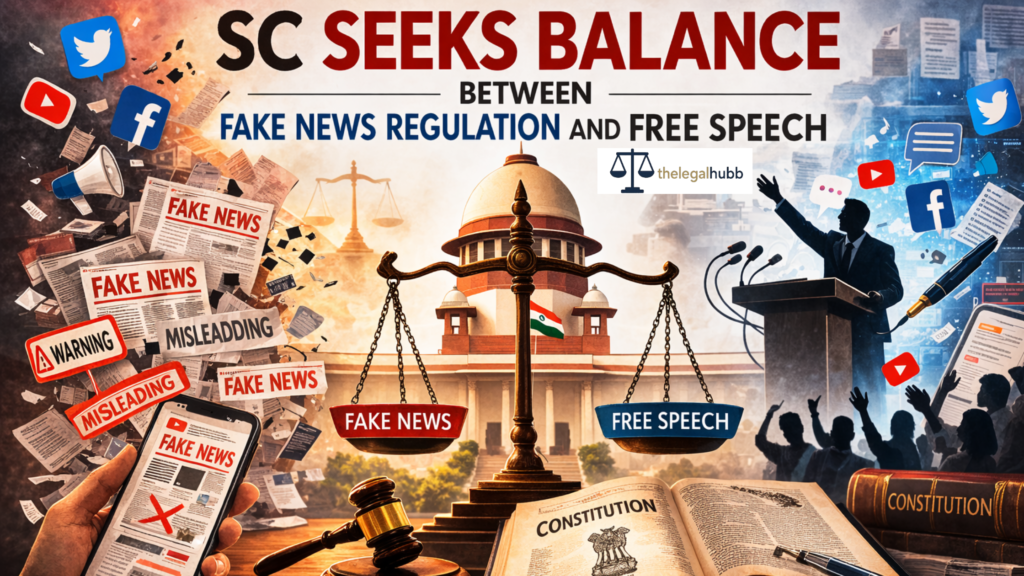
Governments across the world are struggling with a difficult question: how can misinformation be controlled without undermining freedom of expression? In India, this debate recently reached the Supreme Court in a case concerning the regulation of online content under the Information Technology Rules.
The Court emphasised that a balance must be maintained between preventing fake news and protecting the constitutional right to free speech.
Background: The Fact Checking Unit Controversy
The controversy began when the Union government introduced amendments to the Information Technology (Intermediary Guidelines and Digital Media Ethics Code) Rules and notified the creation of a Fact Checking Unit (FCU) under the Press Information Bureau.
The role of this unit was to identify online content that could be considered “fake, false or misleading” with respect to the government’s business. Once content was labelled as such, social media intermediaries could be required to remove or disable access to it.
Supporters of the rule argued that misinformation can spread rapidly online and undermine governance, national security and public trust. The government maintained that the FCU was intended only as a deterrent against misinformation and not as a mechanism to suppress criticism.
However, several journalists, digital rights organisations and civil society groups challenged the rule before the Bombay High Court, arguing that it gave the government excessive power over public discourse.
Bombay High Court Judgment
The Bombay High Court struck down the FCU notification and held that the amended rule violated fundamental constitutional protections.
The Court noted that the terms “fake,” “false,” and “misleading” were not clearly defined in the rules. Such vagueness could allow arbitrary interpretation and misuse. The Court also warned that allowing the government to decide what constitutes misinformation regarding its own actions effectively makes it the “sole arbiter of truth.”
The judgment concluded that the rule was inconsistent with constitutional guarantees under:
- Article 14 – equality before law
- Article 19(1)(a) – freedom of speech and expression
- Article 19(1)(g) – freedom to practise any profession
The Union government appealed this decision before the Supreme Court.
Constitutional Framework of Free Speech
The debate over digital regulation must be understood within the framework of Article 19(1)(a) of the Constitution of India, which guarantees the right to freedom of speech and expression.
This right is a cornerstone of democratic governance because it allows citizens to:
- Criticise government policies
- Participate in political debate
- Express dissent
- Share satire and artistic commentary
However, Article 19(2) allows the State to impose reasonable restrictions on speech in specific situations such as:
- Sovereignty and integrity of India
- Security of the state
- Public order
- Decency or morality
- Defamation
- Incitement to an offence
The challenge lies in ensuring that regulatory measures aimed at controlling misinformation do not go beyond these constitutionally permitted restrictions.
Landmark Case Laws on Free Speech
The Supreme Court has consistently defended freedom of speech while recognising legitimate restrictions. Several landmark judgments shape the legal understanding of online expression.
Shreya Singhal v. Union of India (2015)
This is perhaps the most important case governing online speech in India. The Supreme Court struck down Section 66A of the Information Technology Act, 2000, which criminalised sending offensive messages through electronic communication.
The Court held that the provision was unconstitutional because its terms such as “annoying” or “grossly offensive” were vague and could lead to arbitrary censorship.
The judgment reaffirmed that criticism, satire and dissent are protected forms of expression under Article 19(1)(a).
K.S. Puttaswamy v. Union of India (2017)
In this landmark case, the Supreme Court recognised privacy as a fundamental right under Article 21.
While primarily dealing with privacy, the judgment significantly influenced debates around digital regulation. It emphasised that state interference in the digital space must satisfy the tests of legality, necessity and proportionality.
Anuradha Bhasin v. Union of India (2020)
This case dealt with internet restrictions imposed in Jammu and Kashmir. The Supreme Court held that freedom of speech through the internet is constitutionally protected.
The Court ruled that restrictions on internet access must be proportionate and subject to judicial review.
Together, these cases demonstrate the judiciary’s commitment to protecting digital freedoms while allowing limited regulation.
The Role of the Information Technology Act
India’s primary legislation governing online communication is the Information Technology Act, 2000.
Important provisions include:
- Section 79 – provides “safe harbour” protection to intermediaries such as social media platforms, shielding them from liability for user-generated content if they remain neutral platforms.
- Section 69A – empowers the government to block online content for reasons such as national security, sovereignty and public order.
The Supreme Court upheld Section 69A in the Shreya Singhal case, noting that the provision includes procedural safeguards such as review committees and written orders.
The Supreme Court’s Balancing Approach
During the current proceedings, the Supreme Court emphasised that regulation must not silence legitimate expression.
The Court acknowledged that misinformation poses serious challenges. False information can influence elections, damage reputations and create social unrest. At the same time, overbroad regulations may chill free speech and discourage citizens from expressing opinions.
The Court therefore stressed that any regulatory framework must respect constitutional protections and avoid vague or arbitrary standards.
The Broader Democratic Question
The debate surrounding fake news regulation reflects a deeper tension within democratic societies.
On one hand, misinformation threatens the integrity of democratic institutions. On the other hand, freedom of expression is the foundation of democratic participation.
If governments are given unchecked power to determine what constitutes truth, public debate may be weakened. Conversely, if misinformation spreads without restraint, democratic discourse can be distorted.
The solution lies in building transparent, accountable and independent mechanisms for regulating digital content.
Conclusion
The Supreme Court’s intervention highlights the complexity of governing information in the digital age. The Court’s emphasis on balance reflects a recognition that both concerns—misinformation and free speech—are legitimate.
India’s constitutional framework provides strong protections for freedom of expression, but it also allows carefully designed restrictions in the public interest.
The outcome of this debate will shape the future of digital governance in India. As technology continues to redefine communication, the challenge will be to ensure that regulation protects truth without undermining liberty.
In the end, the strength of a democracy lies not in suppressing debate but in ensuring that debate remains informed, open and free.