This article is written by Prashant Panwar, an Assistant Professor at K.R. Mangalam University. With a strong academic background and expertise in constitutional and contemporary legal studies, he brings a research-oriented and analytical perspective to emerging issues in law, aiming to bridge the gap between theory and practice.
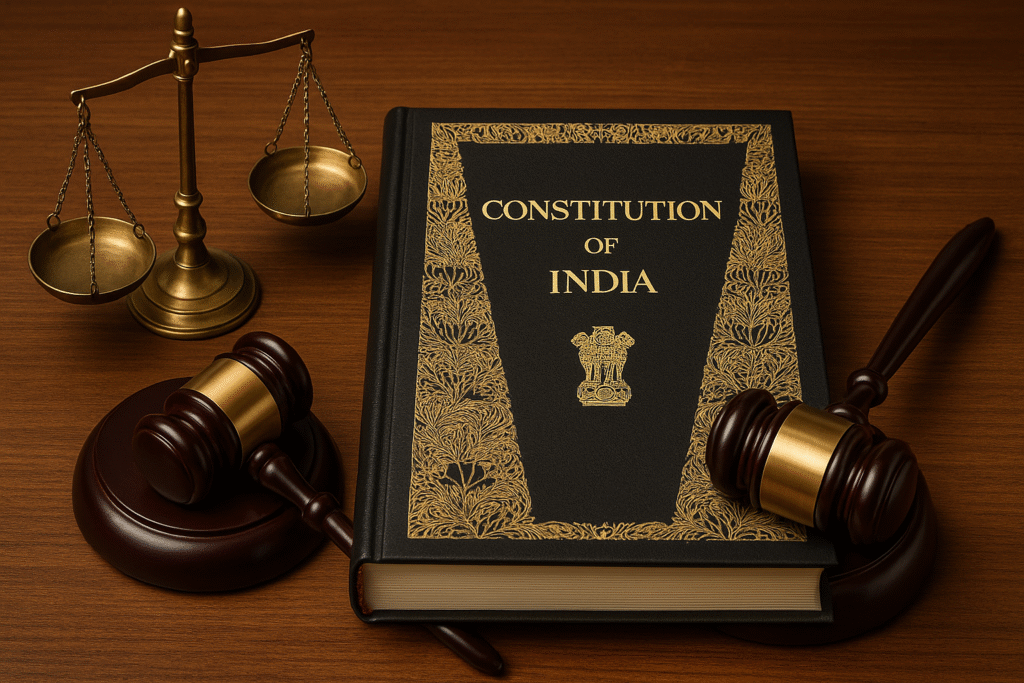
The Constitution (130th Amendment) Bill, 2025 represents a watershed moment in India’s democratic evolution, addressing the persistent challenge of criminalization in politics while raising fundamental questions about constitutional safeguards and due process. Introduced in the Lok Sabha on August 20, 2025, by Union Home Minister Amit Shah, this legislation proposes automatic removal mechanisms for India’s highest executive functionaries under specific conditions.
The Amendment’s Core Framework
The bill proposes targeted amendments to three constitutional provisions: Article 75 (Union Council of Ministers), Article 164 (State Councils of Ministers), and Article 239AA (special provisions for Delhi). The fundamental mechanism establishes that any Prime Minister, Chief Minister, or Union/State/UT Minister accused of an offense punishable by five years or more imprisonment who remains in custody for 30 consecutive days must be removed from office.
The removal process follows a structured hierarchy: Union Ministers face removal by the President on the Prime Minister’s advice, while State Ministers are removed by Governors on Chief Ministers’ advice. Significantly, if the competent authority fails to advise removal by the 31st day, the individual automatically ceases to hold office the following day, ensuring the mechanism cannot be circumvented through inaction. The bill permits reappointment after release from custody, acknowledging that arrest does not constitute guilt under constitutional principles.
The Criminalization Crisis Driving Reform
The urgency behind this legislation becomes apparent when examining contemporary political criminalization data. According to the Association for Democratic Reforms (ADR), 46% of MPs elected to the 18th Lok Sabha face criminal charges, with 31% facing serious criminal cases including murder, rape, and crimes against women. This represents a concerning increase from 43% in the 17th Lok Sabha, indicating that criminalization is becoming more entrenched rather than diminishing.
The phenomenon transcends political boundaries, affecting all major formations. While 39% of BJP winning candidates have criminal charges, the Indian National Congress shows 49% facing criminal charges, with regional parties displaying even higher percentages. State-specific analysis reveals particularly concerning patterns, with Andhra Pradesh leading at 79% MLAs having criminal cases, followed by Kerala and Telangana at 69% each.
The amendment draws from specific recent incidents that highlighted governance concerns. The V. Senthil Balaji case in Tamil Nadu, where a minister continued in office for months while in custody on money laundering charges, and Arvind Kejriwal’s arrest in the excise policy case, which raised questions about governance continuity from custody, demonstrate the constitutional gap this amendment seeks to address.
Current Legal Framework and the Amendment’s Departure
The existing disqualification architecture under the Representation of the People Act, 1951, operates on conviction-based mechanisms. Section 8 establishes different disqualification categories: immediate disqualification for specific offenses even with minimal fines (8(1)), disqualification for six months’ imprisonment in designated offenses (8(2)), and disqualification for any offense with two years or more imprisonment (8(3)). Disqualified individuals cannot contest elections for six years after release from imprisonment.
The Supreme Court’s 2013 decision in Lily Thomas v. Union of India fundamentally altered disqualification dynamics by striking down Section 8(4), which allowed a three-month appeal window, establishing immediate disqualification upon conviction. The court ruled that Article 102(1) doesn’t distinguish between sitting members and candidates for disqualification, making the differential treatment unconstitutional.
The 130th Amendment represents a paradigm shift from this conviction-based system to an arrest-based removal mechanism. Unlike conviction, which involves judicial determination, arrest is purely an executive action, allowing executive agencies to trigger removal of democratically elected officials without judicial oversight.
Constitutional Concerns and Federal Implications
The amendment’s most significant constitutional challenge lies in its departure from established legal principles embedded in Article 21, which ensures that no person shall be deprived of life and personal liberty except according to procedure established by law. The principle that an accused is “innocent until proven guilty” becomes questionable when custody alone determines eligibility for constitutional office, potentially inverting fundamental justice principles.
The amendment raises serious federalism concerns given that most investigative agencies (ED, CBI, NIA) operate under central control, potentially enabling the Union government to influence state-level governance. Chief Ministers derive their authority from direct popular mandate, and allowing central agencies to effectively determine their tenure through arrest powers could undermine state autonomy and democratic federalism.
Statistical evidence underscores potential misuse concerns. Parliamentary data reveals that between 2015 and June 2025, the Enforcement Directorate filed 5,892 cases but secured only 15 convictions—a conviction rate of approximately 0.25%. This suggests that the vast majority of arrests may not result in convictions, raising questions about the appropriateness of using arrest as a removal trigger. However, more recent data from 2020-2025 shows a higher conviction rate of 92.68% (38 out of 41 cases decided on merits), though this covers a smaller timeframe and number of cases.
The 30-day threshold appears arbitrary when considered against legal timelines. Criminal procedure typically allows 60-90 days for chargesheet filing, and investigation processes often require extended periods. The choice of 30 days lacks clear constitutional or procedural justification and could create situations where ministers are removed before adequate investigation is completed.
Alternative Reform Approaches and Systemic Solutions
Legal experts and civil society organizations propose focusing on strengthening existing conviction-based mechanisms rather than creating arrest-based removal systems. Implementing lifetime bans for serious convictions involving rape, murder, and corruption, instead of the current six-year post-release bar, could provide more effective deterrence while maintaining constitutional safeguards. Establishing fast-track courts exclusively for cases against sitting legislators and ministers would ensure swift justice without compromising due process.
Party accountability measures could address root causes more effectively. Bringing political parties under the Right to Information Act would enhance transparency in candidate selection processes. Strictly enforcing Supreme Court directives requiring parties to publish criminal histories of candidates in prominent newspapers within 48 hours of ticket allocation could empower voters with better information. Promoting inner-party democracy through mandatory internal elections and transparent candidate selection processes could reduce reliance on candidates with criminal backgrounds.
Systemic electoral reforms, including state funding of elections to reduce dependence on corporate donations and comprehensive disclosure requirements for political funding sources, would address fundamental drivers of political criminalization rather than merely responding to its symptoms.
Implementation Challenges and Constitutional Implications
The amendment raises fundamental questions about separation of powers by allowing executive agencies to effectively determine legislative tenure while reducing judicial oversight in removal processes. It challenges the principle that elected officials should primarily be accountable to voters, not administrative agencies.
Operational difficulties may arise in courts interpreting “serious criminal charges” and determining custody duration calculations across different jurisdictions. Multiple authorities (President, Governors, Lieutenant Governors) must coordinate removal processes, creating potential for confusion and delay. The law must clearly define what constitutes “custody,” “consecutive days,” and “serious criminal charges” to prevent arbitrary application.
Conclusion
The Constitution (130th Amendment) Bill, 2025 embodies a genuine attempt to address public concerns about criminalization in politics while simultaneously raising fundamental questions about due process, federalism, and democratic accountability. The amendment’s strength lies in its universal application and attempt to address a legitimate crisis of public confidence in political institutions. Its potential weakness resides in the risk of executive overreach and the possibility of undermining the very democratic principles it seeks to protect.
Rather than wholesale adoption or rejection, the amendment requires careful calibration. This might involve strengthening conviction-based mechanisms, enhancing party accountability, implementing systemic electoral reforms, and incorporating robust constitutional safeguards. The ultimate test will not be whether it removes corrupt politicians from office, but whether it strengthens or weakens India’s constitutional framework.
The debate surrounding the 130th Amendment reflects broader questions about the nature of Indian democracy: whether it will evolve toward greater accountability through constitutional means, or risk compromising constitutional principles in pursuit of immediate political cleanliness. As the Joint Parliamentary Committee examines this proposal, it must weigh not only immediate political benefits but also long-term constitutional implications, ensuring that the cure for political criminalization does not prove more harmful than the disease itself.
References
E-FileTax. “ED PMLA Conviction Rate Just 15 Convictions in 10 Years.” July 31, 2025.
Foxmandal. “Constitution (130th Amendment) Bill, 2025: Key Provisions.” August 24, 2025.
The Leaflet. “New Constitution amendment bill to remove PM, CMs detained for 30 days: All that is at stake.” August 19, 2025.
PMF IAS. “Constitution (130th Amendment) Bill, 2025: Provisions & Concerns.” August 25, 2025.
The Geostrata. “The Constitution (130th Amendment) Bill 2025.” August 25, 2025.
Association for Democratic Reforms. “Electoral Reforms: An idea whose time has come in the Indian politics.” June 29, 2024.
PRS India. “The Constitution (One Hundred and Thirtieth Amendment) Bill, 2025.” August 20, 2025.
New Indian Express. “Record 46% of newly-elected Lok Sabha MPs facing criminal cases.” June 5, 2024.
Insights on India. “ADR Report on Criminalization of Politics.” March 17, 2025.
India Code. “The Representation of the People Act, 1951.”
Association for Democratic Reforms. “Can India Clean Up Its Politics? Criminalization, Corruption and Reforms.” February 26, 2025.
iPleaders. “Lily Thomas v. Union of India (2013): legalizing convicted MPs and MLAs.” May 11, 2024.
NDTV. “Probe Agency’s Conviction Rate In PMLA Cases Over 92% In Last 5 Years.” August 6, 2025.
JusCorpus. “Beyond the Verdict: Revisiting the Principle of Presumption of Innocence.” February 4, 2025.
Insights on India. “Lily Thomas case and Section 8(4) of RPA.” August 22, 2023.
Lawyers Club India. “Presumption Of Innocence In Indian Law.” May 28, 2024.
Prepp. “Lily Thomas Case 2013 – Important SC Judgements.” October 12, 2024.
Indian Express. “ED took up 5892 PMLA cases since 2015, got convictions of 15.” August 1, 2025.
TaxTMI. “ED’s conviction rate in PMLA cases over 92 pc in last 5 years.” December 31, 2024.
Live Law. “5892 Cases Investigated By ED Since Jan 2015; PMLA Courts Convicted 15 Persons.” July 30, 2025.