
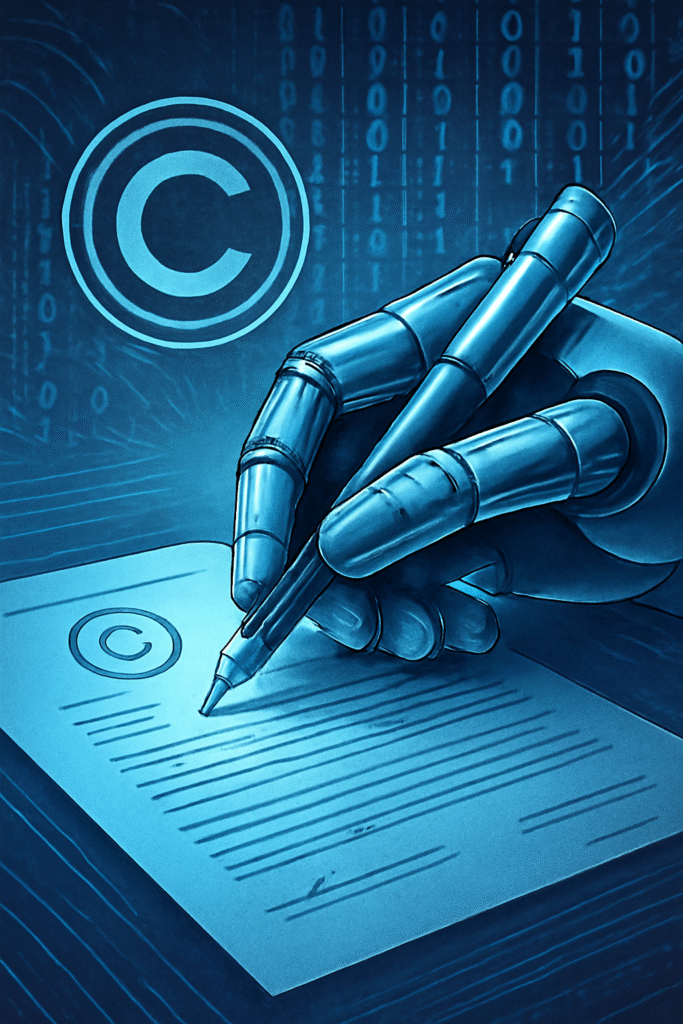
AI-Generated Content and Copyright:
The advent of Artificial Intelligence (AI) has radically transformed the content production in literature, music, visual arts, and academic writing. On the one hand, AI makes business more efficient and more democratic in creativity, but, on the other hand, it questions traditional ideas of authorship and copyright. The paper explores the intersection between AI generated content and the copyright law, with respect to the approach to this topic globally, ethical issues, and the Indian legal landscape. It provides the rationale of the great necessity of the reform of the copyright regimes in order to address the technological reality and at the same time maintain the core of the human creativity.
Introduction
The copyright law conventionally operates under the assumption of human authorship. It gives creators special privileges because their original words have exclusive rights and are awarded recognition and economic gains. This assumption is complicated by the emergence of Generative AI: large language models, image generators, and music complex algorithms. When machines are capable of producing creative output independently, then there are questions.
- Who qualifies as the “author”?
- Can AI-generated works be copyrighted?
- What are the rights of creators whose works form part of AI training datasets?
This paper explores these questions critically, situating the discussion within comparative legal frameworks and ethical considerations.
The Concept of Authorship and Originality
Traditional Understanding
Standard copyright regimes in most jurisdictions tend to acknowledge natural person authorship of the works. The originality is evaluated by means of human intellectual process, imagination and a bit of skill and judgment.
The AI Problem
AI systems function on training data but lack consciousness, intent, or creativity in the human sense. Hence, AI-generated content challenges the doctrinal basis of authorship:
- No human mind = no creativity in the traditional sense.
- Autonomous generation = absence of identifiable author.
Comparative Legal Perspectives
United States
The U.S. Copyright Office has always rejected the idea of copyright protection of a work that was produced and not created by a person (such as Thaler v Perlmutter). Instructions issued in 2023 confirm that AI outputs are not eligible to protection unless a human performer has exercised the creative control, i.e., by choosing, editing or otherwise meaningfully influencing the contribution of the AI.
European Union
Authorship within the EU copyright framework is restricted to the natural persons. The Copyright in the Digital Single Market (DSM) Directive acknowledges the data mining and machine-use exceptions, although the purely machine-generated works are yet to come under full ownership. The lawmaking tempos indicate the establishment of sui generis rights to AI outputs.
India
The Indian Copyright Act, 1957 defines an author as a human being or at times legal person (e.e., a corporate author of a work made on hire). Section 2(d) specifically refers to the author as the individual that causes the creation of the work. The Indian jurisprudence lays stress on human agency and originality (Eastern Book Company v. D.B. Modak, 2008). Currently, works solely created by AI do not have any explicit recognition and Indian law is somewhat open to computer-generated works as amendments to the law in the 1990s brought about software protections.
United Kingdom
The Copyright, Designs and patents act of 1988 of the UK is the first act to acknowledge computer generated works. Sub section 9(3) attributes authorship to the individual where the arrangements that are required to create the work are done. Although it is a progressive provision, it creates confusion on the current AI uses and sophisticated generation engines.
Ethical and Policy Dimensions
Beyond statutes, AI and copyright raise pressing ethical concerns:
AI systems rely on massive datasets, often including copyrighted works without consent. This practice raises the issue of indirect appropriation of intellectual property.- Risk of Unintentional Plagiarism
If AI reproduces patterns, phrases, or artistic motifs from its training data, users might unknowingly present derivative or plagiarized content without attribution. - Attribution and Recognition
Even if ownership is unclear, ethical practice may demand disclosing AI assistance, particularly in academia, journalism, and creative industries. - Economic Fairness
If AI-generated works flood the creative marketplace, human creators risk losing economic opportunities. Legal reforms must balance technological efficiency with the protection of artists.
The Indian Debate: A Way Forward
For India, the issue of AI copyright intersects with broader technological and socio-economic realities. India’s IT Act, 2000 emphasizes accountability in digital domains but does not directly address AI authorship. Considering India’s fast-developing AI ecosystem, a forward-looking model may be required. Possible approaches include:
- Introducing special provisions or sui generis rights for AI-assisted works.
- Developing compulsory licensing frameworks for training datasets.
- Requiring mandatory disclosure when AI tools are substantially involved in creating academic or creative content.
- Balancing innovation promotion with creators’ economic justice.
Proposed Approaches in Legal Scholarship
Legal scholars worldwide propose multiple frameworks to address AI authorship dilemmas:
- Human-Centric Model: Copyright only where human contribution is substantial.
- Joint Authorship Model: Recognizing AI as a “collaborator,” but assigning rights to humans guiding the process.
- Sui Generis AI Rights: Creating a distinct intellectual property regime for AI outputs, avoiding distortion of copyright doctrine.
Conclusion
AI-created content transforms the historical discourse on intellectual property by challenging preconceived ideas of originality, authorship and ownership. Although jurisdictions around the world are trying to experiment with flexible approaches, an international common standard has not yet been developed. In the case of India where the creative industries as well as AI technologies are expanding at a high rate, it is only natural to revise the copyright law in the country. This kind of reform, must make sure that innovation is not thwarted and at the same time it should not interfere with the labor, creativity and economic interests of the human authors.
References
- The Copyright Act, 1957 (India).
- U.S. Copyright Office, “Policy Statement on Works Containing AI-Generated Content” (2023).
- Eastern Book Company v. D.B. Modak, (2008) 1 SCC 1.
- UK Copyright, Designs and Patents Act, 1988, Sec. 9(3).
- EU Directive (2019/790) on Copyright in the Digital Single Market.
- Thaler v. Perlmutter, U.S. District Court for D.C. (2023).

A valuable source of information https://healthfare.ca/ covering different aspects of health and everyday well-being. Readers can find useful materials on healthy eating, along with useful recommendations. Visitors can also access product overviews. The content also covers healthy habits, nutrition and food choices, exercise and fitness, self-care, and general wellness.