
Written by Purti Sharma, LLM student of Amity University
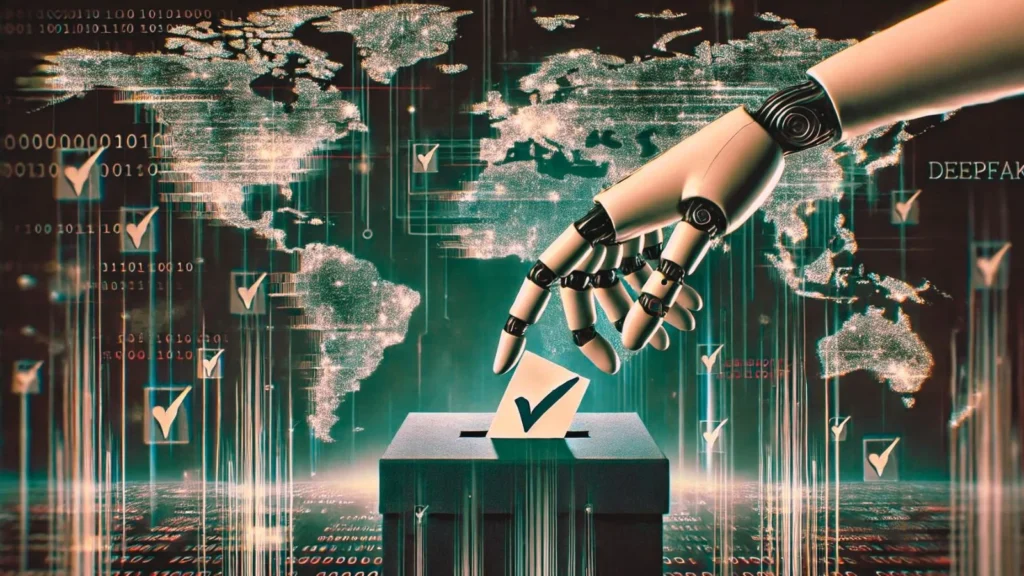
The Nightmare Before Election Day: An Introduction
Imagine this: A general election is about to take place. On their phones, millions of voters see a video that went viral, featuring a prominent politician making offensive comments against a minority group. Protests break out in a matter of hours, social media goes viral, and the Election Commission rushes to confirm legitimacy. The damage is done by the time specialists verify that it was a deepfake. Democracy fractures once the votes are cast.
This is the developing reality of artificial intelligence in the era of democracy, not a dystopian screenplay. Advanced AI-powered deepfakes are more than just malicious tools; they are becoming existential dangers to elections around the globe. The question is straightforward: can democracy endure in a society when people no longer believe what they see?
Recognizing Deepfakes in Political Settings
Synthetic media produced by machine learning, specifically Generative Adversarial Networks (GANs), are known as deepfakes. [1]With startling accuracy, they can mimic faces, sounds, even whole video speeches. Even though AI-generated humor could appear harmless, timing is crucial in politics. Hours before polls open, a well-planned deepfake can influence unsure voters and permanently damage reputations.
Deepfakes rely on deceit, whereas traditional propaganda uses distortion. They deceive even the most doubtful voter by appealing to the visual and auditory senses, unlike memes or rumors[2]. Because of this; deepfakes pose a threat to elections that goes much beyond traditional misinformation.
Case Studies Worldwide: Insights from the Frontlines
Democratic Primary in the United States (2024)
A robocall posing as President Joe Biden was sent to New Hampshire residents in early 2024, advising them not to cast their ballots in the primaries. Voters were perplexed by the AI-generated speech, and the Federal Communications Commission (FCC) was alarmed. Despite being swiftly made public, the incident demonstrated how deepfakes might stifle votes by posing as reliable individuals. [3]
Pakistan Elections (2023)
AI-generated deepfake videos were used by opposition leader Imran Khan to make campaign addresses when government restrictions hindered political events. Critics claimed the innovation eroded the boundaries between digital manipulation and legal political expression, while supporters applauded the innovation.[4]
India’s General Elections (2024)
Deepfake films of political figures went widespread on WhatsApp ahead of the Indian elections. Some were sarcastic, depicting leaders making inappropriate statements or making false pledges, while others were humorous parodies. Many voters took the fakes as fact despite quick fact-checking, which raised questions about electoral integrity in the biggest democracy in the world.[5]
The Ethical and Legal Conundrum
The fundamental conundrum is striking a balance between the preservation of democratic integrity and the right to free speech. Open discussion, criticism, and satire are essential to democracies. But the legal system encounters a conundrum when satire and sabotage are identical.
United States: Outright outlawing political deepfakes is complicated by First Amendment-protected speech. Laws prohibiting deepfakes within 60 days of an election have been implemented in some jurisdictions, such as Texas and California, although enforcement is still weak.[6]
European Union: The EU’s AI Act (2024) establishes the first complete framework on AI accountability in the world by requiring transparency in AI-generated material and penalizing misuse[7].
India: Although impersonation is illegal under Section 66D of the Information Technology Act, deepfakes are not specifically included[8]. Although it has issued advisories, the Indian Election Commission lacks effective enforcement powers to combat misinformation produced by artificial intelligence.
The moral conundrum remains: Are deepfakes considered electoral fraud or free speech? Democracies are still unable to agree.
The Context of India and International Law
Disinformation travels the world, and elections are not limited by national boundaries. International law so becomes crucial.
Although India is not a signatory, the Budapest Convention on Cybercrime places a strong emphasis on international collaboration in the fight against cyberthreats, such as digital fraud. It’s purview includes election meddling caused by deepfakes[9].
India is now at a turning point in its history: it can either continue to be reactive or take the lead in developing democratic protections against the abuse of AI.
Will Democracy Survive in the Age of Deepfake?
The question is not overly dramatic. Voting is only one aspect of democracy; trust is another. Trust is undermined by deepfakes on three levels:
- Trust in Leaders: Political legitimacy is harmed when people do not trust the faces or words of their leaders.
- Trust in the Media: Timely reporting is weakened as journalists are checking facts rather than telling stories.
Voters lose faith in democratic institutions if election commissions are unable to stop digital fraud.
This phenomenon, which some academics refer to as the “liar’s dividend,” allows politicians to brush off real scandals as “deepfakes,” further distorting the facts. [10] The whole basis of democracy is at risk due to this harmful feedback cycle.
The Path Ahead: Potential Protections
Innovation in Regulation
- In order to particularly handle deepfakes during elections, India has to alter its IT Act.
- Parties and candidates should be required by the Election Commission to provide information about AI use in campaigns in real time.
Solutions Using Technology
- AI can combat AI: altered content can be identified by detection systems from firms like Deepware and Microsoft.[11]
- Political advertisements must be required to use watermarking standards, which are backed by programs like the Content Authenticity Initiative (CAI).
Campaigns for Media Literacy
- Voters need to be taught to be wary of dramatic “leaks” that are not confirmed.
- Like voter turnout efforts, election officials should launch digital awareness initiatives.
International Collaboration
- Cross-border cyber law enforcement requires cooperation from democracies.
- A UN-sponsored “International Code of Conduct on AI in Elections” might harmonize standards across the globe.
Conclusion: Defending the Delicate Foundation of Democracy
Printing presses, radio propaganda, and social media manipulation have all failed to destroy democracy. Deepfakes, however, target a more personal weakness- the human senses. Deepfakes are its smoke bombs, blinding voters at the most crucial juncture if democracy is a theater of ideas.
In the AI era, democracy rests on mastering technology rather than outlawing it. To protect the integrity of the voting process, regulation, detection, education, and international collaboration must come together.
Ultimately, democracy is about counting on the truth, not just votes. Elections run the risk of turning into elaborate illusions and freedom itself being a victim of falsehoods if we do not defend the truth against the attack of deepfakes.
[1] Danielle K. Citron & Robert Chesney, Deep Fakes: A Looming Challenge for Privacy, Democracy, and National Security, 107 Calif. L. Rev. 1753 (2019)
[2] Kevin Roose, Distorted Videos of Nancy Pelosi Spread on Facebook and Twitter, Helped by Trump, N.Y. Times (May 24, 2019).
[3] BBC News, Fake Biden Robocall Tells Voters to Skip New Hampshire Primary Election (2024)
[4] Devika Bhattacharya, Deepfakes Become Political Weapon in Pakistan Elections, India Today (2024)
[5] Outlook Business, Deepfake Elections: How Indian Politicians Are Using AI-Manipulated Media To Malign Opponents (2024)
[6]Chris Hables Gray, Political Deepfakes and Elections (Dec. 6, 2024; last updated Jan. 11, 2025)
[7]Press Release, European Commission, European Artificial Intelligence Act comes into force, (2024)
[8]The Information Technology Act, No. 21 of 2000, sec.66D (India)
[9] Budapest Convention on Cybercrime, ETS No. 185, Nov. 23, 2001.
[10] Kaylyn Jackson Schiff, Daniel S. Schiff & Natalia Bueno, The Liar’s Dividend: The Impact of Deepfakes and Fake News on Trust in Political Discourse, 65 Pol. Sci. Res. & Methods 1 (2023).
[11] Eric Soon, Can AI Be Trained to Spot Deepfakes Made by Other AI? ISHIR (June 2025)

Very nice
An extremely well articulated script. Deep fake in conjunction with AI are akin to undertaking covert operations. They are turning out to be easy tools in hands of vested interested people which can cause hurrican effects in a smoothly functioning establishment. Both these digitally created tools have their presence in each and every abnormility occuring in the present era. These are very potent strategic tools which can cause far reaching consensual impersonation, malicious social engineering causing economic disruptions, National security risks, financial fraud, harrasment etc. Cases of digital arrest and extortion of hefty ransom are presently in vogue.
Today these tools have been effectively employed for various political gains as well.
They accrue many advantages as well when used without malicious intentions.
Overall an aptly scripted blog which is highly relevant in today’s parlance.
Видеослоты — являются одни из самых популярные игры в онлайн-казино.
https://beautyblog.urban-moda.ru/8ORTmaAFQCi9/
Здесь веб-сайте можно почерпнуть важную информацию.
https://moneywise.fashionsecret.ru/QEa3bJYeqFZw/
Прокси и VPN-подключение — это способы, применяемые для маскировки реального IP-адреса клиента.
Они обеспечивают конфиденциальность в сети и защищают приватность от злоумышленников.
Основное отличие между состоит в что прокси-сервер действует на базе конкретных программ, а VPN — шифрует целиком канал.
Соответственно, прокси больше подходит для преодоления ограничений ресурсов, а второе решение — для комплексной защиты и сохранения абсолютной анонимности.
https://proxyvpn.uk/
Свое дело является значимым локомотивом прогресса экономики.
Оно формирует дополнительные рабочие места и даёт гражданам стабильный заработок.
https://typical-moscow.ru/oleg-belaj-30-let-na-odnoj-volne-s-rynkom/
Более того, бизнес стимулирует нововведения и разработку современных решений.
Таким образом, бизнес делает среду более динамичной и открывает путь к личностному росту.
The proxy server functions as a type of gateway between a user and online resources.
When someone connects through the proxy, the requests are sent through the proxy initially, and then the proxy forwards the requests toward the target server in your place.
Encrypt files on Windows
Such a setup may hide the user’s IP address, get around geo-restrictions, and increase online safety.
However, some proxy services are insecure, so it is crucial use a reliable proxy provider.
On this resource, users can access a wealth of useful content.
The platform features in-depth articles on many topics.
Whether new to the topic or an expert, you will discover something valuable.
Most of the information is conveniently categorized, making it easy to access what you’re looking for.
https://potensinews.id/kriminal/tiga-pelaku-penyalahguna-narkotika-jenis-sabu-diamankan-polisi/
The proxy server functions as a kind of service connecting a client and the internet.
Whenever you connect through a proxy, their data go through the intermediary at first, and after that the proxy sends the requests to the final recipient for you.
Anonymity Tor Browser Safe download, how onion routing works, what the dark web means, and first-use habits.
This allows you to obscure your location, get around geoblocking, and improve online safety.
Nevertheless, many proxies are not secure, so one should choose a reliable provider.
Еще больше материалов можно просмотреть дополнительно – читать далее
Дополнительную дополнительные подробности можно найти дополнительно: подробнее
Атмосфера в салоне полностью расслабляющая, чувствуешь себя комфортно с первых минут. Девушка была невероятной, очень нежной. Остался доволен: секс петербург проститутки