
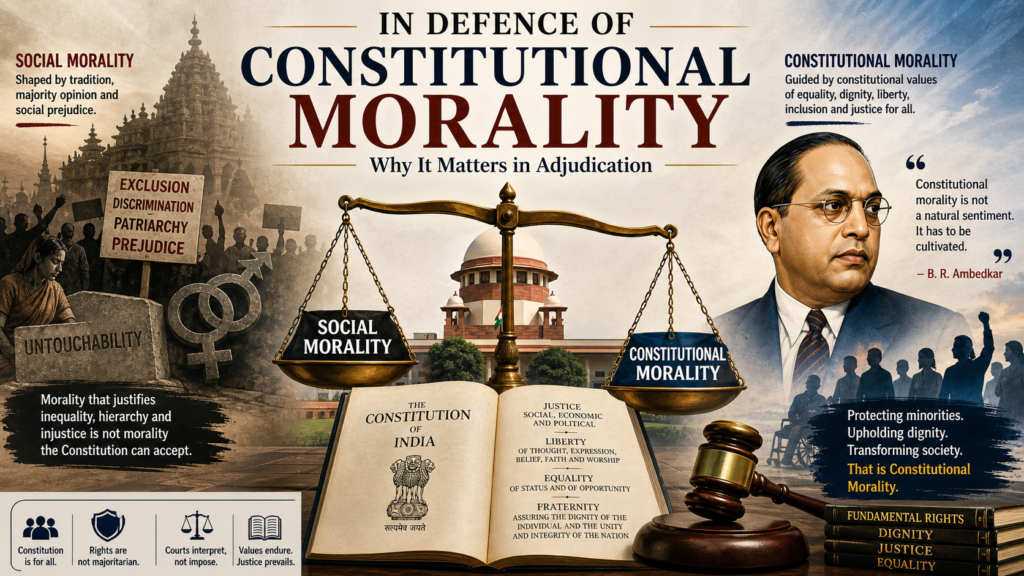
The Debate Around Constitutional Morality
The ongoing constitutional debates in India, particularly in cases like Sabarimala, have brought the idea of “constitutional morality” into sharp focus. While the concept has played a central role in landmark judgments involving gender justice, LGBTQ+ rights and personal liberty, it has also attracted criticism.
Many argue that constitutional morality is too vague, too flexible, and gives judges excessive discretion. The concern is that it may allow courts to substitute their own moral views for those of society.
However, this criticism misses a crucial point. Constitutional morality is not meant to replace the Constitution—it is meant to help interpret it.
The Problem with “Morality” in the Constitution
The Constitution itself uses the term “morality” in several provisions, particularly within Fundamental Rights. Articles dealing with freedom of speech, association and religion allow the State to impose restrictions in the interest of morality.
This raises an unavoidable question: what does “morality” actually mean in constitutional terms?
The Constitution does not define it. If morality is left to be interpreted as prevailing social norms, then fundamental rights may become subject to majority opinion. In a diverse and unequal society, this poses a serious risk.
History shows that practices once considered “moral”—such as untouchability, gender discrimination and criminalisation of same-sex relationships—were deeply unjust. If courts had relied solely on societal morality, many progressive constitutional changes would never have occurred.
Constitutional Morality vs Social Morality
This is where constitutional morality becomes important. It offers a way to distinguish between what society believes is moral and what the Constitution recognises as just.
Social morality is shaped by tradition, culture and power structures. It often reflects the views of dominant groups. Constitutional morality, on the other hand, is grounded in core values such as:
- Equality
- Liberty
- Dignity
- Inclusion
- Protection of minorities
It acts as a safeguard against majoritarian dominance.
In this sense, constitutional morality is not an abstract idea—it is a principle rooted in the Constitution’s transformative vision.
Ambedkar’s Vision
Dr. B.R. Ambedkar’s insights provide the strongest foundation for understanding constitutional morality. He recognised that social morality is unstable and often unjust.
He warned that morality based on custom can legitimise inequality and suppress reform. In his view, democracy cannot survive unless society moves beyond inherited norms and embraces constitutional values.
Ambedkar described constitutional morality as the “flesh” that gives life to the constitutional “skeleton.” This means that the Constitution is not just a legal document—it is a moral commitment to justice.
He also emphasised that constitutional morality requires not only adherence to rules but also a transformation of social attitudes and power structures.
Role in Judicial Interpretation
It is important to clarify that constitutional morality is not a standalone legal test to decide the validity of laws. Courts do not strike down legislation simply by invoking it.
Instead, it functions as an interpretive tool.
When courts interpret terms like “morality” in the Constitution, they must decide whether it refers to:
- The moral beliefs of society at a given time, or
- The deeper values embedded in the Constitution
Constitutional morality helps courts choose the latter.
It ensures that rights are not diluted by shifting social attitudes and that constitutional guarantees remain meaningful.
Protecting Minority Rights
One of the most important functions of constitutional morality is the protection of minorities.
Fundamental rights are designed to protect individuals and groups, especially those who may not have the support of the majority. If morality is defined by majority opinion, minority rights become vulnerable.
By grounding morality in constitutional principles, courts can ensure that rights are upheld regardless of social prejudice.
This is particularly relevant in cases involving religion, gender and identity, where social norms often conflict with individual freedoms.
Addressing the Criticism
Critics argue that constitutional morality gives judges too much power. This concern is valid in a democracy where judicial overreach must be avoided.
However, abandoning constitutional morality is not the solution. The real challenge lies in using it responsibly.
Courts must anchor their reasoning in constitutional text, structure and values. Constitutional morality should guide interpretation, not replace legal reasoning.
When used carefully, it does not expand judicial power—it limits arbitrary interpretation by tying it to constitutional principles.
Relevance in the Sabarimala Debate
The Sabarimala case highlights the importance of constitutional morality. The issue is not merely about temple entry but about the relationship between religious freedom and equality.
Articles 25 and 26 guarantee religious freedom but make it subject to morality. The question then becomes: whose morality?
If social morality is applied, exclusionary practices may continue. If constitutional morality is applied, courts must examine whether such practices align with equality and dignity.
Thus, constitutional morality provides a framework to resolve conflicts between rights without undermining the Constitution.
Conclusion
Constitutional morality is not a threat to democracy—it is one of its strongest safeguards. It ensures that the interpretation of rights is guided by principles rather than prejudice.
In a society marked by diversity and inequality, relying solely on social morality can lead to injustice. Constitutional morality offers a more stable and inclusive standard.
It reminds us that the Constitution is not just a legal document but a transformative vision for society.
Ultimately, the role of courts is not to mirror society as it is, but to uphold the Constitution as it ought to be. Constitutional morality helps them do exactly that.