When Technology Begins to Shape Power
Artificial Intelligence is no longer a distant promise of the future—it is an active force shaping economies, societies and geopolitics. What once appeared as a tool for efficiency and innovation is increasingly becoming a source of concentrated power. The recent articulation of technological dominance by major AI corporations signals a shift in how power itself is imagined in the modern world.
The assertion that global influence will now depend not merely on moral persuasion but on technological capability reflects a deeper transformation. Power is no longer confined to military strength or economic control; it is now embedded in algorithms, data systems and software infrastructures.
The Rise of Corporate Power in the AI Age
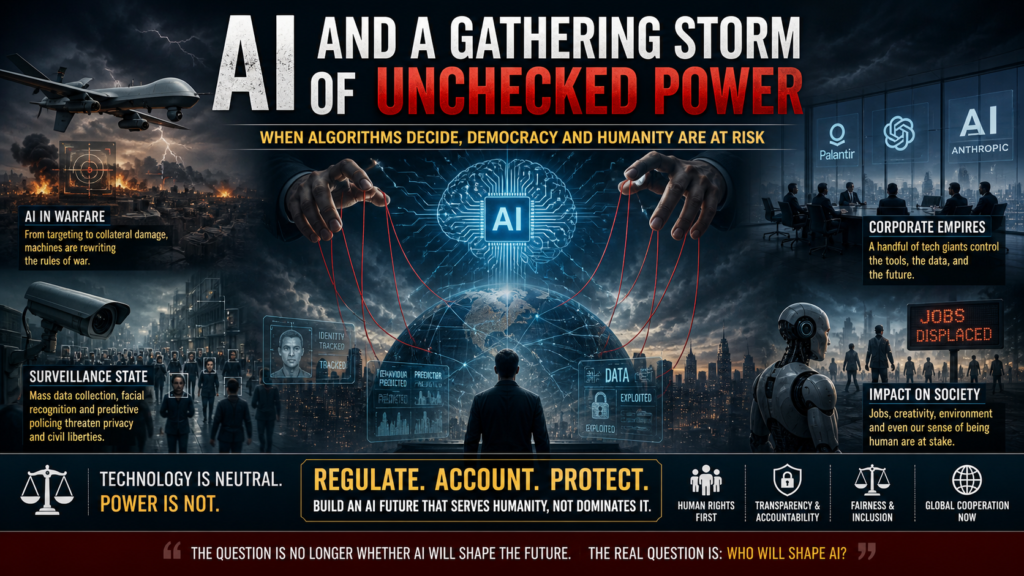
A growing concern is the role of private corporations in defining the trajectory of AI. These entities are no longer just market participants—they are shaping how people communicate, how states govern and how conflicts are conducted.
The idea that Artificial Intelligence will determine not whether wars are fought, but how they are fought and by whom, marks a profound shift in global politics. Decisions once made through human deliberation are increasingly being influenced—or even replaced—by machine-driven systems.
This raises an uncomfortable question: who controls the controllers of AI?
AI in Warfare: A Disturbing Reality
The use of AI in military operations has moved from speculation to reality. Reports of AI-assisted targeting in conflict zones demonstrate how deeply integrated these technologies have become in modern warfare.
This development is ethically troubling. When algorithms contribute to life-and-death decisions, accountability becomes blurred. The distance between decision-makers and consequences widens, creating a system where responsibility is diffused across machines, programmers and institutions.
The danger lies not only in the use of AI in warfare, but in the normalisation of such practices.
The Illusion of Self-Regulation
Many AI companies claim to be aware of these risks and have introduced internal ethical frameworks. Documents outlining safety principles and moral guidelines suggest an attempt to build responsible AI systems.
However, relying on corporations to regulate themselves raises serious doubts. Ethical guidelines created within private organisations lack the transparency and accountability required in democratic systems.
What happens when these guidelines conflict with profit motives or strategic interests? More importantly, who ensures that these internal rules are followed?
The idea that companies will voluntarily limit their own power is, at best, optimistic.
Surveillance and the Erosion of Privacy
Beyond warfare, AI is increasingly being used for surveillance and data-driven governance. Systems designed for efficiency—such as predictive policing or population tracking—often come at the cost of individual privacy.
These technologies have shown tendencies toward bias, particularly when trained on flawed or incomplete data. Instead of eliminating inequality, they risk reinforcing existing social hierarchies.
The expansion of surveillance capabilities also raises concerns about civil liberties. When individuals are constantly monitored, the space for freedom, dissent and autonomy begins to shrink.
The Broader Impact on Society
The influence of AI extends beyond security and governance. It is transforming the nature of work, creativity and human interaction.
Automation threatens traditional employment structures, while the use of AI in creative fields challenges long-held notions of authorship and originality. Questions about intellectual property and fair use remain unresolved.
There are also environmental concerns, as the energy demands of large-scale AI systems continue to grow.
At a deeper level, AI forces us to confront a fundamental question: what does it mean to be human in an age of intelligent machines?
The Regulatory Vacuum
Despite the scale of these challenges, regulation remains inadequate. Governments across the world have struggled to keep pace with technological advancements.
In many cases, regulatory frameworks are either too weak or too slow to address emerging risks. This creates a vacuum where private entities operate with significant autonomy and limited oversight.
Some regions have begun to develop more structured approaches, but global coordination remains fragmented.
The Need for Democratic Oversight
The central issue is not whether AI should be developed, but how it should be governed. In democratic societies, power must be accountable to the public. When technological power is concentrated in private hands, this principle is undermined.
Effective regulation must go beyond minimal safeguards. It should address issues of transparency, accountability, fairness and human rights.
This requires not only national legislation but also international cooperation. AI is a global phenomenon, and its governance must reflect that reality.
Rethinking the Future
One of the most troubling aspects of the current moment is the growing acceptance of technological inevitability. The belief that there is no alternative to the present trajectory discourages critical engagement.
However, alternatives do exist. Societies can choose to prioritise human rights, ethical standards and inclusive development over unchecked technological expansion.
The challenge lies in recognising that the future of AI is not predetermined—it is shaped by choices made today.
Conclusion
Artificial Intelligence holds immense potential, but it also carries unprecedented risks. The concentration of power in the hands of a few corporations and nations poses a serious challenge to democratic values and global stability.
Unchecked, AI could deepen inequalities, erode freedoms and redefine the nature of power itself.
The question is no longer whether AI will shape the future—it already is. The real question is whether that future will be guided by public accountability and human values, or by unchecked technological power.
The answer depends on how we choose to act now.