
Written by Diksha
Introduction:
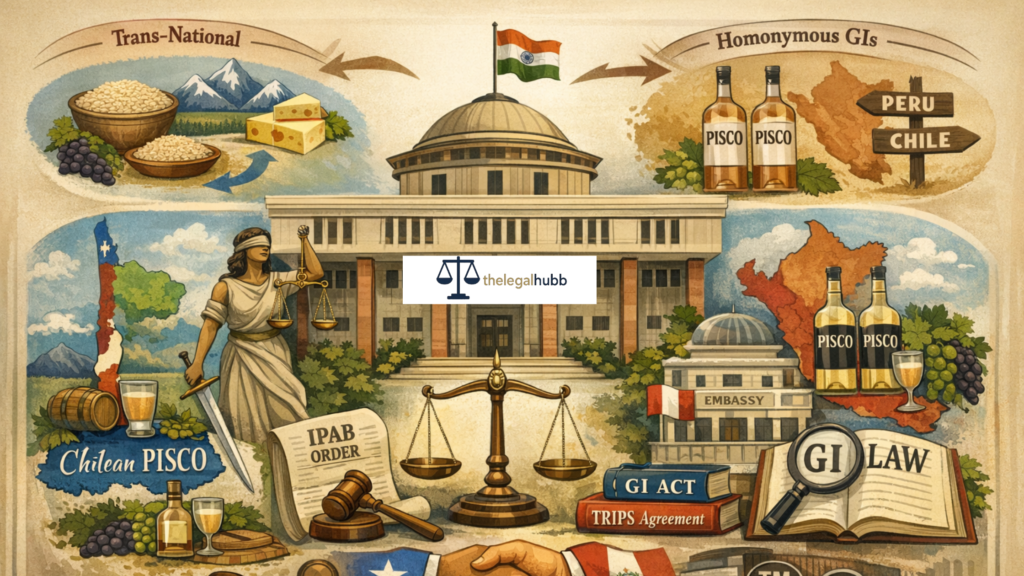
The case discussed herein is a writ petition filed in the High Court of Delhi (under Article 226 of the Indian Constitution) challenging the directives issued by the Intellectual Property Appellate Board (IPAB) on 29th November 2019 in a case related to Geographical Indication (GI). The claim in the petition is over the use of the GI “PISCO”, which is a beverage produced traditionally by the petitioners as well as the respondent.
Through this case, we will analyze the concept of Geographical indications and the balance between sovereign cultural claims and traditional realities. The leading legislation supporting the case includes the Geographical Indications of Goods (Registration and Protection) Act, 1999, and the Trade-Related Aspects of Intellectual Property Rights (TRIPS) Agreement, 1994.
Petitioner: Association of Producers of the alcoholic beverage Chilean PISCO in the III and IV regions of Chile, i.e., Antofagasta and Atacama which includes major river valleys of Elqui, Limari, Huasco, Copiapo, and Choapa representing the Chilean Pisco producers.
Respondent: Respondent No.1: Union of India through the Ministry of Commerce and Industry (responsible for the administration and implementation of Geographical Indications in India).
Respondent no.2- Registrar of geographical indications (Grant or refusal of Registration of GI’s and examination of GI Applications)
Respondent no.3: Intellectual Property Appellate Board (Tribunal for appellate jurisdiction in matters related to trademarks, Geographical Indications, patents, etc.)
Respondent no.4- Republic of Peru, represented through its embassy
Factual Background:
The timeline of events that have led to the current proceedings before the High Court of Delhi is as follows-
1. 29/September/2005- The original application filed by Respondent no. 4 for the adjudication by the Registrar of Trademarks and GI for the bestow of GI ‘PISCO’ in relation to alcoholic beverages. The same was notified in the Geographical Indication journal no. 13 dated 18th September, 2006.
2. 17 January/2007- the petitioner filed an application of opposition with respect to the original application filed by the Respondent in 2005, as the petitioners were also producing beverages named PISCO.
3. 3/July/2009- the Registrar of Trademarks and GI allowed the application with the limitation to register the original application of PISCO as ‘PERUVIAN PISCO’, to avoid any confusion and conflict of interest among the Chilean and Peruvian producers.
4. 29/November/2018- The respondent no.4, aggrieved by the 2009 order, filed the first appeal before respondent no. 3, i.e., the Intellectual Property Appellate Board. Pleading to uphold the original request. The appellate board sustained the application by granting GI “PISCO” to be registered in favor of Respondent no. 4.
5. Aggrieved by the IPAB’s order, the Chilean producers approached the Delhi high court in June 2020, challenging :
- The monopoly over the exclusive use of the term “Pisco.”
- The misinterpretation of GI law principles
- Ignoring the homonymous GI doctrine
Also, during the pendency, Chile filed a separate application for “ Chilean pisco” in 2020.
ISSUES INVOLVED
Core questions discussed are-
- In case the “Chilean liquor” referred to in the contested decision of the IPAB is identified as “PISCO”? Whether the application of sections 2 and 9 of the GI Act is interpreted correctly or not?
Analysis- Geographical indication- In relation to goods, means an indication which identifies such goods as food products, apparels, beverages, exotic agricultural products or synthetics originating or manufactured in the territory of a country or a region or locality in that territory, where a distinct trait, popularity and other functions of such products or items are associated to its geographical origin and in case where such goods are manufactured goods one of the For this clause, any name which is not the name of a country, region or locality of that country shall also be considered as the geographical indication if it relates to a specific geographical area and is used upon or in relation to particular goods originating from that country, region or locality, as the case may be[1].
Thus, the law asserts that to be considered as a GI, the subject matter, i.e., the goods- agricultural, natural, or manufactured, must originate in a province, region, or specific locality where it has a certain given quality, traits, or any specific characters which are embedded from that particular geographical origin.
The law does not express any requirement for historical priority or that the GI must correspond to the name of a single city or place.
Application to the case- Chile and Peru are South American countries located on the western coast. Peru and Chile also share historical connections and share boundaries as well. Chile has produced evidence of a long period of production of the pisco with the earliest documentation as determined in 1773 in a state catalog of Latorre ranch ( a family-run stud farm), where barrels of pisco were produced on that farm. Along with the time being documented, Chile has also been granted geographical indication in PISCO by various countries, including Costa Rica(2008), Mexico (1998), South Korea (2003), the European Union (2002), USA (1997), Central America (1999), Canada (1997), and eleven other 11 countries as provided. Emphasising the cultural and industrial practice of the name given to a product of that country. It held that the impugned order, wherein the Chilean product was referred to as ‘Chilean liquor’, cannot be maintained. The contest as considered by IPAB over the priority of use, misleading the originality of the product and goodwill cannot be maintained.
- Whether the embassy of Peru in India had the locus standi to file and pursue a GI application for “PISCO” under section 11 of the GI Act, 1999.
Analysis-The petitioners had argued that the diplomatic mission, i.e., the Embassy of Peru, does not hold a locus standi to act as a party for registration as it is not a producer. This dispute has been adjudicated based on Section 11 of the GI Act, 1999, which follows: Application for registration.- As per the section 11 of GI act, any group of people, manufacturers or any institution which advocates for the rights of the whole community related to the specified Geography or territory and highlights their interests shall be allowed to file an application before the Registrar of Trademarks for the registration of the concerned GI provided such group, persons or institutions are lawfully authorised to do so along with the fees of nomination.
As per the Act, GIs protect communities and not commercial or private entities or individuals. In accordance with the section, the Embassy of Peru is a legally constituted organ of the Peruvian state and is entrusted with protecting Peru’s commercial and cultural interests abroad, thus satisfying the requirement of an “ authority established under law”.
- Are the rights exclusively given to Peru deceptive or misleading, thereby attracting the prohibition under Section 9(a) and 9(g) of the GI Act,1999? And whether the sole rights provided by IPAB are aligned with provisions of the GI Act?
Analysis- In this issue, the court asserted whether the exclusive Rights provided to Peru for the GI of “pisco” by IPAB were in accordance with the rights provided by section 9.
Section 9 of the GI Act provides the conditions under which certain Geographical Indications are restricted.
A geographical indication-
Section 9(a) and 9(g) states that a geographical indication which might cause misrepresentation, deceive or confuse the consumers and which does originally belong to one nation or region but is represented as another shall not be registered as a geographical indication[2] respectively.
The interpretation of the two cause subjects is that the GI shall not be deceptive or confusing to the consumers.
The section does not count the priority of use or goodwill; rather, it focuses on the originality and the fact that there is a false representation to the consumers regarding the place of origin, such that the actual place, territory, or physical geography is considered for another territory. In such a case, the GI shall not be registered.
Application to the case: both Chilean and Peruvian pisco are consumed at a large level in the country, and in such a scenario, granting of exclusive rights to Peru would be a violation of section 9a, as it is likely to cause deception to the consumers in distinguishing between the two and infringing the Chilean rights.
Also, the respondent has provided evidence that they have been provided recognition under free trade agreements with over eighteen countries, and multiple accolades and awards have also been given, which further supports the claim of the respondent to be provided shared rights. Thus, the explicit right to Peru would falsely suggest that there is Peruvian origin in Chilean products, thus denying accurate recognition to Chilean products.
Hence, the rights provided to Peru would be misleading and deceptive as per the provisions of section 9. As IPAB relied upon trade mark principles such as Dishonest adoptions, misappropriation of goodwill, and priority of use, however, the court rejected ideas stating that the cornerstone of the GI Act is recognising and protecting the territorial or geographical attribution rather than commercial goodwill.
- Does the concept of “trans-national geographical indications” apply to the present case?
Trans-national geographical indications- certain GIs have their presence not only in one territory, but they originate in an identical, single geographic region which extends across two or more territories, and are jointly recognised by the relevant states.
The explicit definition of transnational GI is not provided. However, as per Article 22 of the TRIPS, GI is defined as ‘an indication which identifies a good originating in the provinces of a member of the agreement, or a region or a locality in that territory, where a given quality, trait or other specified characters of the goods is undisputedly associated with its geographical origin[3].
Thus, to be recorded as a trans national GI, the particular charters include
- A single continuous geographical region
- The region spans across more than one country
- Joint recognition or harmonised protection
- Common natural and human factors.
E.,g of such cross-border GI would be Basmati rice; both India and Pakistan have their Registered GI within their territories; however, such right is dictated as one under the international framework. Another contemporary example includes the Alpine cheese/ Alpine products, which are produced across the Alpine mountain region in Europe, especially in France, Switzerland, Italy, and Austria produce the Alpine cheese. This cheese is given trans-national Gis through the EU practice. It is given such status due to a continuous geographical region (Alps), the region is spread across national borders, and the qualities attributed are due to the high altitude grazing, alpine flora, climatic conditions, and traditional pastoral and cheese-making practices. Henceforth, resulting in transnational GI.
Application to the current case- the petitioner originally Transnational/ cross-border GI. However, they failed to establish any such requisites. The respondent has presented their pleading relying upon the maps of the countries which shows the total distance between the Pisco producing region in both countries i.e., Tacna in Peru and Copiapo in Chile is 1,031.07 Kilometers, within the distance of these huge kilometers there lies also a desert known as Atacama desert, which further shows that the climatic conditions, temperature, means and nature of productions are also completely different.
Hence, the court refused to treat the PISCO as a common origin of appellation due to distinct and independent geographical regions, standard of production; moreover, the territorial claims are separate and not joint. As the correct framework is co-existence with geographical qualifiers, and not joint ownership. Thus, the court presided over the claims of whether certain things could be registered as trans national GI or not.
6. Whether “Pisco” constitutes a case of homonymous geographical indications capable of co-existence under Indian GI law with appropriate geographical identifiers? (page 33-35)
Through this issue, the learned court put the subject matter, i.e., to identify what kind of GI it is, and whether it co-exists under the Indian GI with respect to the case of homonymous geographical indications. In the present case, the petitioners have claimed the GI pisco to be homonymous with the respondent’s Peruvian Pisco.
Homonymous geographical Indication- These are the geographical indications which are spelled and pronounced or even the goods are of similar nature or utility, however their place of origin, regions, characteristic differ and if they exist in the same environment without any specific prefixes or suffixes then it certain to mislead or confuse the consumers from the consumption of the actual product also leading to economical and goodwill damages.
Section 10- Registration of homonymous geographical indications.— As per this section, the registrar of trademarks can register an application for GI if the strict considerations as provided in section 7 are met. Section 7 prescribed that the considered GI shall have a practical application, it shall be subject to the equitable treatment with all the related products that may affect the rights of the producers, and such GI is true to the origin and does not mislead the consumers.
Application to the present case- In the present case, the use of GI Pisco is disputed, the process of extraction varies, as Chilean pisco is distilled in a discontinuous manner through various batches, and after distillation, a handful sum of water is added. A few versions of it can be aged. However, Peruvian pisco cannot be aged. Thus, the two might share homonymous identities, but their places of origin, processes of extraction, and characters are varied.
Thus, the court held that the bestowing of GI PISCO to respondent no. 4 without a specified prefix that identifies the origin from Peru would be stripping off rights associated with the GI rights of Pisco originating from Chile. Hence, the registrar’s 2009 decision requiring the prefix “ peruvian” was legitimate and consistent with the objectives of the sections of the GI Act.
CONCLUSION
The high court of Delhi through this case, structured a legal basis for identification of Geographical Indications making a clear distinction between trans-national and homonymous (section 11) while taking into international agreements such as TRIPS, the distinction between objectives of GI act and trademarks ensuring a wide scope for interpretation of claims and providing registration for geographical authenticity rather priority of use and aligning with cultural, regional and commercial rights of the claimants.
[1] Sec 2(1)(e) geographical indication of Goods (Registration, and Protection) act, 1999
[2] Section 9 Geographical indications of goods act, 1999
[3] Agreement on trade-related aspects of intellectual property rights, 1994 (TRIPS)